Northwest Europe (244–387 CE): Roman Decline, Regional…
244 CE to 387 CE
Northwest Europe (244–387 CE): Roman Decline, Regional Autonomy, and Cultural Transitions
Late Roman Stability and Initial Decline
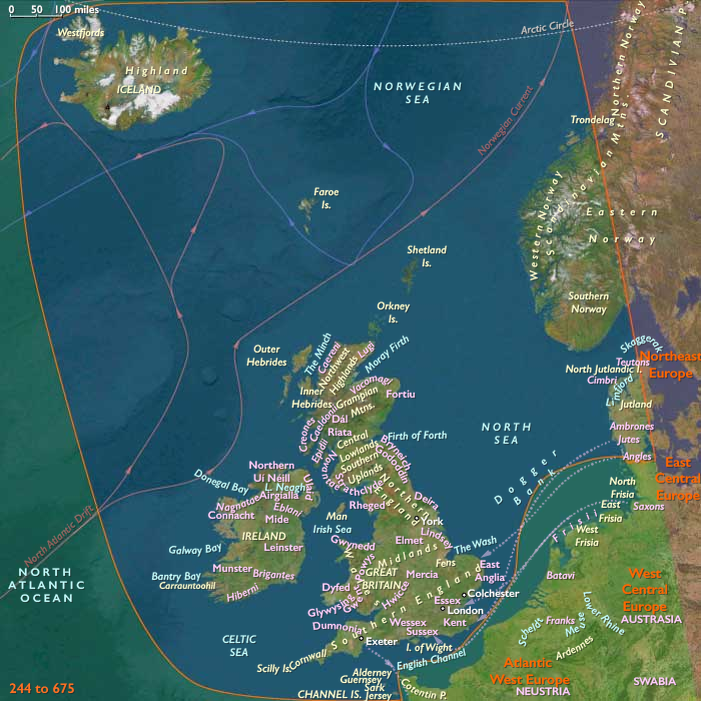
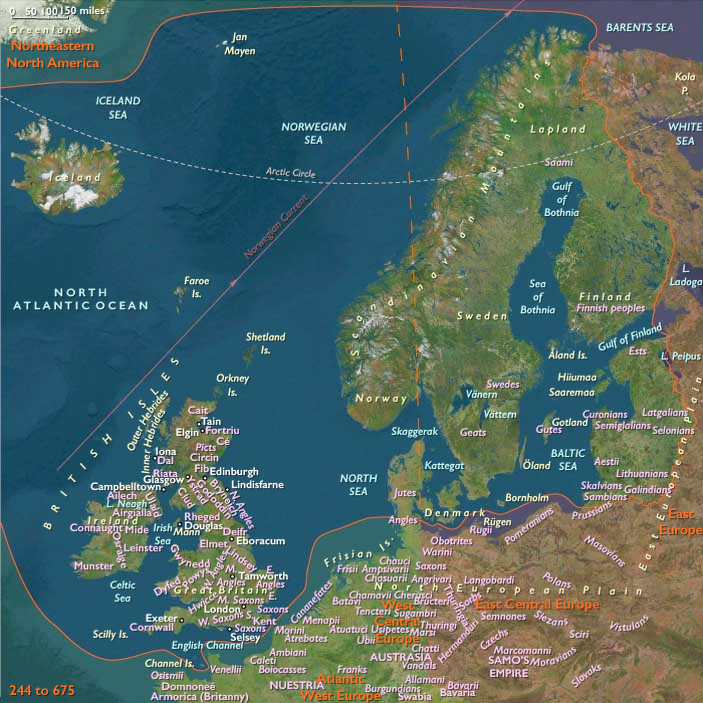
From 244 to 387 CE, Northwest Europe experienced a transitional period characterized by initial stability followed by gradual decline of Roman influence, particularly in Britain. Economic prosperity persisted initially, but increasing internal challenges and external pressures began to erode Roman authority. Military resources were increasingly stretched, leading to weakened frontier defenses.
Challenges on the Frontiers and Military Strain
The latter half of the 3rd century witnessed rising threats from northern tribes and coastal raiders. Continued raids and incursions by groups such as the Picts, Scots, and Saxons highlighted vulnerabilities in Roman military infrastructure. These pressures necessitated significant reinforcement and reconstruction of fortifications, including substantial renovations to Hadrian’s Wall and coastal defensive systems.
Economic Reorganization and Localization
Roman Britain’s economy remained robust initially but gradually shifted towards local and regional self-sufficiency as central Roman control diminished. Trade with continental Europe continued, although it became less intensive. Agricultural practices increasingly adapted to local conditions, reflecting a trend toward economic decentralization.
Social Changes and Shifts in Roman Authority
As the central authority from Rome weakened, local elites increasingly asserted autonomy. Romanized elites in Britain solidified their control over regional resources and political structures, positioning themselves to maintain authority even as imperial connections weakened. This shift foreshadowed later regional fragmentation.
Religious Syncretism and the Rise of Christianity
Religious life in Northwest Europe evolved significantly during this period. Traditional Roman and Celtic religious practices continued, but Christianity began to make significant inroads, particularly among urban populations and elites. By the end of the 4th century, Christianity was increasingly visible, with early churches and Christian communities established in urban centers like Londinium and Eboracum.
Increasing Celtic Resurgence and Cultural Identity
Peripheral regions, particularly Wales, Scotland, and Ireland, saw a resurgence of distinct Celtic identities and cultural practices. Irish cultural continuity remained strong, unaffected by direct Roman control, while northern and western Britain increasingly asserted cultural autonomy, leveraging weakening Roman presence.
Urban Decline and Rural Continuity
Urban centers in Roman Britain experienced gradual decline as resources and population shifted towards rural and fortified locations. Villas and rural settlements maintained relative prosperity, adapting economically and socially to reduced urban influence and increased local autonomy.
Ireland’s Continued Autonomy and Cultural Vitality
Ireland continued to thrive culturally and economically, maintaining independence from Roman rule. Ancient ceremonial sites such as Newgrange, Knowth, and Dowth remained culturally significant. Roman coins and artifacts continued to appear sporadically, indicating ongoing indirect interactions.
Stability and Economic Continuity in Orkney and Shetland
The Orkney and Shetland Islands remained culturally autonomous and economically stable, continuing their robust maritime trade and local industries with minimal Roman influence. Their geographic isolation preserved their cultural identity and economic stability.
Persistent Isolation of Iceland and the Faroe Islands
Throughout this period, Iceland and the Faroe Islands remained uninhabited, their harsh environments deterring settlement. Iceland’s volcanic activity continued providing essential chronological markers for regional archaeological research.
Legacy of the Age
By 387 CE, Northwest Europe had undergone substantial transformations, transitioning from a period of Roman stability to an era marked by regional autonomy, cultural resurgence, and evolving identities. The weakening of Roman central authority laid the foundations for new political and cultural landscapes, influencing subsequent historical developments profoundly.
Groups
Topics
Commodities
Subjects
Regions
North Europe
View →Subregions