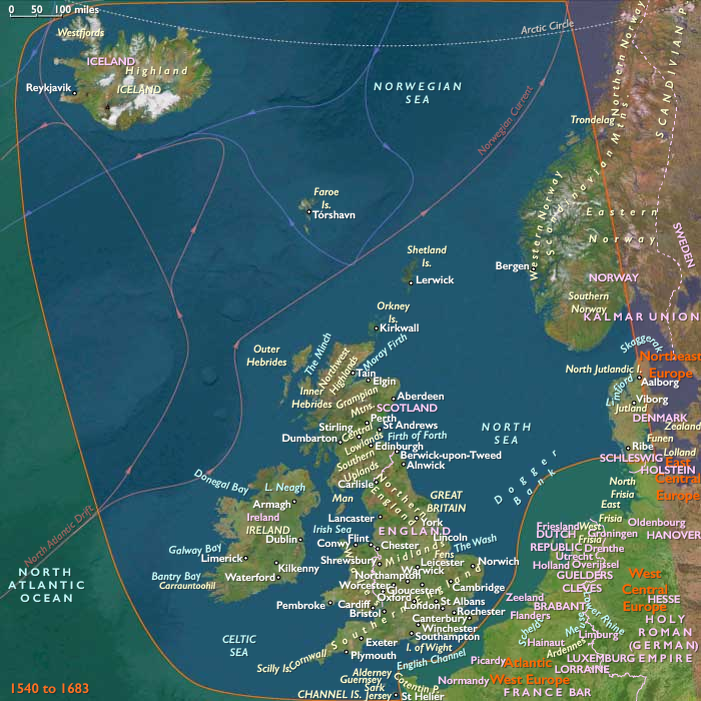
Northwest Europe (1612–1623 CE): Consolidations, Cultural Flourishing,…
1612 CE to 1623 CE
Northwest Europe (1612–1623 CE): Consolidations, Cultural Flourishing, and International Ambitions
England: Jacobean Stability and Religious Tension
Under James I, England experienced relative political stability despite persistent religious divisions. In 1612, the sudden death of Prince Henry, James's heir apparent, deeply affected the English court and shifted dynastic expectations to his younger brother, Charles. James continued to advocate the divine right of kings, maintaining tension with Parliament, which sought greater influence in governance. The king's lavish court expenditures led to financial strain and parliamentary friction, exemplified by ongoing disputes over taxation and royal privileges.
Catholic threats remained a significant concern. Catholics had made several assassination attempts against Protestant rulers in Europe and England during the late sixteenth century, including plans to poison Elizabeth I. Much of James I's political writing addressed the threat of Catholic assassination and refuted the Catholic claim that "faith did not need to be kept with heretics." On February 19, 1604, James publicly denounced the Catholic Church after discovering a papal rosary sent secretly to his queen, Anne of Denmark. This prompted him to order Jesuits and other Catholic priests to leave England and to reimpose fines for recusancy. In 1605, Catholic conspirators plotted to assassinate James in the Gunpowder Plot, foiled by the arrest of Guy Fawkes, whose capture and execution in early 1606 reinforced anti-Catholic policies.
The cultural landscape thrived, especially in drama and literature. William Shakespeare concluded his career with major late works such as The Tempest (1611) and Henry VIII (1613). Ben Jonson further established his literary reputation with plays like The Alchemist (1610) and Bartholomew Fair (1614). The literary and theatrical culture of London flourished, shaping English language and literature profoundly.
Ireland: Plantation and Continued Colonization
Ireland saw the extensive implementation of the Plantation of Ulster, begun in earnest in the previous era. English and Scottish Protestant settlers were systematically established on confiscated Gaelic lands, significantly altering the demographic and cultural landscape of the region. This plantation marked a deliberate strategy of colonization intended to suppress Gaelic culture and solidify English rule, laying the groundwork for persistent ethnic and religious tensions.
Scotland: Continued Union under James VI and I
Scotland remained politically united with England under the dual monarchy of James VI and I, but maintained separate administrative and legal systems. Religious divisions intensified as James sought uniformity in church governance, pushing episcopacy over traditional Presbyterian structures. These policies exacerbated tensions within Scotland, laying foundations for future religious conflicts.
Scandinavia: Ambitious Expansion under Christian IV
Christian IV of Denmark-Norway further expanded his maritime ambitions and international trade. His aggressive pursuit of commerce included founding new towns and enhancing Copenhagen's infrastructure. In 1616, Christian personally led an expedition that established Danish claims in the East Indies, notably founding the settlement of Tranquebar on India's Coromandel Coast. Domestically, he continued to assert Lutheran orthodoxy, consolidating religious and social reforms.
Maritime and Colonial Developments
England's maritime interests expanded significantly, driven by the East India Company, which secured trading outposts in the Indian subcontinent and established a commercial foothold at Surat in 1612, marking England’s enduring presence in South Asia. English traders frequently engaged in hostilities with their Dutch and Portuguese counterparts in the Indian Ocean. In 1612, the company achieved a major victory over the Portuguese in the Battle of Swally at Suvali near Surat. The Crown dispatched Sir Thomas Roe in 1612 on a diplomatic mission to secure formal permission from the Mughal emperor Jahangir to establish permanent trading factories, successfully gaining Mughal approval and expanding English commercial ambitions.
In North America, English colonization steadily expanded, notably with the establishment of a permanent tobacco economy at Jamestown following the introduction of West Indian tobacco cultivation by John Rolfe around 1612, providing economic viability to English colonial ventures.
Cultural and Intellectual Progress
The period saw intellectual advancements alongside literary achievements. Francis Bacon continued the intellectual tradition of empirical science and inductive reasoning. In 1620, he published Novum Organum, advocating methodologies that laid essential foundations for modern scientific inquiry, significantly influencing European thought. Bacon’s intellectual contributions shaped philosophical and scientific discourse profoundly in subsequent centuries.
Legacy of the Era
By 1623 CE, Northwest Europe had firmly entrenched its cultural and intellectual prominence, even as underlying tensions—religious, political, and colonial—persisted. James I’s reign maintained stability while embedding structural disputes with Parliament, shaping future constitutional conflicts. Ireland’s plantation system institutionalized religious and ethnic division, with consequences enduring for centuries. Scotland’s religious tensions foreshadowed broader conflict, while Denmark-Norway expanded its global ambitions significantly. Meanwhile, cultural vibrancy, exemplified by literary and scientific achievements, underscored Europe's evolving modern identity.
People
Groups
Topics
Commodities
Subjects
Regions
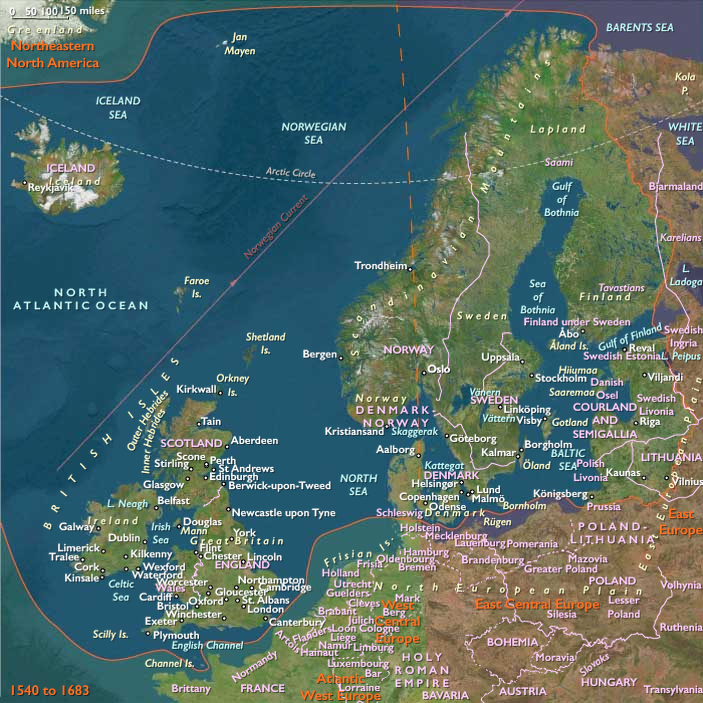
North Europe
View →Subregions