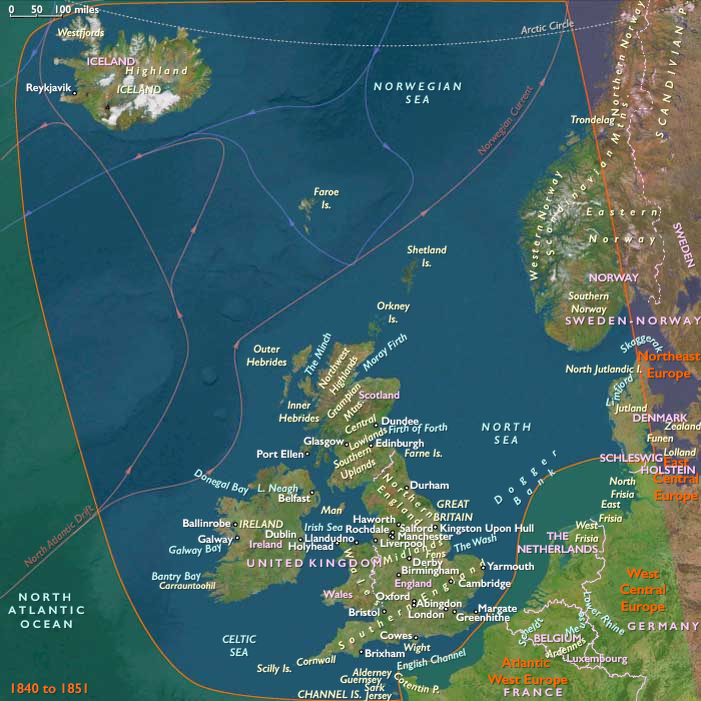
Northwest Europe (1840–1851): Victorian Ascendancy, Social Crisis,…
1840 CE to 1851 CE
Northwest Europe (1840–1851): Victorian Ascendancy, Social Crisis, and Industrial Triumph
The Victorian Era: Stability and New Challenges
Between 1840 and 1851, Britain solidified its position as a global superpower under the stable reign of Queen Victoria (who ascended the throne in 1837 at the age of eighteen). Married to Prince Albert in 1840, Victoria's reign came to embody moral rectitude, domesticity, and social responsibility. The period saw Britain reach the zenith of its economic, political, and imperial influence, distinguished by innovations in transportation, communication, and industry, notably steamships, railways, photography, and telegraphy.
British society, still dominated by aristocracy and landed gentry controlling government, Parliament, the Church, and the military, began to grapple with social reforms and issues brought about by rapid industrialization.
Ireland's Great Hunger and Social Catastrophe
A catastrophic humanitarian crisis struck Ireland with the onset of the Great Irish Famine (1845–1849), caused by devastating potato blight starting in 1846. The rural population, heavily dependent on potatoes, faced widespread starvation as government relief efforts proved inadequate. Hundreds of thousands perished from starvation and disease. Millions emigrated, primarily to England or North America, permanently reducing Ireland's population.
The famine's aftermath was compounded by outbreaks of disease. A major cholera epidemic swept Ireland in 1849, disproportionately affecting famine survivors already weakened by starvation and fever. Additionally, a severe typhus epidemic ravaged Ireland from 1846 to 1849, spreading to England as "Irish fever" and devastating all social classes due to widespread lice infestation.
Cholera in Britain: Public Health Crisis
England and Wales suffered a severe cholera outbreak starting in 1848, lasting two years and claiming 52,000 lives. London experienced its worst cholera epidemic, recording 14,137 deaths from 1848 to 1851, surpassing the previous 1832 epidemic. Liverpool, a major embarkation point for emigrants to North America, lost 5,380 lives to cholera in 1849; Hull recorded 1,834 deaths the same year. These outbreaks highlighted poor urban sanitation, prompting gradual movement toward public health reform.
Social Reform: Labor and Industry
Parliament enacted significant social reforms to improve working conditions amid public outrage over industrial abuses. The shocking exposure of child labor practices led to the passage of the Mines Act of 1842, which banned girls and boys under ten from working underground in coal mines, representing a crucial step in labor protection.
Chartism, a democratic working-class movement demanding political reforms, peaked notably in 1848. Despite its political frustrations, Chartism redirected its energies toward trade unions and cooperative societies. British workers largely ignored revolutionary ideologies introduced by figures such as Karl Marx, instead embracing gradual social reform and increasing prosperity.
Paternalistic Employers and Welfare Innovations
Many British employers adopted paternalistic practices, recognizing trade unions and providing extensive welfare services, including housing, education, churches, libraries, baths, and gymnasia. Middle-class reformers simultaneously encouraged working classes toward middle-class values of respectability, temperance, and moral propriety.
Thomas Cook and the Birth of Organized Travel
Innovations in transportation sparked new social practices, exemplified by Thomas Cook, who pioneered organized leisure travel. On July 5, 1841, inspired while walking to a temperance meeting, Cook arranged his first excursion: 500 people from Leicester to a temperance rally in Loughborough by train, paying a shilling each. Cook expanded rapidly, conducting trips to Liverpool in 1845, Scotland in 1846, and notably, arranging for 150,000 people to visit the Great Exhibition in 1851. His innovations laid the foundation for modern tourism, eventually expanding into international travel in the following decades.
Economic Liberalism and Free Trade Victories
The period marked the definitive triumph of economic liberalism. Advocacy by reformers Richard Cobden and John Bright led to the repeal of the protectionist Corn Laws (1846), dramatically lowering food prices and easing hardship among Britain's urban poor. Britain's embrace of free trade and minimal governmental restrictions facilitated its economic dominance, underpinning an empire sustained both formally through direct rule and informally through financial investment, notably in Latin America and Asia.
The Great Exhibition and Technological Dominance
In 1851, Britain hosted the celebrated Great Exhibition in London’s Crystal Palace, a powerful display of British industrial and engineering dominance. However, it notably showcased industrial achievements rather than excellence in sculpture, painting, or music. This exhibition underscored Britain's position as the leading industrial power, an advantage it would retain until challenged by the rise of the United States and Germany in the later nineteenth century.
Standardization of Industry and Precision Engineering
Industrial precision advanced significantly, notably with standardization in screw-thread production, building on Henry Maudslay’s development of the first practical screw-cutting lathe in 1800. By the 1840s, standardized screw threads became widespread, facilitating compatibility across manufacturers, enabling mass production, and bolstering Britain's industrial capacity and reliability.
Postal Revolution: Uniform Penny Post
Postal reform dramatically reshaped communications. Following advocacy by reformer Rowland Hill, Britain adopted the Uniform Penny Post in 1840, represented by the iconic Penny Black stamp, revolutionizing the postal system from an inefficient, costly service into a reliable, affordable system vital for commerce, industry, and personal correspondence.
Persistent Social Inequalities: Class and Gender
Despite economic prosperity, social inequalities persisted. British society continued to be dominated by aristocratic interests. Wealthy industrialists still lacked the social prestige accorded to landowners and titled families. Gender inequality remained stark, exemplified by women who continued disguising themselves as men for higher wages and better employment opportunities.
Culture and Education
Victorian literature flourished, with figures such as Charles Dickens illuminating social inequalities and urban hardships. However, education remained mediocre, particularly outside Scotland; Britain's universities were uninspiring, reflecting a society still privileging inheritance over merit and land ownership over commerce.
Diplomatic Stability and Imperial Expansion
Britain maintained diplomatic stability, largely staying aloof from Continental revolutions of 1848, under governments led by Prime Ministers including Lord Melbourne, Sir Robert Peel, Lord John Russell, and briefly Lord Derby. British influence grew globally, especially through economic and financial strength. The era further developed Britain’s "second empire," defined by formal colonies and informal spheres of financial influence.
Scandinavia: Stability and National Identities
Scandinavian countries, notably Sweden and Norway, experienced stability, with Norway strengthening its national identity within the union. Denmark navigated cautiously through modest internal liberal reforms, remaining stable but peripheral within European geopolitics.
From 1840 to 1851, Northwest Europe navigated profound economic expansion, technological advancements, and severe humanitarian crises. Victorian Britain, characterized by rapid industrialization, railway innovation, social reforms, and the notable postal revolution, consolidated its global dominance. Simultaneously, catastrophic events like the Irish Famine, epidemics of cholera and typhus, and persistent inequalities highlighted ongoing social vulnerabilities. This era marked Britain's ascendant trajectory toward global economic and imperial preeminence, defining much of the Victorian age’s complex legacy.
People
Groups
Topics
Subjects
Regions
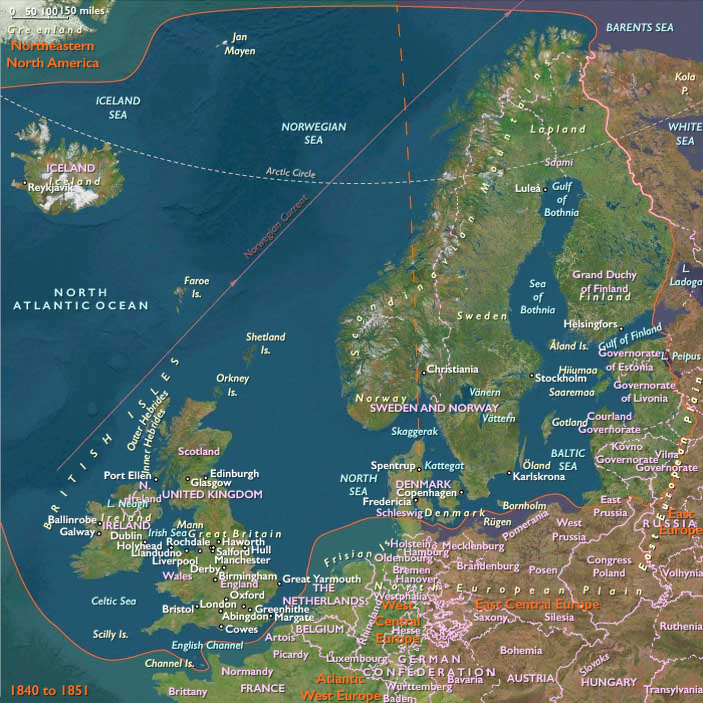
North Europe
View →Subregions