
Northwest Europe (2493–2350 BCE): Cultural Transitions and…
2493 BCE to 2350 BCE
Northwest Europe (2493–2350 BCE): Cultural Transitions and Technological Advances
Introduction of the Bell Beaker Culture
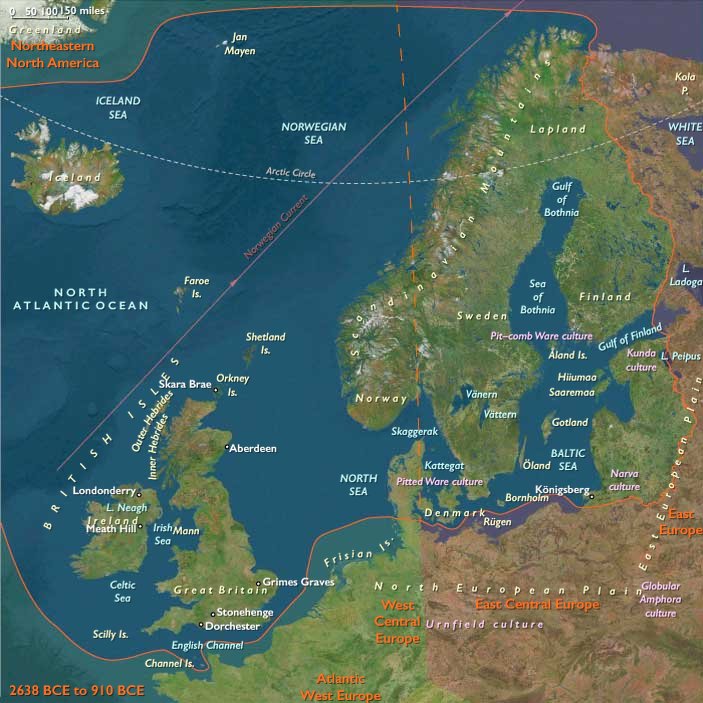
Between 2493 and 2350 BCE, Northwest Europe—including the British Isles, western parts of Denmark and Norway, Orkney, Shetland, and the Channel Islands—witnessed significant cultural transformations, particularly with the arrival and spread of the Bell Beaker culture around 2450 BCE. Originating from the Iberian Peninsula, this culture introduced distinctive pottery styles, characterized by their inverted bell-shaped vessels, along with advanced metalworking skills primarily involving copper and gold.
Expansion and Influence in Britain
In Britain, the Bell Beaker culture significantly reshaped existing Neolithic traditions, especially evident at ceremonial sites like Stonehenge. During this period, known archaeologically as Stonehenge Phase 3, construction intensified, notably through the placement and rearrangement of large sarsen stones into their iconic trilithon formations. This era also saw the increasing complexity of social structures and burial practices, reflected in individual inhumations accompanied by rich grave goods such as finely crafted pottery, metal tools, and ornamental items.
Continuation and Transformation in Orkney
In the Orkney Islands, settlement at Skara Brae continued until approximately 2500 BCE before its eventual abandonment, possibly due to environmental pressures or shifting societal structures influenced by wider cultural transitions. Nevertheless, Orkney remained an important ceremonial center, with sites like the Ring of Brodgar and the Stones of Stenness continuing to serve significant ritual functions amid evolving cultural practices.
Advances in Irish Monumental Architecture
In Ireland's Boyne River Valley, passage graves such as those at Dowth, Knowth, and Newgrange reached their zenith around 2500 BCE. At Dowth, an eighty-four-meter diameter mound covered two burial chambers decorated with spiral and lozenge designs. Knowth featured Europe's longest known stone passages, intricately designed cruciform chambers, and numerous satellite tombs. Newgrange contained elaborate ornamental stone basins and was encircled by standing stones, showcasing sophisticated astronomical alignments and ceremonial importance.
Advances in Metalworking
The period saw substantial advancements in metallurgy throughout Northwest Europe, driven by Bell Beaker influences. Copper working techniques became more widespread, alongside initial experimentation with bronze alloying. This transition toward metallurgical sophistication fostered enhanced tool production, improved agricultural implements, and facilitated stronger trade networks, connecting distant regions through the exchange of metals and crafted objects.
Burial Practices and Social Complexity
Burial customs evolved significantly under Bell Beaker influence, transitioning from communal burial traditions toward individual graves often marked by prominent barrows. These single inhumations frequently included elaborate grave goods—particularly pottery vessels, copper daggers, and jewelry—highlighting increasing social differentiation and the emergence of recognizable social hierarchies across the region.
Cultural Interactions in Denmark and Norway
In western Denmark, the introduction of Bell Beaker cultural traits blended seamlessly with existing local traditions, reinforcing agricultural prosperity and social complexity. In Norway, coastal communities increasingly adopted metalworking techniques and pottery styles introduced through extensive maritime trade routes, integrating these innovations into their traditional maritime subsistence economies.
Continued Isolation of Iceland and Faroe Islands
Throughout this era, Iceland and the Faroe Islands continued to remain isolated and uninhabited. Environmental conditions and geographic isolation precluded human settlement, although Iceland's ongoing geological activity provided important chronological markers used by archaeologists to date developments in inhabited areas elsewhere in Northwest Europe.
Legacy of the Age
By 2350 BCE, the Bell Beaker culture had significantly reshaped the cultural landscape of Northwest Europe. The introduction of advanced metallurgy, distinct pottery traditions, and individualized burial practices marked a notable departure from earlier Neolithic communal traditions. These changes set the foundation for the emerging Bronze Age, defining future social, economic, and technological trajectories within the region.
Commodities
Subjects
Regions
North Europe
View →Subregions
