Northwestern North America (1252–1395 CE): Climatic Adaptation,…
1252 CE to 1395 CE
Northwestern North America (1252–1395 CE): Climatic Adaptation, Regional Specialization, and Enduring Indigenous Networks
Geographic Parameters
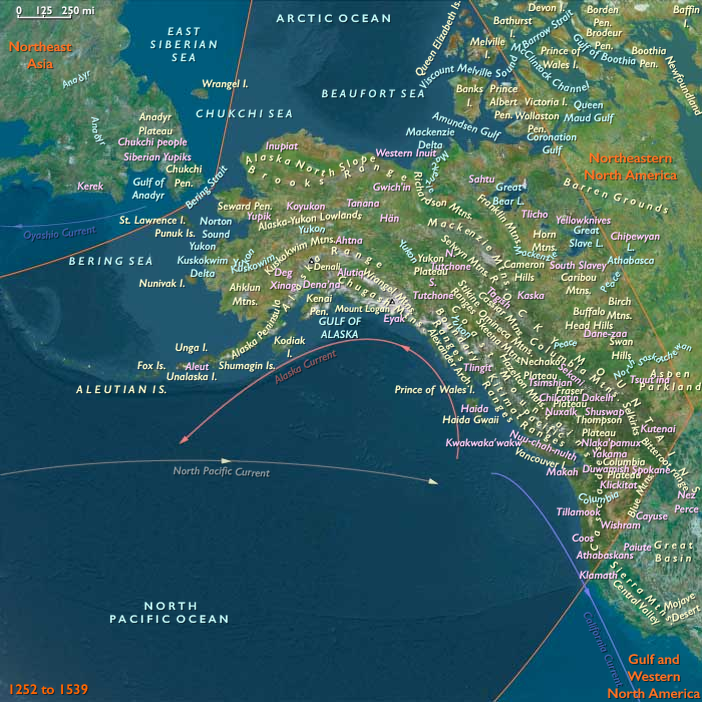
Northwestern North America comprised Alaska, the Yukon, British Columbia, Washington, northern Idaho, northwestern Montana, Oregon, and the far northern Pacific coast of California. The subregion encompassed the Gulf of Alaska, the Aleutian chain, the Alexander Archipelago, Haida Gwaii, Vancouver Island, the Salish Sea, the Fraser and Columbia river systems, the interior plateaus, the Coast and Cascade Mountains, and the western slopes of the Rockies.
Its extensive network of fjords, rainforests, salmon rivers, mountain corridors, boreal forests, grasslands, and Arctic coastlines continued to integrate coastal, interior, and northern societies despite growing climatic variability.
Environmental Continuity
During this period, the Medieval Warm Period gradually yielded to the early phases of the Little Ice Age. Cooler temperatures, advancing glaciers in portions of Alaska and the Coast Mountains, increased winter snowpacks, and greater climatic variability affected parts of the subregion.
These changes were uneven. Some salmon systems remained highly productive while others experienced periodic fluctuations. Marine ecosystems continued to support abundant fisheries, and interior forests and tundra remained exceptionally productive despite shorter growing seasons in some northern districts.
The enduring ecological framework of rivers, forests, mountains, and coastal waters remained fundamentally unchanged.
Human Adaptation
Communities responded to increasing climatic variability by strengthening long-established patterns of ecological flexibility rather than fundamentally altering their ways of life.
Coastal villages diversified harvests among salmon, halibut, herring, shellfish, marine mammals, berries, and forest resources. Interior Dene and Plateau communities adjusted seasonal movements between fisheries, hunting territories, and gathering grounds according to annual environmental conditions. Arctic peoples continued coordinating whale, seal, fish, and caribou harvests while adapting travel routes to changing sea ice and weather.
Storage technologies, seasonal mobility, and diversified resource use remained the principal foundations of regional resilience.
Economic Organization
Regional exchange became increasingly specialized as neighboring ecological zones relied upon one another's distinctive resources.
Eulachon oil continued moving inland along well-established grease trails, while preserved salmon, native copper, obsidian, dentalium shells, carved cedar products, hides, marine oils, woven textiles, and other specialized goods circulated through extensive exchange networks linking coast, plateau, subarctic, and Arctic communities.
Rather than creating economic centralization, this growing specialization reinforced interdependence among environmentally distinct regions while preserving local production systems.
Institutions
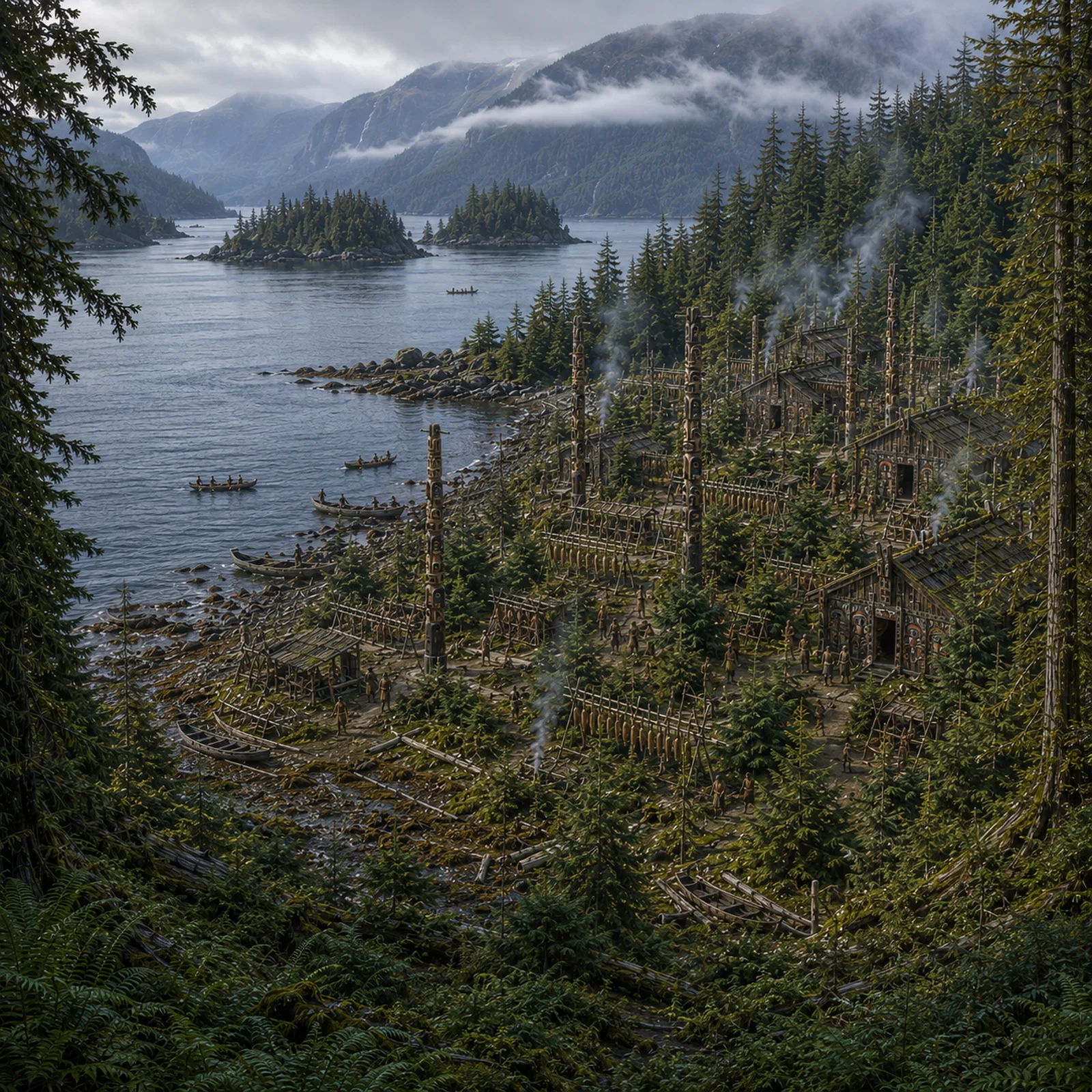
House societies along the Pacific coast continued to mature as enduring institutions managing inherited rights to fisheries, forests, villages, names, ceremonial privileges, and trade relationships.
Ceremonial exchange assumed greater regional significance as feasts increasingly reinforced diplomacy, succession, conflict resolution, marriage alliances, and reciprocal obligations between neighboring communities. Wealth continued to derive its social importance through public distribution and witnessed generosity rather than permanent accumulation.
Artistic traditions reached new levels of refinement. Monumental carving became more widespread within village settings alongside elaborately carved house fronts, memorial poles, ceremonial masks, bentwood chests, woven robes, and masterfully constructed cedar canoes. These works remained integral components of living communities rather than isolated monuments.
Interior and Arctic societies continued emphasizing oral tradition, ritual specialists, ecological knowledge, and flexible seasonal leadership adapted to changing environmental conditions.
Political Systems
Political organization remained decentralized throughout the subregion. Coastal hereditary leaders increasingly coordinated diplomacy, ceremonial exchange, stewardship of productive landscapes, and relations among neighboring house groups while preserving substantial local autonomy.
Interior Dene, Plateau, and Arctic communities continued relying upon leadership grounded in experience, generosity, hunting success, mediation, and environmental knowledge rather than formal territorial administration.
Competition occasionally intensified over productive fisheries, transportation corridors, or access to trade routes, yet customary law, kinship alliances, ceremonial obligations, and negotiated agreements generally limited conflict and maintained broad regional stability.
Legacy of the Age
Between 1252 and 1395 CE, Northwestern North America demonstrated the remarkable resilience of its Indigenous civilizations during a period of growing climatic variability. Rather than producing social disruption, environmental change encouraged further refinement of diversified subsistence systems, regional specialization, and extensive exchange relationships.
House societies, grease-trail commerce, salmon economies, Arctic marine hunting, and interior seasonal mobility all continued to evolve within the enduring ecological framework of forests, rivers, mountains, and coastal waters. By the close of the age, the subregion possessed one of the most mature and environmentally integrated cultural landscapes in the Americas, providing a stable foundation for the final centuries of wholly Indigenous development before sustained overseas contact began to reshape portions of the Pacific coast.
Images
Northwestern North America in the Late Modern (Lower) Age
Groups
Commodities
Subjects
Regions
Northern North America
View →Subregions