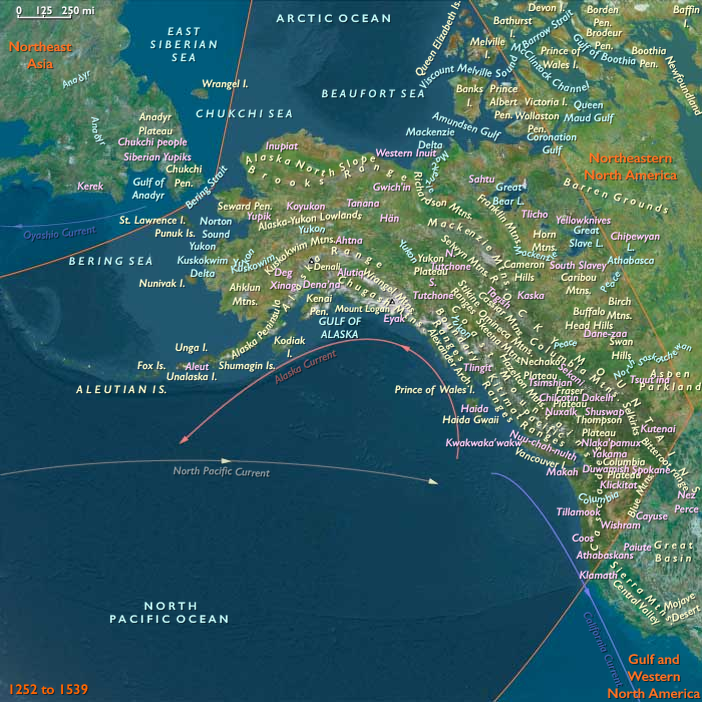
Northwestern North America (1396–1539 CE): Mature Indigenous…
1396 CE to 1539 CE
Northwestern North America (1396–1539 CE): Mature Indigenous Landscapes and the Threshold of Overseas Contact
Geographic Parameters
Northwestern North America comprised Alaska, the Yukon, British Columbia, Washington, northern Idaho, northwestern Montana, Oregon, and the far northern Pacific coast of California. The subregion encompassed the Gulf of Alaska, the Aleutian chain, the Alexander Archipelago, Haida Gwaii, Vancouver Island, the Salish Sea, the Fraser and Columbia river systems, the interior plateaus, the Coast and Cascade Mountains, and the western slopes of the Rockies.
Its vast network of fjords, forests, islands, salmon rivers, mountain passes, boreal lowlands, and Arctic coastlines continued to unite diverse Indigenous societies while preserving strong regional environmental identities.
Environmental Continuity
The Little Ice Age became more firmly established during this period. Glaciers advanced across portions of coastal Alaska and the high mountains, winters lengthened in many northern districts, and greater climatic variability affected both terrestrial and marine ecosystems.
Despite these changes, the environmental foundations of the region remained remarkably stable. Cedar forests continued to dominate the Pacific coast, salmon remained the principal organizing resource of major river systems, and productive marine environments sustained abundant fisheries from California's northern coast to the Bering Sea.
Communities adapted to annual fluctuations through established ecological knowledge rather than fundamental changes in settlement or subsistence.
Human Adaptation
Seasonal economies continued balancing marine harvesting, river fisheries, hunting, gathering, and food preservation across complementary environments.
Large coastal villages remained concentrated near major salmon rivers, protected bays, and sheltered inlets. Interior communities maintained seasonal movements linking fisheries with hunting territories, berry grounds, and upland travel corridors, while Arctic societies continued coordinating whale, seal, walrus, fish, and caribou harvests according to changing environmental conditions.
Across the subregion, generations of accumulated environmental knowledge allowed communities to absorb climatic variability while maintaining long-term continuity.
Economic Organization
Regional exchange networks reached a high degree of maturity. Canoe routes along the Inside Passage and river corridors throughout the Fraser, Skeena, Columbia, Yukon, and Copper systems supported regular movement of people, information, and goods across multiple ecological zones.
Grease trails remained among the principal arteries of inland commerce, carrying eulachon oil alongside preserved salmon, native copper, obsidian, dentalium shells, hides, carved cedar products, woven textiles, marine oils, and other specialized resources.
Trade continued to reinforce ecological interdependence rather than economic centralization, allowing each environmental zone to contribute distinctive resources to the wider regional economy.
Institutions
Coastal house societies reached one of their most mature pre-contact expressions during this age. Inherited rights to fisheries, forests, village sites, ceremonial knowledge, names, and trade relationships were maintained through increasingly sophisticated systems of kinship, customary law, and public ceremony.
Ceremonial exchanges continued serving as mechanisms for succession, diplomacy, conflict resolution, alliance building, and the affirmation of territorial rights. Wealth derived its authority through witnessed generosity and reciprocal obligation rather than permanent concentration.
Monumental artistic traditions likewise matured. Carved house fronts, memorial poles, crest poles, ceremonial regalia, masks, bentwood chests, canoes, and woven textiles formed integrated expressions of living communities whose artistic achievements remained inseparable from their ecological foundations.
Interior and Arctic societies continued preserving institutions emphasizing oral tradition, ritual specialists, ecological expertise, and highly adaptive seasonal leadership.
Political Systems
Political organization remained decentralized across the subregion. Coastal hereditary leaders exercised authority through stewardship of productive landscapes, ceremonial responsibilities, diplomacy, and established kinship relationships rather than territorial administration.
Interior Dene, Plateau, and Arctic communities maintained leadership structures based upon consensus, ecological knowledge, hunting success, generosity, and mediation.
Although localized warfare, raiding, and competition periodically occurred between neighboring communities, extensive kinship networks, ceremonial obligations, and long-established exchange relationships continued to provide important mechanisms for regional stability.
Legacy of the Age
Between 1396 and 1539 CE, Northwestern North America represented one of the world's most sophisticated Indigenous cultural landscapes. Coastal house societies, interior seasonal networks, Arctic maritime communities, and Plateau exchange systems had all reached mature forms while remaining firmly grounded in the ecological rhythms of forests, rivers, mountains, and the Pacific Ocean.
No sustained overseas presence had yet transformed the region. Foreign voyages remained far beyond the horizon, and Indigenous institutions continued directing political, economic, ceremonial, and environmental life throughout the subregion. By the close of the age, Northwestern North America stood at the height of its autonomous Indigenous development, immediately preceding the gradual appearance of distant maritime powers that would begin reshaping portions of the Pacific coast during the centuries that followed.
Images

Northwestern North America in the Late Modern (Upper) Age
Groups
Commodities
Subjects
Regions
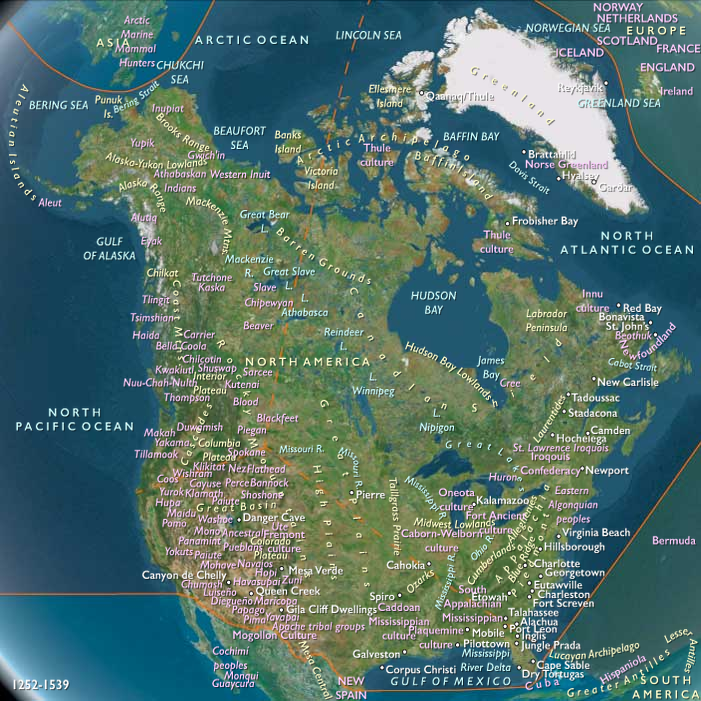
Northern North America
View →Subregions