Northwestern North America (820–963 CE): Salmon Landscapes,…
820 CE to 963 CE
Northwestern North America (820–963 CE): Salmon Landscapes, House Communities, and Expanding River Networks
Geographic Parameters
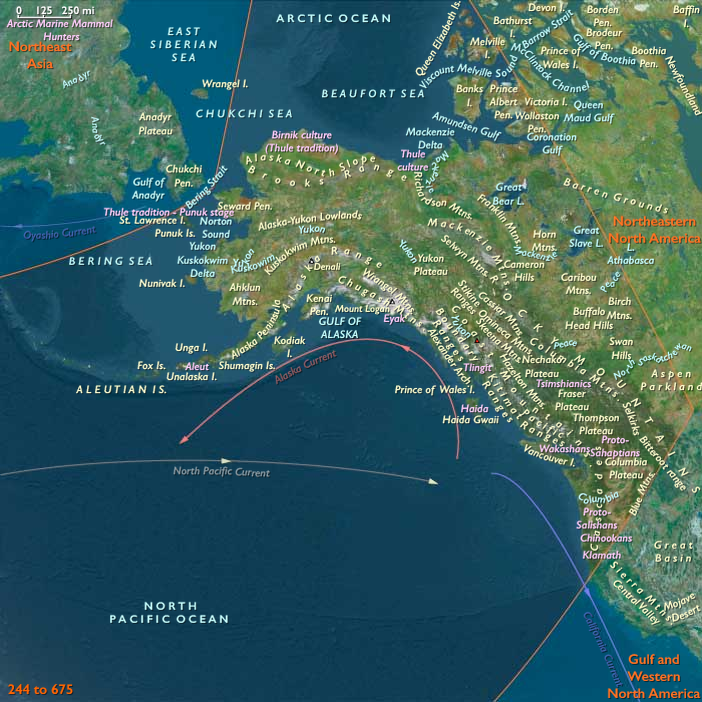
Northwestern North America comprised Alaska, the Yukon, British Columbia, Washington, northern Idaho, northwestern Montana, Oregon, and the far northern Pacific coast of California. The subregion encompassed the Gulf of Alaska, the Aleutian chain, the Alexander Archipelago, Haida Gwaii, Vancouver Island, the Salish Sea, the Fraser and Columbia river systems, the interior plateaus, the Coast and Cascade Mountains, and the western slopes of the Rockies.
Temperate rainforests, glaciated fjords, salmon-bearing rivers, boreal forests, interior grasslands, alpine passes, and Arctic tundra together formed one of the world's richest ecological mosaics, while the Inside Passage and major river systems connected coastal and interior communities across thousands of kilometers.
Environmental Continuity
Cool maritime conditions continued to dominate the Pacific coast, while long winters and short productive summers characterized the interior and Arctic. Mature cedar, spruce, fir, and hemlock forests covered much of the coastal landscape, and annual salmon migrations continued to link ocean, estuary, and river throughout the region.
The gradual onset of the Medieval Warm Period near the close of the age modestly lengthened ice-free seasons in parts of the north without fundamentally altering the region's ecological character. Salmon remained the principal organizing force of both coastal and many interior economies.
Human Adaptation
Communities increasingly refined long-established seasonal rounds that balanced fishing, marine hunting, terrestrial hunting, gathering, and food preservation across diverse environments.
Along the Pacific coast, large cedar plank-house villages became increasingly permanent around productive estuaries, sheltered bays, and major salmon rivers. Inland, Dene and Plateau peoples continued highly flexible seasonal movements between salmon fisheries, caribou ranges, upland hunting territories, and berry grounds, while Arctic communities coordinated marine hunting with river fishing and inland harvests.
Rather than relying upon a single resource, households deliberately diversified their subsistence calendars, creating resilient economies capable of absorbing localized environmental fluctuations.
Economic Organization
Salmon remained the foundation of regional production. Extensive use of weirs, reef nets, basket traps, fish fences, dip nets, and smokehouses generated substantial preserved food reserves that supported increasingly stable winter communities.
Spring eulachon fisheries supplied valuable oil that began moving in growing quantities between coastal and interior populations. Cedar, native copper, obsidian, dentalium shells, hides, dried fish, carved wooden goods, and marine products circulated through expanding exchange networks linking the Gulf of Alaska, the Inside Passage, the Fraser and Columbia systems, the Yukon Basin, and adjacent interior plateaus.
River corridors increasingly functioned as integrated economic systems rather than isolated local fisheries.
Institutions
Household organization became progressively more formalized along much of the coast. Extended families increasingly maintained inherited rights to fishing locations, cedar groves, shoreline landings, and ceremonial traditions through kinship rather than centralized political authority.
Winter ceremonial gatherings, communal labor during salmon harvests, and reciprocal gift exchange reinforced social obligations among neighboring communities. Artistic traditions in carving, weaving, woodworking, and ceremonial regalia became increasingly sophisticated, although monumental public carving remained subordinate to the broader village landscape.
Interior societies retained more flexible leadership structures centered upon experienced hunters, respected elders, ritual specialists, and accomplished travelers whose authority remained closely tied to seasonal knowledge rather than permanent offices.
Political Systems
Political authority remained overwhelmingly local. Coastal villages were governed through hereditary house leaders whose influence rested upon stewardship of productive resources, successful mediation, generosity, and ceremonial responsibilities rather than territorial conquest.
Interior Dene bands continued organizing through seasonal kin groups adapted to highly mobile lifeways, while Arctic communities coordinated cooperative whale, seal, and fish harvests through customary leadership rooted in experience and communal trust.
Relations between neighboring societies emphasized trade, intermarriage, reciprocal obligations, and negotiated access to resources, although localized conflict occasionally accompanied competition over especially productive fisheries.
Legacy of the Age
Between 820 and 963 CE, Northwestern North America experienced steady institutional maturation without dramatic political upheaval. Expanding salmon-storage economies, increasingly permanent coastal house communities, and growing exchange along river and maritime corridors strengthened connections across the subregion while preserving its remarkable ecological balance.
The enduring relationship between forests, salmon rivers, marine waters, and human communities continued to shape every aspect of regional life. By the close of the age, Northwestern North America had developed one of the world's most sophisticated resource-based cultural landscapes, providing the stable ecological and social foundations upon which the more elaborate ceremonial institutions and regional exchange systems of the High Medieval centuries would gradually emerge.
Images

Northwestern North America in the Early Medieval (Upper) Age
Groups
Commodities
Subjects
Regions
Northern North America
View →Subregions