
Northwestern North America (964–1107 CE): House Societies,…
964 CE to 1107 CE
Northwestern North America (964–1107 CE): House Societies, Grease Trails, and Expanding Ceremonial Exchange
Geographic Parameters
Northwestern North America comprised Alaska, the Yukon, British Columbia, Washington, northern Idaho, northwestern Montana, Oregon, and the far northern Pacific coast of California. The subregion encompassed the Gulf of Alaska, the Aleutian chain, the Alexander Archipelago, Haida Gwaii, Vancouver Island, the Salish Sea, the Fraser and Columbia river systems, the interior plateaus, the Coast and Cascade Mountains, and the western slopes of the Rockies.
Its interconnected environments—temperate rainforests, fjords, salmon rivers, interior forests and grasslands, alpine passes, and Arctic coasts—continued to bind together one of the world's richest ecological regions through an expanding network of waterways and overland trails.
Environmental Continuity
The Medieval Warm Period became more fully established during this age, bringing modestly longer growing seasons in northern districts and generally favorable conditions for many salmon systems. Coastal rainforests remained dense and highly productive, while the interior continued to support diverse mosaics of boreal forest, river valleys, wetlands, and upland meadows.
Although local fluctuations affected individual fisheries and wildlife populations, no broad environmental transformation altered the fundamental ecological structure established during earlier centuries.
Human Adaptation
Communities continued refining diversified seasonal economies that balanced fishing, marine hunting, terrestrial hunting, gathering, and food preservation.
Along the Pacific coast, increasingly permanent villages clustered around highly productive estuaries and salmon rivers. Interior Dene and Plateau communities maintained flexible annual movements between fisheries, hunting territories, root-gathering grounds, and winter settlements, while Arctic peoples coordinated whale, seal, fish, and caribou harvests according to changing seasonal conditions.
The ability to move efficiently between complementary ecosystems remained the principal foundation of regional resilience.
Economic Organization
Salmon production continued to expand as the organizing framework of regional economies. Smokehouses, drying racks, storage facilities, and communal fishing systems supported larger winter populations and increasingly dependable food reserves.
Eulachon oil assumed growing importance as a valuable exchange commodity. Well-established grease trails linked coastal fisheries with interior river valleys, carrying oil, preserved fish, native copper, obsidian, dentalium shells, hides, carved goods, and other materials across the Coast Mountains.
The Inside Passage, Fraser, Skeena, Nass, Columbia, Yukon, and Copper River systems became increasingly integrated commercial corridors that connected distinct ecological zones while preserving strong regional specialization.
Institutions
This period witnessed the steady maturation of coastal house societies. Rights to fisheries, cedar groves, shoreline settlements, names, ceremonial privileges, and ancestral histories became more formally organized within enduring kin groups whose continuity extended across generations.
Seasonal feasts and reciprocal gift distributions became increasingly elaborate mechanisms for confirming marriages, inheritance, alliances, territorial rights, and social obligations. Rather than concentrating wealth permanently, these institutions emphasized public generosity, witnessed agreements, and reciprocal responsibility among neighboring communities.
Artistic traditions likewise expanded. Carved house fronts, crest boards, ceremonial regalia, woven textiles, bentwood containers, and increasingly sophisticated woodworking reflected growing institutional complexity while remaining integrated into inhabited village landscapes.
Interior societies continued emphasizing flexible leadership rooted in ecological knowledge, successful subsistence, mediation, and spiritual authority, preserving institutional forms well suited to highly mobile lifeways.
Political Systems
Political authority remained decentralized throughout the subregion. Coastal hereditary leaders increasingly coordinated the management of fisheries, ceremonial activities, trade relationships, and resource stewardship within expanding house communities, while neighboring villages maintained their independence through diplomacy, intermarriage, and reciprocal obligations.
Interior Dene, Plateau, and Arctic communities continued relying upon seasonal leadership that reflected experience, consensus, and specialized knowledge rather than permanent territorial government.
Competition occasionally developed around especially productive fisheries, trade corridors, or hunting territories, but long-distance exchange and kinship alliances generally reinforced regional stability across the broader landscape.
Legacy of the Age
Between 964 and 1107 CE, Northwestern North America experienced the gradual maturation of institutional life without disrupting its ecological foundations. House societies became more enduring along the Pacific coast, ceremonial exchange expanded through increasingly formalized systems of reciprocal obligation, and the grease trails strengthened economic integration between coast and interior.
Throughout these developments, forests, salmon rivers, marine waters, and seasonal mobility continued to define the rhythm of human life. The growing complexity of social institutions emerged directly from sustained ecological abundance rather than political centralization, preparing the region for the broader ceremonial landscapes and increasingly interconnected exchange systems that would characterize the High Medieval centuries.
Images

Northwestern North America in the High Medieval (Lower) Age
Groups
Commodities
Subjects
Regions
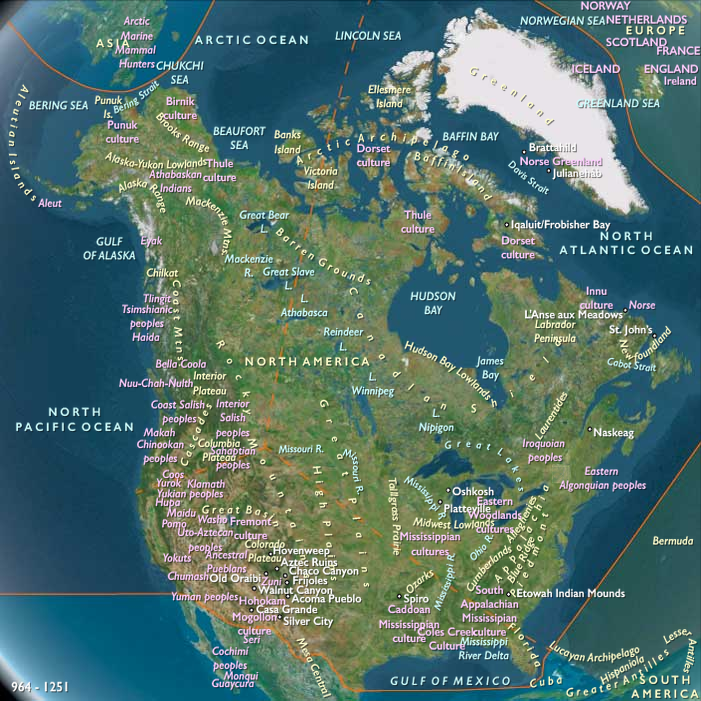
Northern North America
View →Subregions
