
On first reaching Tabriz with his army …
Years: 1514 - 1514
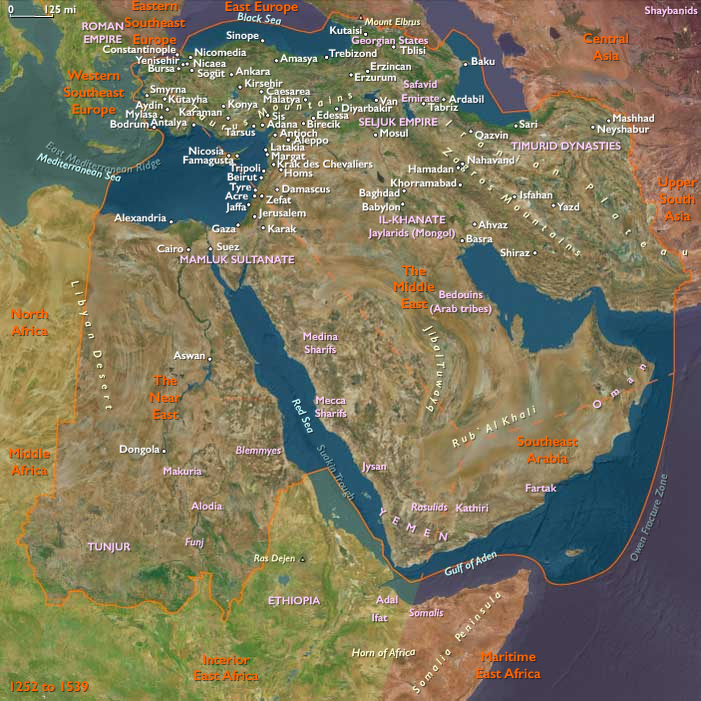
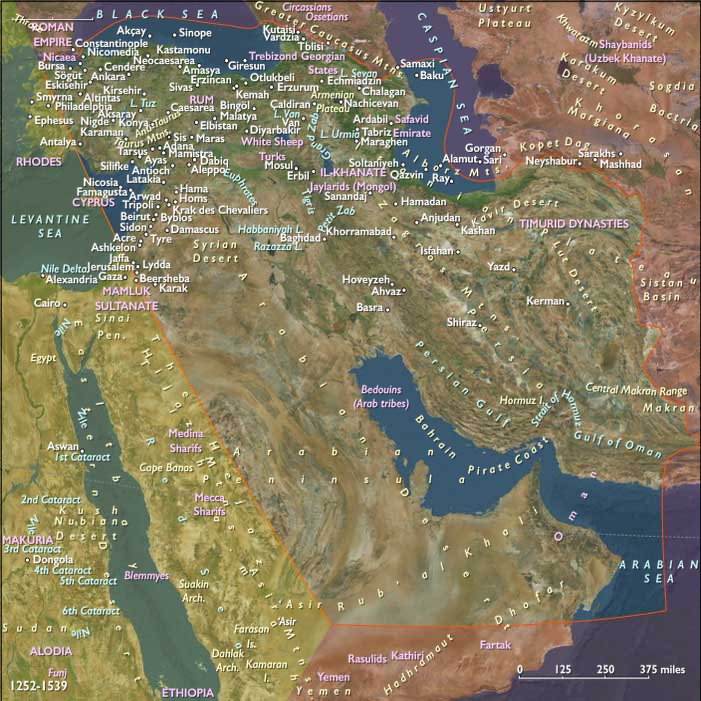
On first reaching Tabriz with his army in July, Selim had left the Azerbaijani capital unharmed, moving on to defeat the Persians at Chaldiran.
He now returns to Tabriz and reduces the partially populated city within two weeks, sacking it and massacring all its inhabitants save one thousand artisans, who he sends to Istanbul.
The Ottoman victory at Chaldiran and the occupation of Tabriz on September 7 does not lead to the conquest of Iran or the collapse of Isma'il's Safavid empire.
The Ottoman army becomes increasingly discontented under the impact of Safavid propaganda among the already heterodox Janissaries.
A relative lack of booty and supplies compared with campaigns in Europe also weakens morale.
A mutiny among his troops fearing a counterattack and entrapment by the fresh Safavid forces called in from the interior forces the triumphant Ottomans to withdraw prematurely.
Among the booty from Tabriz is Ismail's favorite wife, for whose release the Sultan demands huge concessions, which are refused.
Despite his defeat at the Battle of Chaldiran, Ismail quickly recovers most of his kingdom, from east of Lake Van to the Persian Gulf.
The Ottomans, however, manage to annex for the first time Eastern Anatolia and parts of Mesopotamia, as well as, briefly, northwestern Iran.
The Turkish army withdraws to Amasya and Ankara to disperse.
The major result of the Chaldiran battle is to persuade Ismail and his successors to avoid open conflict with the Ottomans at all costs, a policy that will continue for a century.
This preserves the Safavid army, but it enables Selim to turn toward the last independent Anatolian Kurdish and Turkmen principalities.
Locations
People
Groups
- Iranian peoples
- Kurdish people
- Oghuz Turks
- Muslims, Sunni
- Muslims, Shi'a
- Turkmen people
- Ottoman Empire
- Qizilbash or Kizilbash, (Ottoman Turkish for "Crimson/Red Heads")
- Persia, Safavid Kingdom of
Topics
Commodoties
Subjects
Regions
Subregions
Related Events
Filter results
Showing 10 events out of 89 total
The Spanish Invasion of Portugal and the Defense of Britain's Oldest Ally (1762)
As Britain and Spain entered open war in 1762, the most immediate threat was a Spanish invasion of Portugal, which had remained neutral for most of the conflict despite its historic alliance with Britain. Encouraged by France, Spain sought to open a new front that would force Britain to divert troops away from its campaigns against France, particularly in North America and the Caribbean.
Spain’s Strategy – Attacking Portugal Instead of Gibraltar
Although Spain had long sought the capture of Gibraltar, the heavily fortified British stronghold presented a formidable challenge. Instead, France persuaded Spain to invade Portugal, believing its long but rugged borderwas vulnerable and easy to overrun. By capturing key Portuguese cities, Spain hoped to force Lisbon to break its alliance with Britain and potentially gain strategic leverage in the broader war.
Britain Responds to the Threat
Recognizing the danger, Britain moved swiftly to reinforce Portugal, dispatching supplies, military officers, and troops to help organize its defense. The original Spanish plan was to capture Almeida, then advance toward the Alentejo and Lisbon, but the strategy shifted to Porto, aiming to strike directly at British trade interests.
The Spanish Advance and British-Portuguese Resistance
In the spring of 1762, under the command of the Marquis of Sarria, Spanish troops crossed from Galicia into northern Portugal, quickly capturing several towns. However, their advance on Porto was slow and disorganized, hampered by:
- Difficult terrain
- Heavy flooding of the River Esla
- Supply and coordination problems
By May 9, Spanish forces invested and captured the key border fortress of Almeida, dealing a serious blow to Portuguese defenses.
The British-Portuguese Counterattack
Britain responded by dispatching 8,000 troops to Portugal:
- 6,000 troops arrived from Belle Île, under Lord Loudoun
- 2,000 more troops came from Ireland
As reinforcements landed, a British-Portuguese counterattack, led by John Burgoyne, struck back at the Spanish, capturing the town of Valencia de Alcántara. This bold maneuver disrupted Spanish supply lines and demonstrated that Portugal’s defenses were stronger than anticipated.
French Intervention and the Bourbon Retreat
France, eager to support its Spanish ally, sent reinforcements, but these forces, like their Spanish counterparts, suffered high rates of attrition due to:
- Disease
- Desertion
- Logistical failures
By November 1762, with supply and communication lines stretched thin, the Bourbon allies recognized the futility of their campaign. Facing increasing resistance and unable to secure a decisive victory, they withdrew from Portugal and sued for peace.
A War Without Major Battles
Despite the large number of troops involved, the campaign saw no major battles. Instead, the Spanish invasion was characterized by logistical failures, difficult terrain, and an underestimation of British-Portuguese resistance. In the end, Britain's swift military response, Portugal’s resilience, and the Spanish-French inability to sustain the campaign ensured that Portugal remained unconquered, reaffirming its place as Britain’s oldest ally.
The Battle of Valencia de Alcántara – A Daring Preemptive Strike (August 27, 1762)
By mid-1762, the Franco-Spanish invasion of Portugal had evolved into three separate campaigns, each aimed at a different strategic region:
- The Northeast Division (Galicia) – Targeted Trás-os-Montes and Minho, with Oporto as its final objective(first invasion, May–June 1762).
- The Central Division (Beira) – Reinforced by French troops and remnants of the Northeast Division, aimed at Lisbon (second invasion, July–November 1762).
- The Southern Division (Valencia de Alcántara, Estremadura) – Positioned to invade Alentejo, a flat and open province, making it an ideal route for a Spanish cavalry advance toward Lisbon.
The Portuguese King Pressures for an Offensive
As the Franco-Spanish army gained momentum in central Portugal (Beira), King José I pressured Count Wilhelm von Schaumburg-Lippe, the Allied commander, to go on the offensive.
Lippe, however, knew that a direct confrontation with the larger enemy army would be disastrous. Instead, he devised a bold preemptive strike—attacking the southern Spanish forces near Valencia de Alcántara, where the Spanish third corps was amassing troops and munitions for another planned invasion through Alentejo.
Valencia de Alcántara – A Key Spanish Supply Depot
The Spanish troops stationed near Valencia de Alcántara were part of the vanguard of Spain’s third invasion force. The city served as:
- A main supply depot, storing munitions and artillery.
- A staging ground for the planned advance into Alentejo, from where Spanish cavalry could move unopposed toward Lisbon.
However, the Spanish commanders believed their numerical superiority made a Portuguese attack unthinkable. As a result, they had failed to set up proper defenses:
- No barricades or advanced piquets.
- Minimal guard patrols, except in the city’s central square.
- Major-General Don Miguel de Irunibeni, the Spanish officer in charge of the Alentejo invasion, had just arrived the day before, unaware of any immediate threat.
Burgoyne’s Lightning Attack – August 27, 1762
On the morning of August 27, 1762, Colonel John Burgoyne, commanding a 2,800-strong Anglo-Portuguese force, launched a surprise assault on Valencia de Alcántara.
Despite the enemy’s larger numbers, the element of surprise and Burgoyne’s tactical boldness led to a decisive victory:
- The Seville Regiment, one of Spain’s elite units, was routed.
- All resisting Spanish soldiers were killed.
- The city was swiftly taken, and the supply depot fell into Allied hands.
Key Spanish Officers Captured
The attack inflicted heavy losses and led to the capture of multiple high-ranking officers, including:
- Major-General Don Miguel de Irunibeni, commander of the planned Alentejo invasion.
- Two colonels, two captains, and seventeen subaltern officers.
- Three Spanish flags, symbolizing a humiliating defeat for Spain.
Additionally, large quantities of arms and munitions were seized or destroyed, crippling Spain’s ability to launch a third invasion.
Strategic Impact – Preventing the Third Invasion of Portugal
The Battle of Valencia de Alcántara was a turning point in the Portuguese defensive campaign.
- It galvanized the Portuguese army at a critical moment, boosting morale during the early stages of the Second Invasion (Beira Front).
- It eliminated the threat of a third invasion through Alentejo, which would have allowed Spain’s powerful cavalry to advance toward Lisbon with little resistance.
- It forced Spain to divert resources away from the central campaign, weakening their overall position.
Burgoyne’s Reward and Legacy
For his brilliant leadership, John Burgoyne was:
- Personally rewarded by King José I of Portugal with a large diamond ring.
- Given the captured Spanish flags as a symbol of honor.
- Internationally celebrated, enhancing his military reputation.
Conclusion – A Masterstroke in the Iberian Campaign
Burgoyne’s daring raid on Valencia de Alcántara exemplified the aggressive defensive strategy employed by Lippe and his Anglo-Portuguese forces. Instead of waiting to react, they struck first, disrupting Spanish plans and ensuring that the Alentejo remained secure.
This decisive action, combined with continued Portuguese resistance, would ultimately contribute to the complete failure of Spain’s 1762 campaign, leading to the final withdrawal of Bourbon forces from Portugal.
The Second Invasion of Portugal – The Bourbon Shift to the Beira Front (July–November 1762)
Following the disastrous failure of the first invasion of Portugal (May–June 1762), Sarria’s shattered Spanish army, after suffering heavy losses in Trás-os-Montes, retreated to Ciudad Rodrigo in Spain. Once there, it was merged with the Spanish Central Army, and soon after, reinforced by 12,000 French troops under Prince de Beauvau. This reorganization gave the Bourbon forces a fresh numerical advantage, bringing their total strength to 42,000 men:
- 30,000 Spaniards, under Count of Aranda (who replaced Sarria)
- 12,000 French troops, under Prince de Beauvau
A New Plan: Abandoning Oporto, Advancing on Lisbon
With the Portuguese victory in Trás-os-Montes and the failure to capture Oporto, the Bourbon high command abandoned their original plan of invading Portugal via the northern provinces. Instead, a new strategy was devised:
- The main invasion force would now attack via the province of Beira, in the east-central region of Portugal.
- The final objective was Lisbon, the capital and political heart of Portugal.
Reorganizing for a Prolonged Campaign
Recognizing that logistical failures had doomed the first invasion, the Spanish minister Esquilache personally arrived in Portugal to improve supply chains. He established supply depots and secured food stocks for six months, ensuring the Bourbon forces would not suffer from starvation as they had before.
Portugal’s Grim Situation – A Last Resort Evacuation Plan
Despite their previous successes, the Portuguese government faced a dire reality:
- The combined Bourbon army (42,000 men) vastly outnumbered the Anglo-Portuguese forces.
- The Portuguese army remained small and ill-prepared, with only:
- 7,000–8,000 Portuguese regulars
- 7,104 British troops
- Lippe’s Anglo-Portuguese force was outnumbered nearly 3 to 1, facing a well-supplied enemy.
Recognizing the threat of total defeat, Prime Minister Sebastião José de Carvalho e Melo, the Marquis of Pombal, took precautionary measures:
- Twelve ships were assembled in the Tagus Estuary, ready to evacuate the Portuguese royal family and court to Brazil if Lisbon fell.
- This was a realistic contingency plan, as Portugal had been ruled from Brazil before (during the Spanish occupation of Portugal, 1580–1640).
The Second Invasion Begins
With their forces reorganized and resupplied, the Franco-Spanish army began its advance into Beira, initiating the second invasion of Portugal (July–November 1762).
Despite the overwhelming odds, Count Lippe and the Anglo-Portuguese forces would implement a masterful defensive strategy, utilizing guerrilla warfare, scorched earth tactics, and defensive maneuvering to once again frustrate the Bourbon invasion.
This campaign would ultimately decide the fate of Portugal, as the Bourbon forces sought to succeed where they had failed in the north—by taking Lisbon itself.
The Battle for the Tagus – Lippe's Masterful Defense and the Turning Point of the War (October 1762)
By October 1762, the Bourbon invasion of Portugal had reached a critical phase. With their initial successes in Beira, the Spanish and French forces under the Count of Aranda were now focused on breaking through the final Portuguese defenses and marching on Lisbon.
Count Wilhelm von Schaumburg-Lippe, aware of his numerical inferiority, abandoned the idea of defending the entire frontier and instead withdrew into the interior, forming a strategic defensive line along the River Tagus. This maneuver was essentially a forward defense of Lisbon, ensuring that the capital remained protected behind natural barriers.
Lippe’s Strategy – A War of Movement, Not Set-Piece Battles
Lippe’s primary objectives were:
- Avoiding a direct battle with the superior enemy force – Instead of engaging in conventional combat, Lippe focused on controlling mountain passes and gorges, using small units to harass and attack enemy flanks.
- Preventing the Franco-Spanish forces from crossing the River Tagus – If the enemy could cross the Tagus, they would reach Alentejo’s open plains, where their superior cavalry could march on Lisbon without opposition.
The Spanish Plan – Crossing the Tagus at Vila Velha
After capturing Almeida, Aranda moved swiftly to cross the Tagus at Vila Velha, a location historically used by Philip V of Spain to cross the river during the War of the Spanish Succession.
However, Lippe anticipated this move and acted first, securing:
- Abrantes, his main headquarters, a strategic position halfway between Lisbon and the Spanish border.
- Detachment placements:
- Burgoyne was posted at Niza.
- The Count of Santiago was positioned near Alvito to block the Spanish passage at Vila Velha.
When the Spanish army arrived at Vila Velha, they found that all strategic positions were already occupied and that the Portuguese had either taken or destroyed all boats—making a river crossing impossible.
This left the Bourbon forces with only two options:
- Retreat into Spain and cross at Alcántara, which was strategically sound but dishonorable, as it implied they had been forced to withdraw before an inferior force.
- Advance toward Lisbon via the mountains north of the city, a risky choice that played directly into Lippe’s hands.
As expected, Aranda opted for the second option, attempting a mountain march toward Lisbon.
The Bourbon Offensive Toward Abrantes
While Lippe’s Anglo-Portuguese forces fortified their positions in the mountains between the Tagus, Zêzere, and Codes rivers, the Bourbon army launched a desperate offensive aimed at breaking through toward Abrantes, Lippe’s headquarters.
The Battle of Vila Velha (October 3–5, 1762)
On October 3, the Spaniards seized the small castle of Vila Velha (on the north bank of the Tagus) and forced the defiles of St. Simon, pushing deep into Portuguese territory. A large Spanish force began pursuing the Count of Santiago’s detachment through the mountains, nearly cutting them off completely.
Realizing the danger, Lippe acted immediately, sending a reinforcement under Lord Loudoun. The combined Allied forces counterattacked and defeated the pursuing Spaniards at the River Alvito on October 3, allowing Santiago’s force to escape to Sobreira Formosa.
However, the Spanish advance had weakened their position at Vila Velha, leaving them vulnerable. On October 5, Anglo-Portuguese forces under Colonel Lee launched a decisive assault on Vila Velha, routing the Spanish garrison.
- A Spanish general was killed while trying to rally his troops.
- Several Spanish officers and soldiers were captured.
- Sixty artillery mules were seized, and enemy supplies and magazines were destroyed.
The Battle of Sabugal – A Simultaneous Allied Victory
On the same day (October 5, 1762), Portuguese forces under Townshend ambushed and defeated a French force escorting a supply convoy at Sabugal.
- A large quantity of supplies was captured, further strangling the Bourbon army’s logistics.
- This simultaneous defeat at Sabugal compounded the disaster at Vila Velha, ensuring that the Spanish offensive was completely stalled.
The Tide of War Turns – The Franco-Spanish Offensive Fails
The losses at Vila Velha and Sabugal were crippling for the Bourbon invasion:
- The offensive toward Abrantes had failed.
- The Spaniards could not cross the Tagus, preventing them from reaching Alentejo and the open plains leading to Lisbon.
- The Portuguese and British forces had proven highly effective, using strategic mobility, fortifications, and well-timed counterattacks to neutralize the numerically superior enemy.
Abrantes – The Key to Portugal
Abrantes had proved to be “the key of Portugal”, as its strategic location:
- Blocked the southern route to Lisbon.
- Served as a staging ground for Anglo-Portuguese counterattacks.
- Allowed Lippe to control enemy movements, forcing them into increasingly disadvantageous positions.
Conclusion – The War Had Turned Against Spain and France
The failure of the Bourbon army to cross the Tagus marked a turning point in the war. The Franco-Spanish offensive was over, and now, the Anglo-Portuguese forces would seize the initiative, launching counteroffensives that would force the invaders to retreat.
What had once seemed like a winning campaign for Spain and France had, by October 1762, transformed into a full-scale strategic disaster.
The Final Blow – The Pursuit and Collapse of the Franco-Spanish Army (October–November 1762)
By mid-October 1762, the Franco-Spanish army, trapped in front of Abrantes, was starving, exhausted, and demoralized. Their supply lines were shattered, their troops were deserting, and the Anglo-Portuguese forces remained well-fed and entrenched.
Recognizing that total collapse was imminent, Count Wilhelm von Schaumburg-Lippe devised a bold maneuver to complete the enemy’s defeat.
Lippe’s Masterstroke – A Psychological Encirclement
To push the invaders into full retreat, Lippe exploited their worsening morale by launching a brilliant deception campaign:
- General Townshend’s Portuguese force was ordered to maneuver toward the enemy’s rear.
- At the same time, rumors were deliberately spread that Townshend’s detachment was part of a massive British force of 20,000 newly landed troops.
The psychological effect was immediate and devastating:
- The already starving and exhausted Bourbon forces panicked, fearing they would be completely encircled.
- From October 15 onward, the invaders began a full-scale withdrawal toward Castelo Branco, where they attempted to regroup closer to the Spanish border.
- The new Spanish headquarters was hastily established there, marking the effective end of their offensive campaign.
The Anglo-Portuguese Army Goes on the Offensive
Now that the Bourbon army was in retreat, the Anglo-Portuguese forces finally abandoned their defensive positions and launched a full-scale counteroffensive.
- The retreating enemy forces were relentlessly pursued, their rear guard constantly harassed.
- Many Spanish and French soldiers were captured in the chaotic withdrawal.
- Almost all the towns and fortresses previously taken by Spain were retaken by the Portuguese, undoing months of Bourbon gains in just weeks.
The Collapse of Spanish Hopes
The entire Spanish campaign, which had once inspired such confidence in Madrid, had completely unraveled.
- Charles III’s hopes of conquering Portugal had evaporated, as nearly every territorial gain had been reversed.
- The Franco-Spanish army, which had once numbered over 42,000 men, was now shattered, with thousands dead, captured, or starving.
- The war had reached its final stage, and Spain and France were now forced to seek a diplomatic exit.
Conclusion – The End of the Invasion
Through deception, mobility, and relentless pressure, Lippe and the Anglo-Portuguese army had transformed the war from a defensive struggle into a decisive rout of the invading forces.
The Spanish dream of taking Lisbon had turned into a nightmare, and by November 1762, their entire military effort had collapsed. The war was now effectively over, with Portugal and Britain emerging victorious.
The Siege Without Walls – Starving Out the Invaders at Abrantes (October–November 1762)
By October 1762, the Franco-Spanish invasion of Portugal had stalled. The Anglo-Portuguese army under Count Wilhelm von Schaumburg-Lippe remained entrenched at Abrantes, while the Spanish and French forces under the Count of Aranda found themselves immobilized in front of the fortified Allied positions.
Although neither side launched a full-scale attack, the situation heavily favored the Anglo-Portuguese forces. While they continued to receive reinforcements and provisions, the Bourbon forces were being strangled by guerrilla warfare, starvation, and disease.
Scorched Earth – The Strategy That Destroyed the Invasion
The Portuguese scorched earth policy, carefully executed by Lippe and Pombal, turned the Province of Beira into a wasteland:
- Villages were abandoned, their inhabitants fleeing with all food supplies.
- Crops were burned and livestock was taken to prevent the enemy from foraging.
- Even houses and roads were destroyed to hinder enemy movement.
This deliberate devastation forced the Franco-Spanish army into an impossible situation:
- They could not advance, as the fortified Anglo-Portuguese positions at Abrantes blocked the route to Lisbon.
- They could not retreat, without admitting total failure.
- They could not remain where they were, because they were slowly starving to death.
The starvation tactic, used successfully against the Bourbon forces in 1762, would be repeated in 1810–11 against the French army of Marshal Masséna, who, like the invaders of 1762, would find himself trapped in front of Lisbon, cut off from supplies, harassed by guerrillas, and forced into a disastrous retreat.
Lisbon – A Fortress by Geography
Lippe’s strategy capitalized on the unique geography of Portugal’s capital. To conquer Portugal, the Franco-Spanish forces had to take Lisbon, but:
- The Atlantic Ocean blocked any attack from the west.
- The Tagus River protected the city to the south and east.
- Only the mountainous terrain north of the city offered an approach—and that route was now blocked by the Allied defensive system centered on Abrantes.
With Lisbon still receiving provisions by sea, the Anglo-Portuguese army had no logistical issues, while the Bourbon invaders were collapsing from starvation.
The Franco-Spanish Army Begins to Disintegrate
Trapped in an uninhabitable wasteland, the Franco-Spanish forces faced mounting losses:
- Guerrilla fighters and militias relentlessly attacked supply convoys, further isolating the enemy army.
- Hunger ravaged the invading forces, leaving soldiers too weak to fight.
- Desertions soared, as soldiers abandoned their ranks to search for food.
- Disease spread rapidly among the starving troops, killing thousands.
The once-confident Bourbon army was now in survival mode, and retreat was becoming inevitable.
The Collapse of the Franco-Spanish Campaign
By November 1762, the invading Spanish and French armies were disintegrating. Their choices were clear:
- Remain at Abrantes and starve.
- Retreat while they still could—though in a shattered state.
Ultimately, the Bourbon high command chose to withdraw, abandoning their dream of conquering Portugal. The strategic brilliance of Lippe, combined with Portuguese resilience, guerrilla warfare, and the devastating scorched earth tactics, had turned the tide of war.
The defense of Lisbon was never tested, because the invaders never got close enough to attack it. Instead, they were starved into submission, much like Napoleon’s troops would be half a century later.
Conclusion – Portugal’s Victory Secured
The Second Invasion of Portugal (July–November 1762) had ended in total failure for Spain and France. Despite their vast numerical superiority, they had been outmaneuvered, outlasted, and outwitted by a smaller but more strategically mobile Anglo-Portuguese force.
The war was no longer about conquest—it was now about how many of the starving Spanish and French troops could make it back to Spain alive.
The Fall of Almeida and the Illusion of Bourbon Success (August–October 1762)
At the outset of the Second Invasion of Portugal (July–November 1762), the Anglo-Portuguese forces were in dire straits. A British observer, initially dismayed by the poor state of the Portuguese army, described its soldiers as the most "wretched troops" he had ever seen, noting that they were often left without bread for five days while their horses lacked forage.
Amid these hardships, Count Wilhelm von Schaumburg-Lippe, the Allied commander, faced overwhelming odds. At first, the Franco-Spanish forces encountered little resistance, seizing several fortresses with ruined walls and few defenders:
- Alfaiates
- Castelo Rodrigo
- Penamacor
- Monsanto
- Salvaterra do Extremo
- Segura (September 17, 1762)
- Castelo Branco (September 18, 1762)
- Vila Velha (October 2, 1762)
These fortresses surrendered almost without firing a shot, much to Lippe’s frustration. In the aftermath of the war, several Portuguese governors of these strongholds would be tried and convicted for treason and cowardice.
The Siege of Almeida – A Hollow Victory for Spain
The key stronghold of Almeida, the main fortress of Beira, was in no condition to withstand a siege. The British officer O’Hara, who had led Portuguese militias at the Battle of the Douro, advised the fortress commander to evacuate the garrison and fight in open terrain, where defense could be more sustainable. However, the commander refused, stating he could not act without superior orders.
Almeida’s Defenders and Their Plight
- The garrison consisted of two regular regiments and three militia regiments, totaling 3,000–3,500 men.
- Desertion skyrocketed as the Franco-Spanish army approached, leaving only 1,500 defenders.
- The besieging force was an overwhelming 32,000 troops (24,000 Spanish and 8,000 French).
The fortress was commanded by General Palhares, an octogenarian commander widely considered incompetent. His replacement, sent by the Portuguese government, had not arrived in time.
On August 25, 1762, after only nine days of symbolic resistance, Almeida capitulated with honors of war.
The Surrender – A Stunning Capitulation
According to General Dumouriez, the garrison had fired only five or six artillery shots before surrendering. Palhares had even forbidden firing on the enemy, and the entire battle resulted in only two Portuguese casualties.
The terms of surrender were remarkably lenient, largely because the Franco-Spanish army had been shocked at how quickly Almeida proposed to surrender:
- The garrison was allowed to leave with full honors, carrying their guns and luggage.
- They were released under the condition of not fighting Spain for six months.
- The Portuguese defenders marched to reinforce the garrison at Viseu.
Despite this remarkably easy victory, Palhares would later die in a Portuguese prison, condemned for his shameful capitulation.
Madrid Celebrates – But the War Takes a Different Turn
The capture of Almeida, along with its 83 cannons and nine mortars, was hailed as a great victory in Madrid, marking the high point of Spanish success in the war.
At this moment, Spain and France believed the war was turning in their favor. The Bourbon advance led many to assume that the fall of Lisbon was imminent. However, this illusion of victory would soon crumble, as Spain and France learned the hard lesson that occupying fortresses in a guerrilla war meant nothing.
The Fatal Error – Overextending the Franco-Spanish Army
Rather than securing a decisive advantage, the occupation of multiple strongholds became a strategic liability for the Franco-Spanish invaders:
- Spread Too Thin – With garrisons stationed in multiple fortresses, Bourbon forces were scattered, making it difficult to concentrate their army for a decisive strike.
- A War of Movement, Not Fortresses – Like Napoleon decades later, the Bourbon high command failed to grasp that Portugal’s war strategy was based on mobility, not static defenses.
- The Rising Guerrilla Revolt – The occupation of these fortresses fueled national resistance, as Portuguese peasants and militias intensified their attacks on enemy supply lines.
The Guerrilla Uprising – A Growing Nightmare for the Invaders
As the Franco-Spanish army advanced deeper into Beira, they were confronted not just by the Anglo-Portuguese army, but by an increasingly emboldened guerrilla movement:
- The Portuguese militias and irregular fighters relentlessly attacked Bourbon supply convoys and small detachments.
- Communications between French and Spanish divisions were cut off, isolating their forces.
- The civilian population openly resisted, forcing the Bourbon army to expend time and resources on repression.
Even in occupied cities, resistance never ceased, as reported by Count of Aranda, who begged Lippe to intervene to stop the Portuguese popular uprising.
The Final Lesson – Fortresses Mean Nothing in a Guerrilla War
Like Napoleon during the Peninsular War (1808–1814), the Franco-Spanish commanders of 1762 would learn at their own expense that seizing fortresses, while celebrated in Spanish historiography, was ultimately irrelevant in the face of:
- Unrelenting guerrilla warfare
- Supply line disruptions
- An enemy army that refused to fight a conventional battle
Thus, while Madrid rejoiced at the fall of Almeida, the real war was being lost elsewhere, as Portugal’s scorched earth tactics, irregular resistance, and strategic maneuvering by Count Lippe would turn the tide against the invaders.
Conclusion – A Hollow Spanish Victory
While Almeida's fall seemed to signal Bourbon dominance, it did not bring them closer to their ultimate goal—Lisbon. Instead, it overstretched their forces, leaving them vulnerable to the final phase of the Portuguese counteroffensive.
This so-called victory would soon be reversed, as the Anglo-Portuguese forces, supported by the relentless Portuguese militias, would go on to reclaim lost territory and force the invaders to withdraw in total defeat.
The Brutality of the Beira Campaign and the Rise of Guerrilla Warfare (July–November 1762)
The initial successes of the Franco-Spanish invasion of Beira were, in part, aided by strong internal opposition to Prime Minister Sebastião José de Carvalho e Melo, the Marquis of Pombal. Many Portuguese nobles and commoners alike resented Pombal’s autocratic rule, and there was little initial enthusiasm to fight in his defense.
However, the conduct of the invading forces—particularly the massacres and plundering committed by the French troops—quickly transformed local resentment against Pombal into fury against the invaders.
The Rise of Guerrilla Warfare
Having penetrated deep into Portugal’s mountainous interior, the Franco-Spanish army soon found itself harassed and decimated by local militias, armed civilians, and guerrilla fighters.
- Portuguese guerrilleros, taking advantage of the rugged terrain, launched constant ambushes on isolated French and Spanish units.
- They cut enemy supply lines, attacked convoys, and disrupted communications, leaving the invaders stranded without resources.
- Even occupied cities and villages rebelled, forcing the Bourbon forces to expend energy and resources suppressing revolts.
The Most Feared Fighters – The Guerrilleros of Trás-os-Montes and Beira
Several French officers who participated in the campaign later testified that the most feared fighters were the Portuguese guerrilleros from Trás-os-Montes and Beira. Their knowledge of the terrain, combined with their ruthless ambush tactics, inflicted heavy losses on the enemy.
In one remarkable instance, the inhabitants of Beira wrote directly to Pombal, declaring that they did not need regular soldiers and would fight alone against the invaders.
A Cycle of Atrocities – Retaliation and Counter-Retaliation
The brutality of the war intensified, as the Portuguese guerrilleros sometimes tortured Spanish and French prisoners. In response, the Franco-Spanish forces carried out brutal retaliations against Portuguese civilians, leading to a spiral of violence.
- Villages that resisted occupation were burned, and many inhabitants were executed.
- Captured guerrilleros were summarily killed, but new fighters constantly emerged to replace them.
- Unlike the invaders, whose losses could not be easily replaced, the Portuguese peasantry had an almost inexhaustible pool of fighters.
D’Aranda’s Desperation – A Letter to Lippe
Even within occupied cities, resistance never ceased. The situation became so dire that Count of Aranda, the Spanish commander, sent a letter to Count Lippe, begging him to intervene and stop the popular resistance. But Lippe had no control over the local population, and the Portuguese continued their campaign of defiance.
Strategic Impact – The Invasion Begins to Crumble
The unrelenting harassment by guerrilla forces, coupled with the Anglo-Portuguese army’s defensive strategy, placed the Franco-Spanish army in an increasingly untenable position:
- The invaders found themselves trapped in a hostile land, without food, reinforcements, or secure supply lines.
- While Portuguese casualties could be absorbed, Spanish and French losses were devastating, as they had no way to replace their fallen troops.
- The population’s defiance, even under occupation, made it impossible for the invaders to establish control over Beira.
What had begun as a well-planned offensive toward Lisbon was rapidly turning into a nightmare for the invaders—a campaign of attrition that Spain and France could not afford to sustain.
The Complete Collapse of the Franco-Spanish Invasion (November 1762)
By November 1762, the Franco-Spanish invasion of Portugal had turned into a full-scale catastrophe. What had begun as a well-planned conquest had devolved into a desperate retreat through a devastated landscape, with the Anglo-Portuguese forces relentlessly pursuing the broken enemy army.
The Rout at Escalos de Cima and Salvaterra (November 3, 1762)
As the Bourbon forces retreated, they suffered repeated defeats:
- At Escalos de Cima, Portuguese troops under Hamilton crushed a Spanish cavalry force, aiding in the reconquest of Penamacor and Monsanto.
- At Salvaterra, British troops under Fenton routed another retreating Spanish corps, ensuring that no organized Spanish force remained capable of counteroffensive action.
The hunters had become the hunted. The invaders, who had once entered Portugal as conquerors, plundering villages and torching those that refused to supply them, now fled through enemy territory, harassed by Portuguese regulars, militia, and enraged peasants.
Starvation, Disease, and Mass Desertion – The Army Disintegrates
As the Franco-Spanish army limped toward the border, its situation deteriorated even further:
- Hunger and torrential rains took a brutal toll on the exhausted troops.
- Thousands defected—the Portuguese government offered 1,600 reis for each Spanish deserter and 3,000 reis for those who enlisted in the Portuguese army.
- Peasants, seeking vengeance for earlier atrocities, slaughtered countless stragglers and wounded soldiers.
The Scale of Bourbon Losses – 30,000 Men Lost
The true extent of the disaster is revealed in a British diplomatic report, sent by Ambassador Edward Hay to the Earl of Egremont on November 8, 1762:
- Total Franco-Spanish losses in Portugal: 30,000 men (nearly three-quarters of the original invading force).
- Half of them were deserters, many of whom were captured or killed.
- Many Spanish deserters joined the Portuguese army, leading to the creation of new full regiments by July 1762.
This was one of the most devastating defeats Spain had suffered in the 18th century.
Portuguese and British Casualties – A Stark Contrast
In comparison, British and Portuguese losses were minimal:
- 14 British soldiers killed in combat.
- 804 British soldiers died from disease and other causes—a vastly smaller figure than the tens of thousands lost by the Franco-Spanish army.
The Final Blow – The Encirclement at Castelo Branco
By late October, the remnants of the Bourbon army had concentrated around Castelo Branco, the last stronghold before reaching the Spanish border. Other than small garrisons in Almeida and Chaves, this was their final position in Portugal.
Recognizing the opportunity for total victory, the Allied forces launched a second encirclement maneuver, aimed at cutting off the last escape routes for the Bourbon troops.
- Facing complete destruction, the Franco-Spanish forces fled to Spain.
- They abandoned thousands of wounded and sick soldiers, leaving a letter from Count of Aranda to Townshend, pleading for humane treatment of the prisoners.
- According to Portuguese military intelligence, 12,000 Spanish soldiers were left behind in hospitals, a testament to the epidemic and starvation that had ravaged the enemy army.
The Tragedy of Castelo Branco – Disease Spreads to the Victors
When Portuguese civilians and soldiers re-entered Castelo Branco, they unknowingly spread the Spanish army’s disease among the local population.
- What should have been a moment of triumph turned into a period of mourning, as many residents died from the epidemic left behind by the retreating army.
- This was one final, cruel consequence of the Bourbon invasion—even in retreat, the invaders brought suffering to Portugal.
The Precipitous Retreat – “Half-Starved, Half-Naked” Soldiers Flee Portugal
By November, the once formidable Franco-Spanish army had been reduced to a desperate mass of starving, ragged men, fleeing into Spain as fast as possible.
- Aranda’s troops left behind their sick and wounded, along with huge stockpiles of abandoned equipment.
- According to reports, the Spanish were so desperate that they fled so quickly they left their supplies behind.
This was not just a retreat—it was a total military disaster.
Spain’s Wider Defeats – A Global Setback
As the Spanish army collapsed in Portugal, Spain suffered other major defeats:
- British naval forces inflicted heavy losses on Spanish shipping.
- Spain’s empire suffered setbacks, compounding the humiliation of the Portuguese campaign.
The Ignorance of Aranda’s Admirers
While Europe watched Spain’s disaster unfold, some, like the Polish reformer Stanisław Konarski, were still unaware of reality. Anticipating Aranda’s “inevitable” victory, Konarski wrote a Latin ode praising the Spanish general’s “humanity and generosity” toward the surrendered inhabitants of Lisbon.
Ironically, Lisbon had never been threatened, much less surrendered, and the Spanish had suffered one of their worst military disasters of the 18th century.
Conclusion – A Total Strategic Defeat for Spain
The 1762 Franco-Spanish invasion of Portugal ended in catastrophe:
- More than 30,000 Bourbon soldiers lost (deserted, captured, or dead).
- The Anglo-Portuguese army emerged victorious, suffering minimal losses.
- Spain failed in its goal to subjugate Portugal, and its wider global position weakened.
- The scorched earth tactics, guerrilla warfare, and strategic maneuvering of Lippe had won the war without a major pitched battle.
The invaders had come to conquer—but left shattered, starving, and in retreat. The tide of war had turned decisively against Spain and France, and the dream of forcing Portugal into the Bourbon Family Compact had been utterly destroyed.
The Final Phase of the War – Portugal Liberated, Spain in Retreat (November–December 1762)
By November 1762, the Franco-Spanish invasion of Portugal had completely collapsed. With the remnants of the Bourbon armies expelled from Portuguese territory, only two frontier strongholds—Chaves and Almeida—remained under Spanish control.
The Anglo-Portuguese army, now in full pursuit, had not only driven the invaders back to the border but had even crossed into Spain, capturing Spanish soldiers on enemy soil.
The Third Spanish Offensive (November 1762) – A Final Desperate Attack
Despite their devastating losses, the Spanish attempted one last offensive, hoping to salvage their disastrous campaign:
- Spanish forces launched surprise attacks on the Portuguese towns of Ouguela and Marvão.
- However, both assaults failed, as the reinforced Anglo-Portuguese army repelled the attackers and even captured more Spanish prisoners.
The Anglo-Portuguese Counterattack – Entering Spain
- On November 19, 1762, a Portuguese force led by British Colonel Wrey crossed into Spain and attacked the region of Codicera.
- Additional Spanish prisoners were taken, further humiliating the already demoralized Bourbon army.
Aranda Seeks an Armistice – The War Ends
By late November 1762, Count of Aranda realized that further fighting was futile:
- His army was ruined, demoralized, and unable to sustain further operations.
- The Anglo-Portuguese army was advancing, taking prisoners inside Spanish territory.
Recognizing defeat, Aranda sent an emissary to Count Lippe on November 24, proposing an armistice.
The terms were accepted, and on December 1, 1762, a formal ceasefire was signed, ending the war in Portugal.
Conclusion – A Decisive Victory for Portugal and Britain
- Portugal emerged victorious, having completely expelled the invaders and even launched counteroffensives into Spain.
- The Spanish campaign, which had once seemed unstoppable, had ended in disaster.
- Portugal remained independent, and the Bourbon dream of forcing it into the Family Compact had been utterly destroyed.
The war had ended not with Spanish troops marching into Lisbon—but with Portuguese and British forces capturing Spanish prisoners inside Spain itself.
Years: 1514 - 1514
Locations
People
Groups
- Iranian peoples
- Kurdish people
- Oghuz Turks
- Muslims, Sunni
- Muslims, Shi'a
- Turkmen people
- Ottoman Empire
- Qizilbash or Kizilbash, (Ottoman Turkish for "Crimson/Red Heads")
- Persia, Safavid Kingdom of
Topics
Commodoties
Subjects
Regions
Subregions