
…Padua.
January 1410 CE
…Padua.
Locations
Subjects
Regions

Southwest Europe
View →Subregions
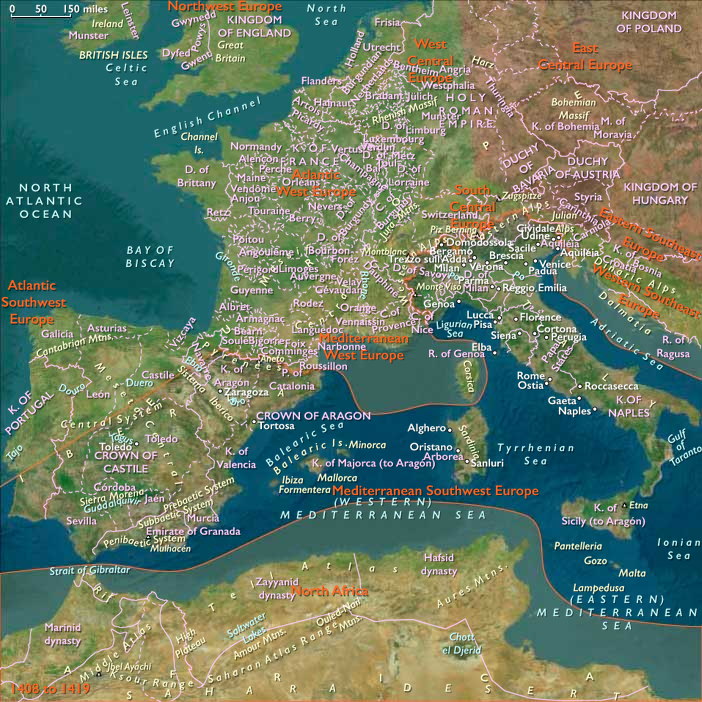
Mediterranean Southwest Europe
View →Related Events
No active filters.
Showing 10 events out of 42447 total
Burmese forces from Ava under King Minhkaung’s son, Crown Prince Minrekyawswa, invade the Pegu-controlled kingdom of Arakan in 1410 and depose the puppet ruler installed by King Razadarit, but suffer defeat by the Mons in the Irrawaddy River delta area.
Smolensk, although spared the ravages of the Mongol armies in 1240, had paid tribute to the Golden Horde, gradually becoming a pawn in the long struggle between Lithuania and the Grand Duchy of Moscow.
The last sovereign monarch of Smolensk was Yury of Smolensk; during his reign the city was taken by Vytautas the Great of Lithuania on three occasions: in 1395, 1404, and 1408.
After the city's incorporation into the Grand Duchy of Lithuania, some of Smolensk's boyars (e.g., the Sapiehas) move to Vilnius; descendants of the ruling princes (e.g., the Tatishchevs, Kropotkins, Mussorgskys, Vyazemskys) flee to Moscow.
With tens of thousands of people living here, Smolensk is probably the largest city in fifteenth-century Lithuania.
Three Smolensk regiments prove decisive during the Battle of Grunwald against the Teutonic Knights.
The Ottoman Interregnum continues into its second decade, as the sons of the late Sultan Bayezid fight for control of the empire.
Musa has the support of Wallachians and Serbs and Süleyman has the support of Constantinople, but the Serbs change sides and Musa is defeated in the Battle of Kosmidion on June 15, 1410.
Suleyman is a weak prince, however, and to the dismay of his partisans, he begins living in extravagance.
Taj-ud-Din Firuz collects a tribute payment and marries the daughter of the king of Vijayanagar under the peace made in 1410 between the kingdoms of Bahmani and Vijayanagar.
The situation in Dalmatia had been settled in 1408 by a truce with King Sigismund of Hungary.
At its expiry, Venice immediately invades the Patriarchate of Aquileia, and subjects Traù, …
…Split, …
…Durazzo and other Dalmatian cities.
The difficulties of Hungary allow the Republic to consolidate its Adriatic dominions.
Ottobono Terzi of Parma had seized Reggio nell’Emilia from the Visconti in 1405 but had been killed by Michele Attendolo, a cousin or a nephew of the more famous Muzio Attendolo Sforza, who had handed the city over to Nicolò III d'Este, Marquess of Ferrara; he had therefore become seignor of Reggio in 1409.
The city maintains a relative autonomy, however, with laws and coinage of its own.
The fighting master Fiore dei Liberi dedicates his treatise, the Fior di Battaglia (The Flower of Battle) to Niccolò III in 1410.
This manuscript, the third-oldest European fencing manual yet discovered and the most extensive from the Medieval period, is a large part of the foundation of modern attempts to rebuild the Western martial arts.
The Aragonese capture Oristano, capital of the Giudicato di Arborea in Sardinia.
William III of Narbonne, having returned to Sardinia in spring 1410, reorganizes his territories with his capital at Sassari.
With the help of Nicolò Doria, he recaptures Longosardo on August 9, and tries unsuccessfully to retake Oristano and …
…Alghero.