
Petrus Ramus had withdrawn from Paris but…
June 1547 CE
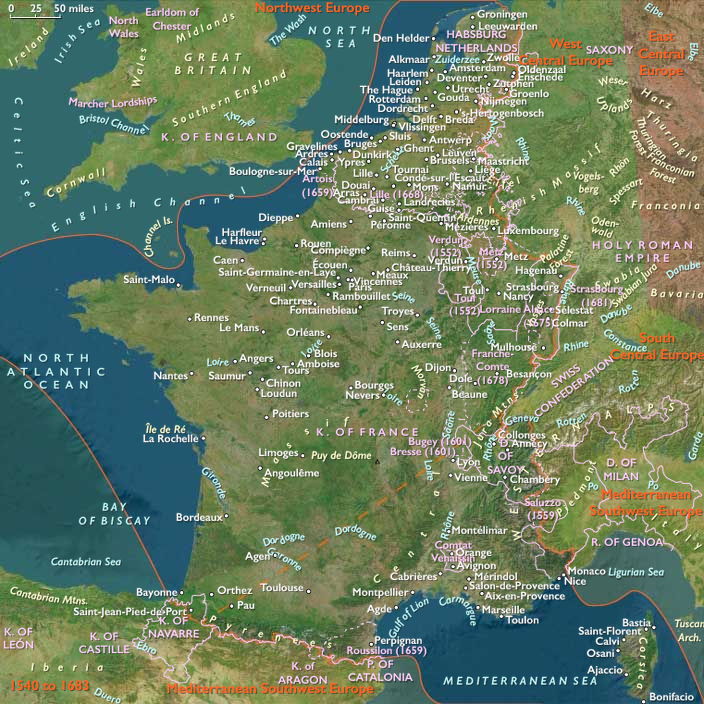
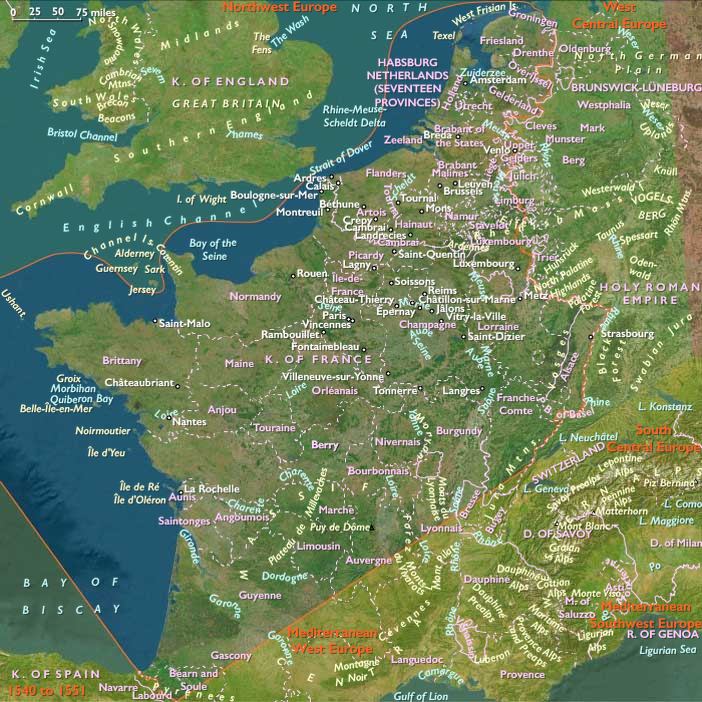
Petrus Ramus had withdrawn from Paris but soon afterwards returns, the decree against him being canceled by the new monarch, Henry II, through the influence of Charles, Cardinal of Lorraine.
The Sorbonne lifts its ban on his books and he obtains a position at the Collège de Navarre.
Locations
People
Topics
Subjects
Regions
West Europe
View →Subregions
Atlantic West Europe
View →Related Events
No active filters.
Showing 10 events out of 36484 total
Tabinshwehti makes Pegu his capital in 1547.
Seventeen-year-old Ivan IV is crowned, not as Grand Duke of Moscow (his father’s title), but as Tsar of all the Russias in 1547, thus underlining his claim to the succession of both Byzantium and the Golden Horde.
He is the first Russian ruler to be crowned tsar and to hold that official title (although the exact date that he assumes de facto control from the aristocracy is in dispute).
He marries Anastasia Romanov later in the year.
In this year also, thirteenth-century Russian prince and military leader Alexander Nevsky, canonized locally in Vladimir in 1380, is canonized generally by the Russian Orthodox church.
The city of Weimar, whose oldest record dates from the year 899, becomes important in 1547 as the capital of the Saxe-Weimar duchy.
Destined to become one of the great cultural sites of Europe, home to such luminaries as Bach, Goethe, Schiller, and Herder, it will become a site of pilgrimage for the German intelligentsia from the time Goethe first moves to Weimar in the late eighteenth century.
It will also give its name to the Weimar Republic, the period in German history from 1919-1933.
Emperor Charles V had determined in 1546 to destroy the power of the German Protestant princes, who have allied against him in the Schmalkaldic League.
The death of King Francis of France leaves Charles temporarily free to pursue this action.
Charles declares war from Regensburg, using as a pretext the Protestant princes’ refusal of his invitation to attend the ongoing Council of Trent.
Neither of the formidable imperial armies is near the emperor at this time, and the league’s forces could almost certainly overcome either, but the princes delay mobilization.
The Ottoman Turks, winning the current Austro-Turkish War, would prefer to continue their conquests, but hostilities cease.
The Porte signs with the Empire the Peace of Adrianople, thus ending in 1547 the war that had begun a decade earlier.
Limited to five years, the peace recognizes Ferdinand’s de facto rule over the Hungarian territory now held by him, in return for an annual tribute of thirty thousand gold ducats.
János II Sigismund Zápolya receives Transylvania and neighboring areas, together with the title “prince.” Emperor Charles V, the pope, France, and Venice are all signatories, heralding the acceptance by European powers of Turkish influence and power in European politics.
Bandinelli begins a choir screen in 1547 for the Duomo (Cathedral) of Florence.
Titian, now fifty-seven, had traveled in 1545 to Rome, where he had been received as a great celebrity and made a citizen of the city.
His triumphant reception had prompted him to paint Pope Paul III and his Grandsons, Cardinals Alessandro and Ottavio Farnese, in 1546.
The earliest modern book on checkers, known in England as draughts, is written by Antonio Torquemada and published in Valencia, Spain, in 1547.
Pier Luigi, who had taken possession of his new states on September 23, 1546, is infamous for his cruelty, ruthlessness and profligacy, and has been accused of violent homosexual acts against young men.
His firm rule and his taxes gain him the enmities of cities accustomed to the fair authority of the Popes.
Emperor Charles V, who aims to reunite Parma and Piacenza with the Duchy of Milan, supports the aristocracy, in particular, against him.
In 1547 a conspiracy against him by the counts Francesco Anguissola and Agostino Landi and the marquises Giovan Luigi Confalonieri and Girolamo and Alessandro Pallavicini.
After Anguissola and others stab him to death, the conspirators hang his body from a window of his palace in Piacenza.
Charles V's vicar Ferrante Gonzaga, who has served as served as Governor of the Duchy of Milan since 1546, captures the Duchy of Parma and Piacenza soon after.
Nicolas Gombert, one of the most famous and influential composers between Josquin Desprez and Palestrina, best represents the fully developed, complex polyphonic style of this period in music history.
While most composers of the next generation will not continue to write vocal music using Gombert's method of pervasive imitation, they will continue to use this contrapuntal texture in instrumental works.
Forms such as the canzona and ricercar are directly descended from the vocal style of Gombert; Baroque forms and processes such as the fugue are later descendants.
Gombert's music represents one of the extremes of contrapuntal complexity ever attained in purely vocal music.
Gombert vanishes from chapel records in 1540, during the height of his career.
According to contemporary physician and mathematician Gerolamo Cardano, writing in Theonoston (1560), Gombert had been convicted in 1540 of sexual contact with a boy in his care and was sentenced to hard labor in the galleys.
The exact duration of his service in the galleys is not known, but he was able to continue composing for at least part of the time.
Most likely he was pardoned sometime in or before 1547, the date he sent a letter along with a motet from Tournai to Charles' gran capitano Ferrante I Gonzaga.
The Magnificat settings preserved uniquely in manuscript in Madrid are often held to have been the "swansongs" that according to Cardano won his pardon; according to this story, Charles was so moved by these Magnificat settings that he let Gombert go early.
An alternative hypothesis (Lewis 1994) is that Cardano was referring to the highly penitential First Book of four-part motets; however, in neither case is it clear how Gombert was able to compose while rowing in the galleys as a prisoner.