Philip has by this time concluded that…
July 1579 CE
Philip has by this time concluded that the Netherlands revolution never would have developed had he supported his minister Antoine Perrenot de Granvelle, who has from 1565 been serving in Italy as viceroy of Naples (1571–75) and as president of the Council for Italy (1575–79).
Philip appoints him secretary of state, in which capacity he campaigns in 1579 against William and the Dutch Protestants.
The charming and well-connected Spanish courtier Antonio Pérez, an illegitimate son of Gonzalo Pérez, secretary of Philip's predecessor, the emperor Charles V, had quickly risen in Philip's service, becoming the king's secretary in 1568 and secretary of several of the royal councils.
Many of the grandees hate the upstart secretary, as do his rivals in the Spanish civil service.
The king's favor is unstable, and to safeguard himself, Pérez intrigues with all parties: with Philip II's half-brother Juan de Austria and his secretary, Juan de Escobedo, against the king; with the king against Juan de Austria; and perhaps even with the Netherlands rebels against both.
When Juan de Austria, then governor-general of the Netherlands, sent Escobedo to Spain in 1577 to plead for his plan to invade England and liberate and marry Mary, Queen of Scots, Pérez had feared the exposure of his own intrigues.
For this reason, it is thought, Pérez made several attempts to murder Escobedo.
Finally, he had persuaded the suspicious king that Escobedo was Juan de Austria's evil genius and was plotting treason.
The king had given his consent to the murder of Escobedo, and Pérez had organized his assassination by bravos on Easter Monday March 31, 1578.
However, Philip will never forgive Pérez for having forced his hand.
He has Pérez and the princess of Eboli arrested on July 28, 1579.
Pérez will remain in prison for the next eleven years, but all efforts to extract a full confession and incriminating documents from him will fail.
Locations
People
Topics
Commodities
Subjects
Regions
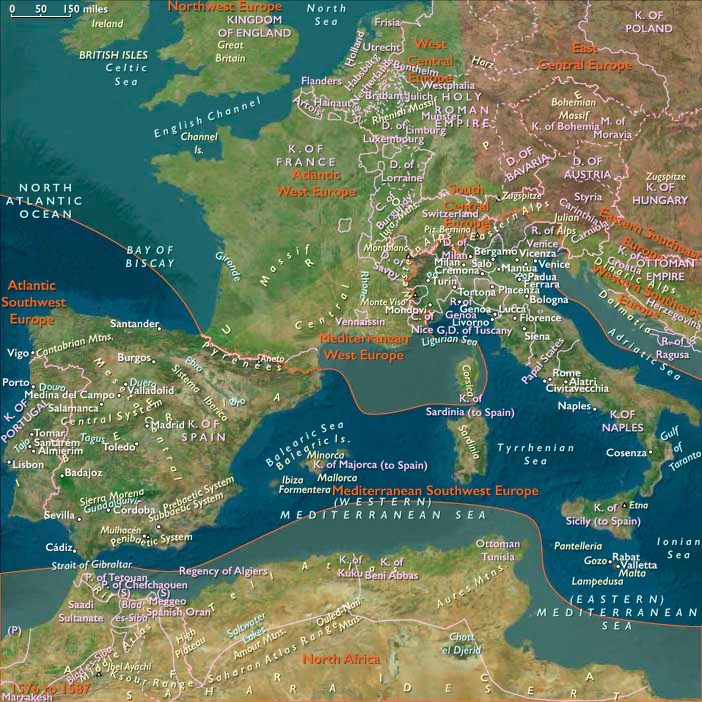
Southwest Europe
View →Subregions