
John II of Portugal: "The Perfect Prince"…
1492 CE
John II of Portugal: "The Perfect Prince" and His Legacy (1481–1495)
King John II of Portugal (r. 1481–1495) earned the nickname "the Perfect" (O Príncipe Perfeito) for his ruthless assertion of royal authority over the aristocracy, his patronage of the arts, and his commitment to overseas exploration, all of which contributed to Portugal’s prosperity and international dominance.
Strengthening Royal Authority and Crushing the Nobility
- John II curtailed the power of the Portuguese nobility, which had grown too strong under his father, Afonso V.
- He confiscated the vast estates of his rivals, particularly from the House of Bragança, Portugal’s wealthiest and most powerful noble family.
- Key events in his suppression of the nobility:
- 1483 – Fernando II, Duke of Bragança, was executed for treason, and his family’s wealth and lands were seized.
- 1484 – Diogo, Duke of Viseu, was personally stabbed and killed by John II in the palace after being accused of conspiring against the king.
- His policies secured absolute royal control, making the monarchy Portugal’s dominant institution.
Economic Growth and Urban Prosperity
- With the nobility weakened, John II focused on economic development, particularly benefiting the urban merchant class.
- The towns and cities of Portugal flourished under his rule, as the Crown invested in trade, maritime expansion, and infrastructure.
- The growth of Lisbon, Porto, and coastal trading hubs laid the foundation for Portugal’s global commercial empire.
Overseas Expansion: Patron of Exploration
- John II continued Prince Henry the Navigator’s vision, supporting exploration along the African coast and the search for a sea route to India.
- Major exploratory achievements during his reign:
- 1487 – Bartolomeu Dias rounds the Cape of Good Hope, proving that a sea route to India was possible.
- 1487 – Pêro da Covilhã reaches Ethiopia by land, gathering intelligence on Indian Ocean trade routes.
- 1494 – The Treaty of Tordesillas is signed with Spain, dividing the newly discovered world between Portugal and Spain, securing Portugal’s dominance in Africa, Asia, and Brazil.
The Admission of Spanish Jews (1492)
- After the expulsion of Jews from Spain in 1492 by Ferdinand and Isabella, John II allowed thousands of Jewish refugees to enter Portugal.
- Many of these Jews were skilled merchants, doctors, scholars, and financiers, contributing to Portugal’s intellectual and economic development.
- However, John II only permitted temporary residence, imposing high taxes and restrictions, and some Jewish children were forcibly sent to São Tomé, a Portuguese colony.
- His successor, Manuel I (r. 1495–1521), later forced mass conversions of Jews and Muslims in 1496, ending Portugal’s brief period of relative religious tolerance.
Legacy of John II: The Foundation of the Portuguese Empire
- His strengthening of the monarchy ensured Portugal became a centralized, absolute state, capable of leading the Age of Discovery.
- His focus on overseas expansion laid the foundation for Portugal’s Golden Age, making it the first European global empire.
- His reputation as a ruthless but visionary ruler remains, marking him as one of Portugal’s greatest kings.
John II’s reign secured Portugal’s position as a world power, shaping its political, economic, and maritime future for centuries to come.
Locations
People
Groups
Topics
Regions
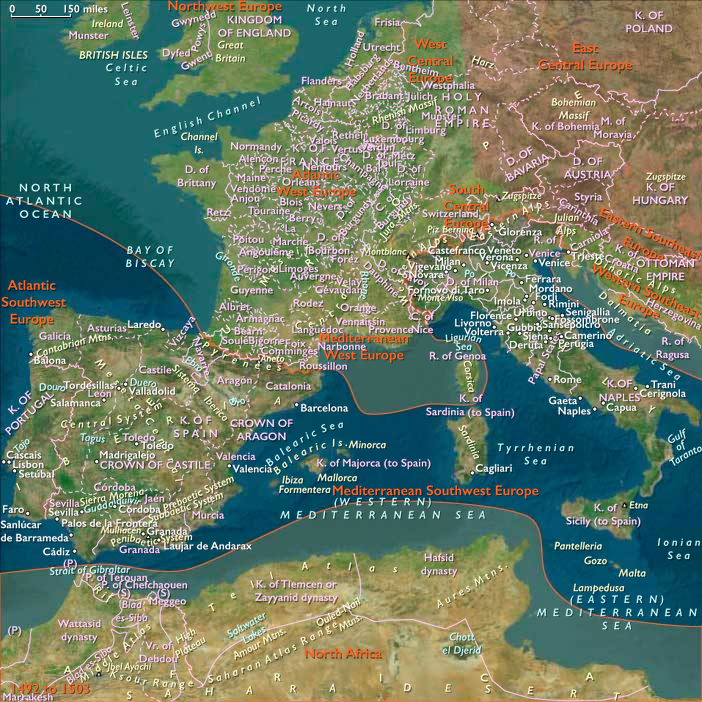
Southwest Europe
View →Subregions
