
Jacopo della Quercia completes the bronze relief…
1434 CE
Jacopo della Quercia completes the bronze relief and marble statues on the baptismal font in the Sienese Baptistery in 1434.
Locations
People
Regions
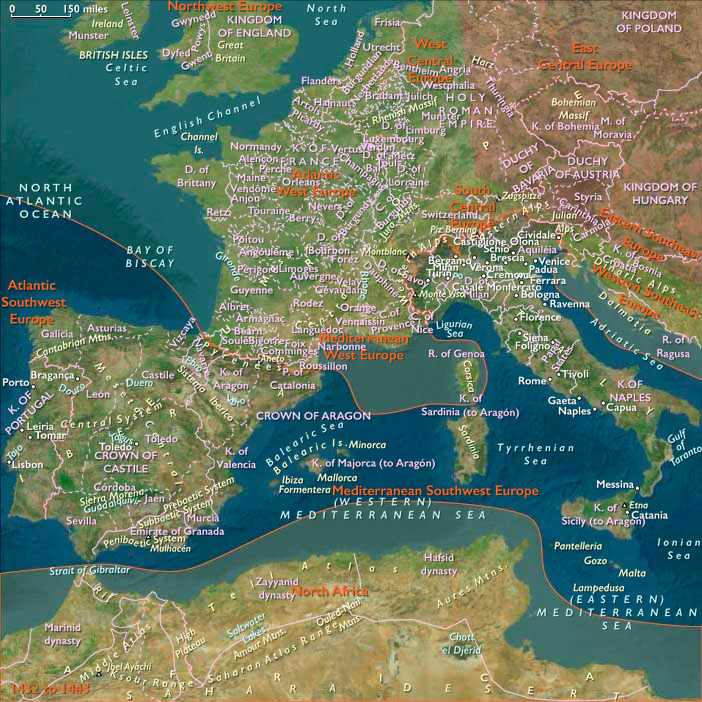
Southwest Europe
View →Subregions
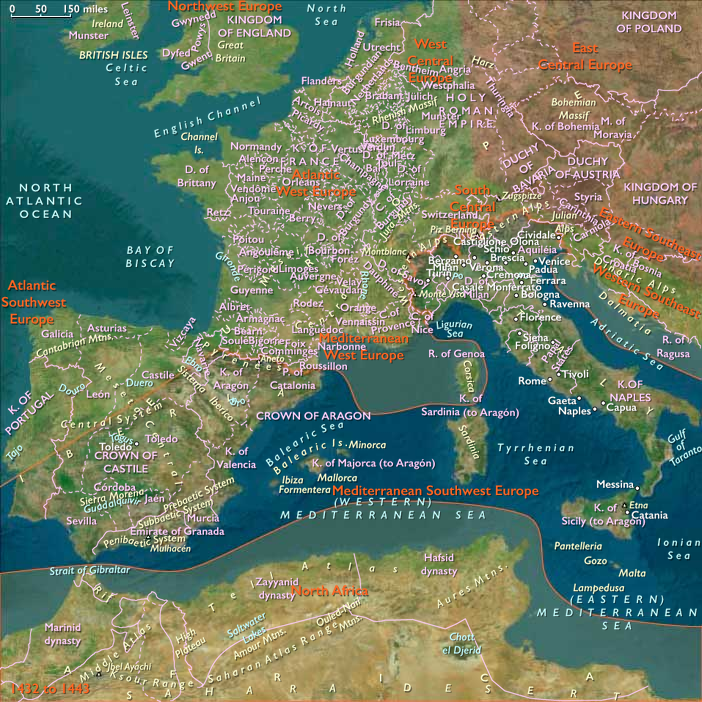
Mediterranean Southwest Europe
View →Related Events
No active filters.
Showing 10 events out of 41953 total
Longvek, situated at the confluence of the Mekong and Tonle Sap rivers, and settled during the fourteenth century, becomes the capital of the greatly diminished Khmer domains in about 1434 following the Thais’ capture and sack of Angkor.
The late Arakanese ruler Narameikhla is succeeded in 1434 by his son, Ali Khan, who has adopted a Muslim name.
The Ming Dynasty, turning inward, decommissions the Chinese navy in 1434.
This alteration of the balance of power in the Indian Ocean will make it easier for Portugal and other Western naval powers to gain dominance over the Eastern seas.
Korea’s Yi dynasty in 1434 orders the casting in bronze of another font, the set consisting, like others cast since the first in 1403, of one hundred thousand pieces of type; this event precedes Europe’s imminent discovery of typography.
Yury, feeling the insecurity of his throne, resigns and then leaves Moscow for his northern hometown.
Yuri’s sons Vasily the Cross-Eyed and Dmitry Shemyaka continue the struggle and manage to defeat Vasili, who has to seek refuge in the Golden Horde.
After the death of Yuri in 1434, Vasily the Cross-Eyed enters the Kremlin and is proclaimed the new Grand Duke.
Dmitry Shemyaka, who has his own plans for the throne, quarrels with his brother and concludes an alliance with Grand Prince Vasily.
Erik, facing internal revolts in Sweden and Norway, concludes separate peace agreements in 1434 with Holstein and the Hanseatic League.
King Eric in 1434 builds Malmö Castle; this structure will be demolished in the early sixteenth century.
Prokop, in 1434, embraces the more militant, antifeudal, peasant-worker (Taborite) branch of the Hussite movement, who in 1420 had given the biblical name of Tabor (Czech: Tábor) to their fortified settlement south of Prague.
Like their more moderate coreligionists, the Utraquists, they are strict biblicists and insisted on receiving a Eucharist of both bread and wine, though they deny transubstantiation and the Real Presence.
Nicholas of Pelhrimov, first bishop of the Taborites, heads an independent church that has replaced Latin with Czech in the liturgy, allowed married clergy, and rejected all the sacraments except Baptism and the Eucharist.
The Taborites' military campaigns and their destruction of churches, which had taken place under the leadership of Prokop the Lesser and the late Jan, Count Zizka, have aroused widespread animosity.
The Sirotci ("Orphans"; German: Waisen), officially Orphans' Union, are followers of a radical wing of the Hussites in Bohemia.
This force, founded in 1423 originally under the name Lesser Tábor, consists mostly of poorer burghers and some members of lower aristocracy, who had joined with and the eastern Bohemian Hussites, the so-called Orebites (Orebité).
After Žižka's death in 1424, the "orphaned" combatants adopted their new name.
From 1424 till 1428 they had been led by the priest Ambrož of Hradec, subsequently by another priest, Prokop the Lesser.
Hejtman Jan Čapek of Sány had been elected as their military commander in 1431.
When, after a brief peace following the convening of the Council of Basel, a united Utraquist and Romanist force from the old part of Prague seizes control of the more radical “new town,” Prokop Holý seeks, with the aid of Prokop the Lesser, to regain it but both generals are killed, together with other Taborite leaders, in at the ensuing Battle of Lipany on May 30, 1434.
As a consequence of the battle, the Taborite army is markedly weakened, and the Orphans virtually cease to exist as a military force.
Wladyslaw II Jagiello, Grand Duke of Lithuania and King of Poland, has joined two states that have become the leading power of eastern Europe.
In Poland, the nobility has strengthened its position, especially during the latter part of Wladyslaw's reign, and Wladyslaw has been unable to win the burghers to his side and use them politically as a counterweight to the nobles.
In questions of national religion the king has showed resoluteness, particularly in his attempt to suppress the Polish followers of Jan Hus.
Continually, he has played his hand cautiously: although he had supported the Hussites during the decade of the 1420s in their struggle against King Sigismund of Bohemia and Hungary, for example, he had refrained from intervention.
Wladyslaw, who dies on May 31/June 1, 1434, ends his reign with good relations between Poland and Hungary.
His eldest son, ten years old, succeeds him as Wladyslaw III.
Duke Amadeus VIII of Savoy retires after forty-two years on the throne to a monastery at Ripaille, near Geneva, in 1434.
His retirement is only partial, however, and he continues to exercise power, with his son Louis (Ludovico) acting as his lieutenant.
During this period Amadeus' daughter Margherita is betrothed to Louis III of Anjou, pretender to the throne of Naples.
When Louis dies suddenly in 1434, Amadeus briefly claims Naples for Margherita but in the end abandons the kingdom to Alfonso V of Aragon.