Sigismondo Pandolfo was born in Brescia, northern…
1450 CE
Sigismondo Pandolfo was born in Brescia, northern Italy, the elder of the two illegitimate sons of Pandolfo III Malatesta and Antonia da Barignani.
His younger brother, Malatesta Novello, was born in Brescia on August 5, 1418.
An elder (and also illegitimate) half-brother, Galeotto Roberto Malatesta, born in 1411, was the issue of the relationship of their father Pandolfo III with Allegra de' Mori.
Following the family's tradition, Sigismondo, after the death of his father, had debuted as man-at-arms at the age of thirteen against his relative Carlo II Malatesta, lord of Pesaro and Pope Martin V's ally, who aimed to annex Rimini, Cesena and Fano to his territories.
After his victory, Sigismondo had obtained, together with his brothers Galeotto Roberto and Domenico, the title of Papal vicar for those cities.
In 1431, albeit with inferior forces, he had repelled another invasion by the Malatestas of Pesaro.
When, soon afterwards, his elder brother abdicated, he became lord of Rimini, at the age of fifteen.
In 1432, he had accepted the command of a papal corps, defeating the Spanish condottiero Sante Cirillo and thwarting Antonio I Ordelaffi's attempt to capture Forlì (1435–36).
However, the following year Sigismondo occupied the papal city of Cervia and was excommunicated; he was soon pardoned and created commander of the papal army.
Later, he fought in Romagna and the Marche alongside Francesco Sforza.
In the meantime he married his niece Ginevra d'Este, Niccolò III's legitimate daughter by his second wife Parisina Malatesta, first cousin of Sigismondo.
On October 12, 1440, she died, and rumors spread that she had been poisoned by Sigismondo.
Two years later, he married Polissena Sforza, Francesco I's illegitimate daughter; they had two children: a son, Galeotto, born in 1442 and who only lived a few months, and a daughter, Giovanna, born in 1444 and later Duchess of Camerino by marriage.
In this period, he had fought several times against the condottiero Niccolò Piccinino: first, in 1437, as a Venetian commander, he was defeated at Calcinara sull'Oglio.
Later, while defending his lands from the papal invasion army led by Piccinino, Federico III da Montefeltro and Malatesta Novello, he had crushed them at Monteluro, managing to obtain some territories of Pesaro, although the latter was successfully defeated by Federico's forces.
In his restlessness, he had betrayed Sforza twice, but he also betrayed his momentary ally against him, Niccolò Piccinino.
Enmity against Sforza had turned into true hatred when his father-in-law bought the signory of Pesaro from Carlo Malatesta.
Therefore, Sigismondo had allied with Pope Eugene IV and the Sforza duke of Milan.
Later, he was hired by King Alfonso V of Naples, but soon afterwards received money for a condotta to be spent in the service of Florence against Alfonso.
In 1445, he had forced the Neapolitans to raise the siege of Piombino in Tuscany.
His second wife Polissena had died under mysterious circumstances in 1449.
Francesco Sforza claims that Sigismondo had had her drowned by one of his servants, but this has remained unconfirmed.
During his two marriages, he has had numerous mistresses, but only two are well known: Vannetta dei Toschi, who bore him a son, Roberto, in 1441, and Isotta degli Atti, who bore him four children: Giovanni (who died in infancy), Margherita (later wife of Carlo di Fortebraccio), Sallustio and Antonia (also called Anna), later the first wife of Rodolfo Gonzaga, Lord of Castiglione delle Stiviere, who will behead her in 1483 when she is discovered in adultery.
Sigismondo commissions Leon Battista Alberti to redesign the exterior of the church of San Francesco in Rimini as a shrine to the Malatesta court members and family.
Now known as the Tempio Malatestiano (Malatesta Temple), it bears the date 1450.
Images
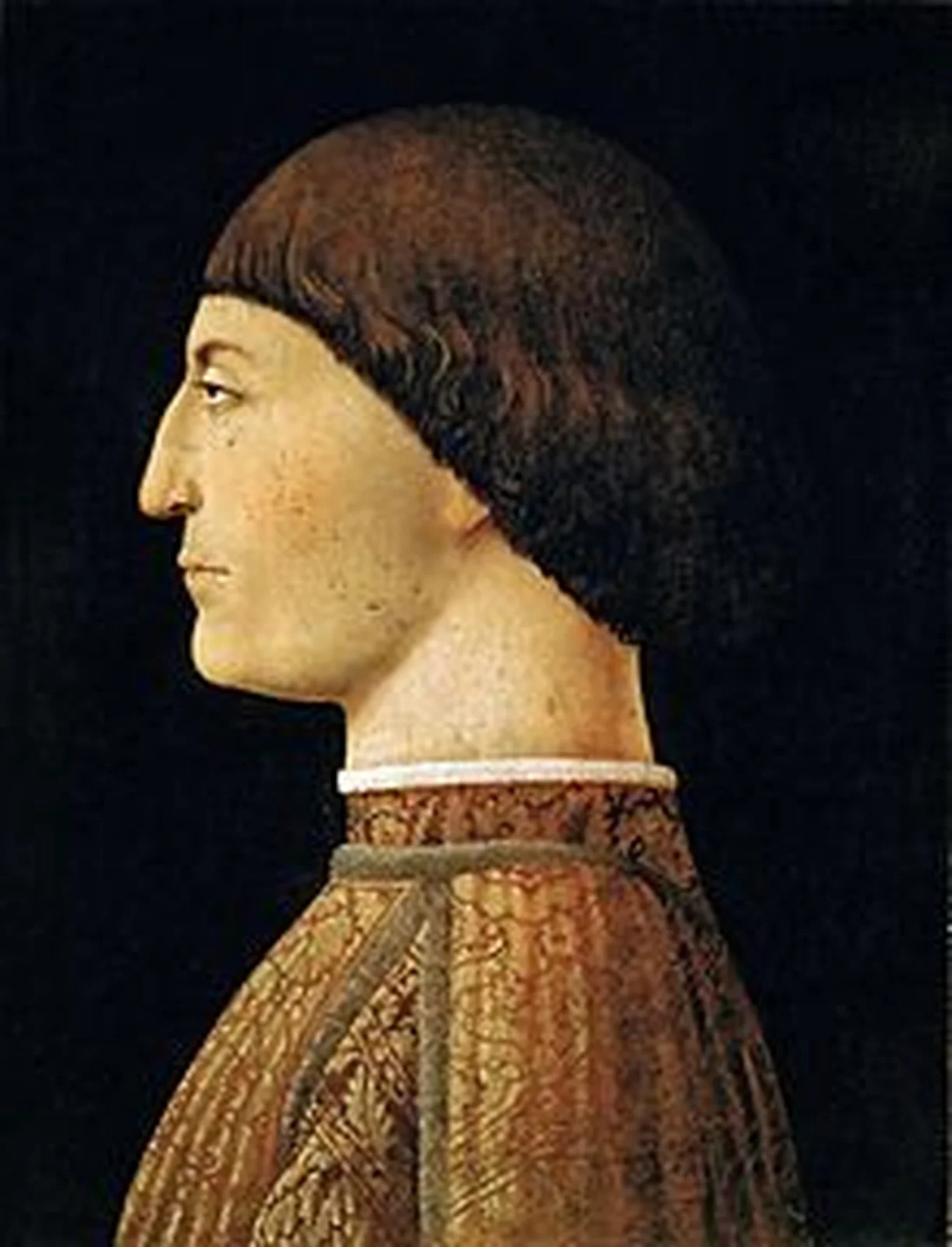
Portrait of Sigismondo Pandolfo Malatesta called the Wolf of Rimini, by Piero della Francesca, c. 1450, Louvre
Locations
Groups
Topics
Commodities
Regions
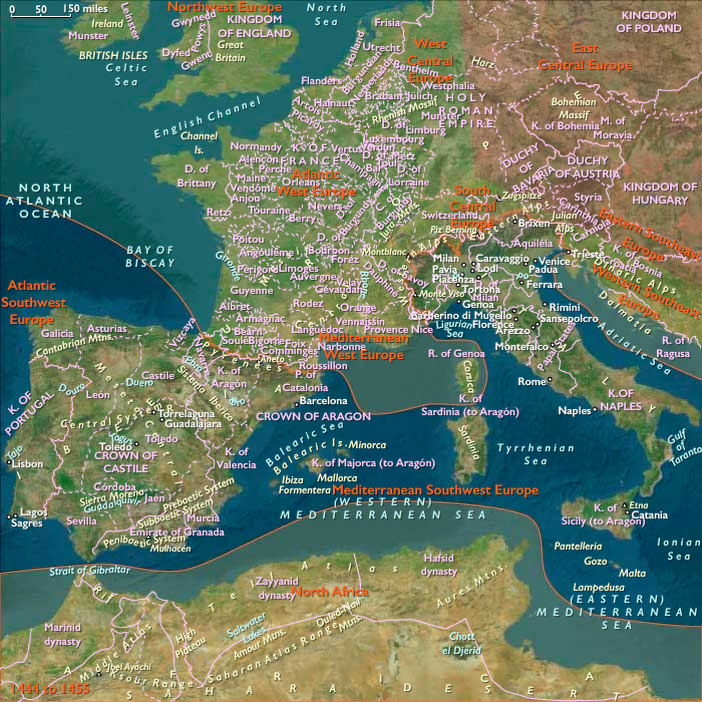
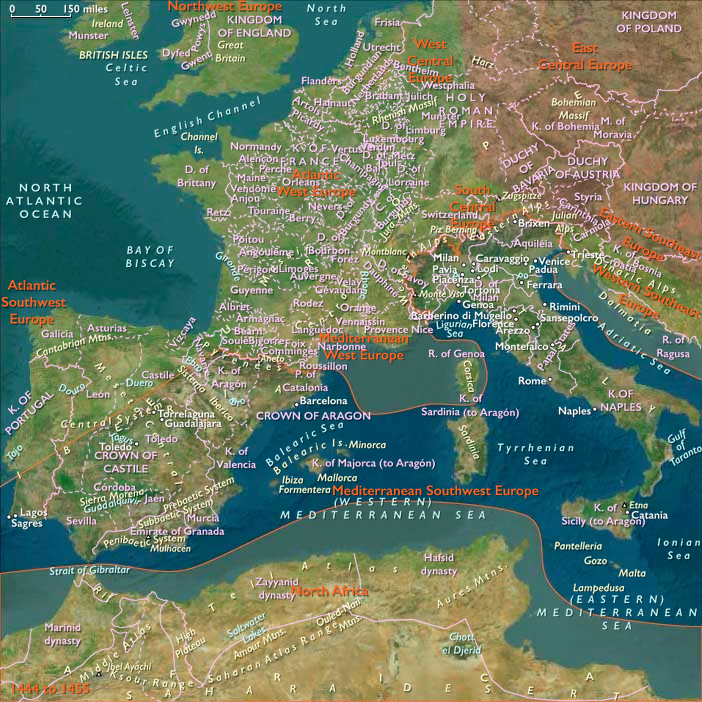
Southwest Europe
View →Subregions