Skara Brae, occupied from roughly 3180 BCE…
3213 BCE to 3070 BCE
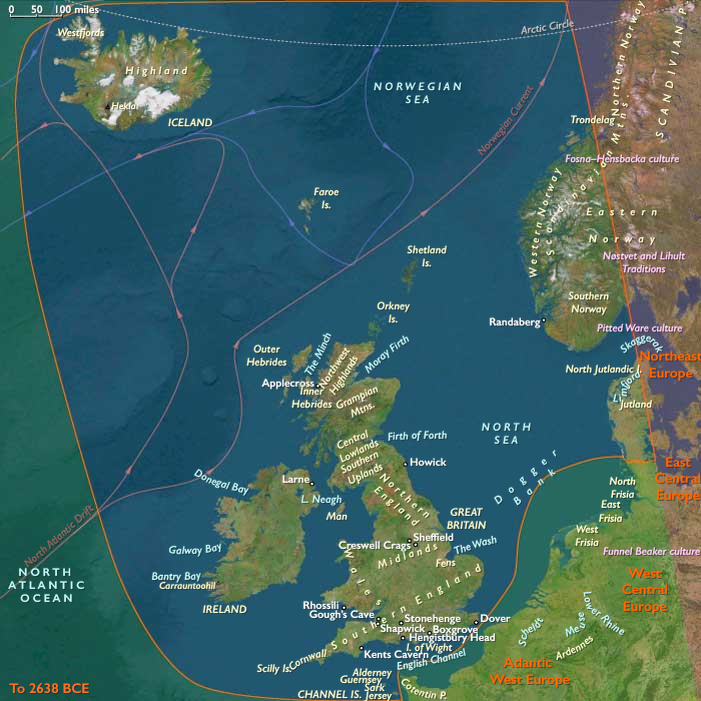
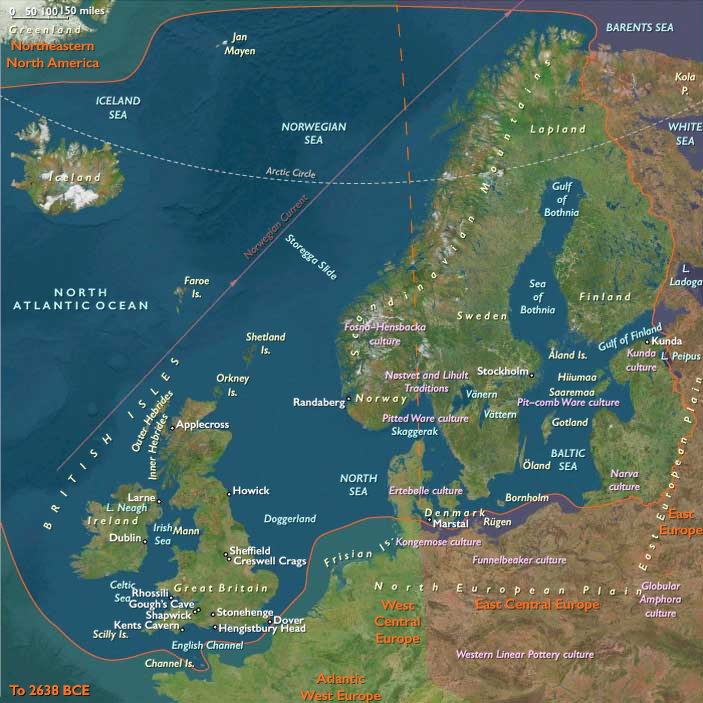
Skara Brae, occupied from roughly 3180 BCE to 2500 BCE, is a large stone-built Neolithic settlement, located on the Bay of Skaill on the west coast of Mainland, Orkney, Scotland, consists of ten clustered houses.
Skara Brae's inhabitants are apparently makers and users of grooved ware, a distinctive style of pottery that had appeared in northern Scotland not long before the establishment of the village.
The houses used earth sheltering but, being sunk into the ground, they are built into mounds of preexisting domestic waste known as "middens.” Although the midden provides the houses with a small degree of stability, its most important purpose is to act as a layer of insulation against Orkney's harsh winter climate.
On average, the houses measure forty square meters (four hundred and thirty square feet) in size with a large square room containing a hearth that would have been used for heating and cooking.
Given the number of homes, it seems likely that no more than fifty people lived in Skara Brae at any given time.
It is unclear what fuels the inhabitants used in the stone hearths.
A detailed analysis of vegetation patterns and trends suggests that climatic conditions conducive to the development of thick beds of peat did not develop in this part of Orkney until after Skara Brae was abandoned.
Other obvious possible fuel sources include driftwood and animal dung, but there vis evidence that dried seaweed may have been a significant source.
At a number of sites in Orkney, investigators have found a glassy, slag-like material called "cramp" that may be the residue of burnt seaweed.
The dwellings contain a number of stone-built pieces of furniture, including cupboards, dressers, seats, and storage boxes.
Each dwelling was entered through a low doorway that had a stone slab door.
A sophisticated drainage system was even incorporated into the village's design, one that included a primitive form of toilet in each dwelling.
Seven of the houses have similar furniture, with the beds and dresser in the same places in each house.
The dresser stands against the wall opposite the door, and would have been the first thing seen by anyone entering the dwelling.
Each of these houses has the larger bed on the right side of the doorway and the smaller on the left.
Lloyd Laing noted that this pattern accorded with Hebridean custom up to the early twentieth century suggesting that the husband's bed was the larger and the wife's was the smaller.
The discovery of beads and paint-pots in some of the smaller beds may support this interpretation.
Additional support may come from the recognition that stone boxes lay to the left of most doorways, forcing the person entering the house to turn to the right-hand, 'male', side of the dwelling.
At the front of each bed lie the stumps of stone pillars that may have supported a canopy of fur, another link with recent Hebridean style.
Locations
Topics
Commodities
Subjects
Regions
North Europe
View →Subregions