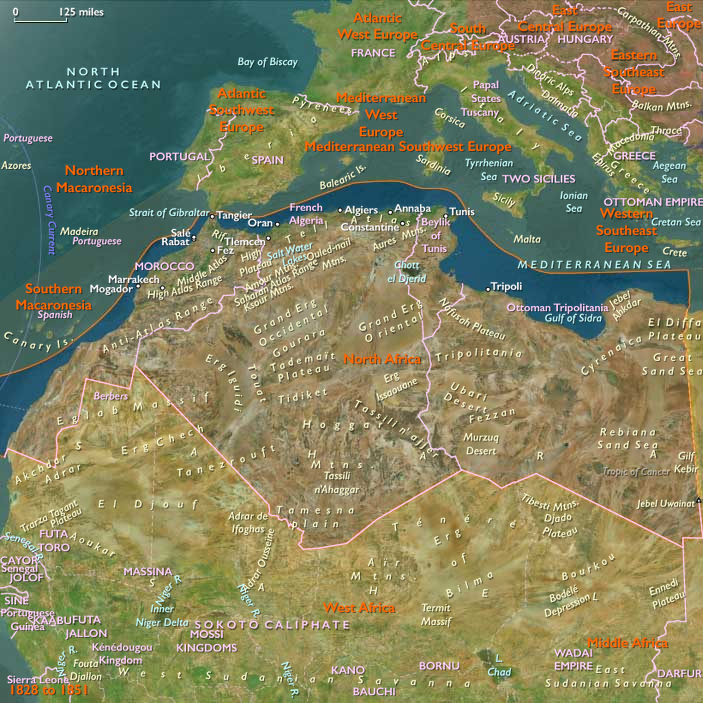
Algeria's European settlers—called colons (colonists) or, more…
1840 CE to 1851 CE
Algeria's European settlers—called colons (colonists) or, more popularly, pieds noirs (literally, black feet)—are largely of peasant farmer or working-class origin from the poor southern areas of Italy, Spain, and France.
Others are criminal and political deportees from France, transported under sentence in large numbers to Algeria.
In the 1840s and 1850s, to encourage settlement in rural areas official policy is to offer grants of land for a fee and a promise that improvements will be made.
A distinction soon develops between the grands colons (great colonists) at one end of the scale, often self-made men who have accumulated large estates or built successful businesses, and the petits blancs (little whites), smallholders and workers at the other end, whose lot is often not much better than that of their Muslim counterparts.
According to historian John Ruedy, although by 1848 only fifteen thousand of the one hundred and nine thousand European settlers are in rural areas, "by systematically expropriating both pastoralists and farmers, rural colonization was the most important single factor in the destructuring of traditional society."
Locations
Groups
Regions
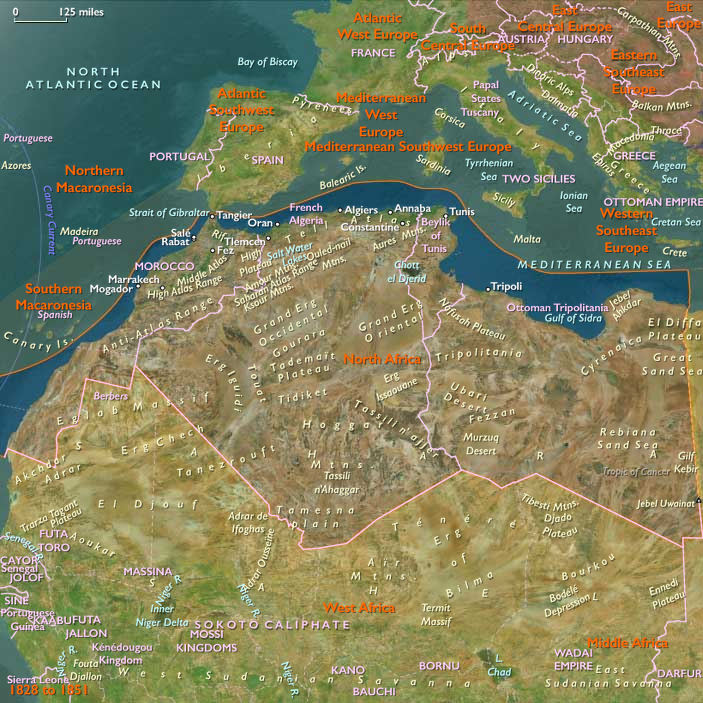
North Africa
View →Subregions