Event
Southern Macaronesia (820–2019 CE): Islands of Isolation,…
Southern Macaronesia (820–2019 CE): Islands of Isolation, Atlantic Exchange, Migration, and Environmental Constraint
Geographic and Environmental Setting
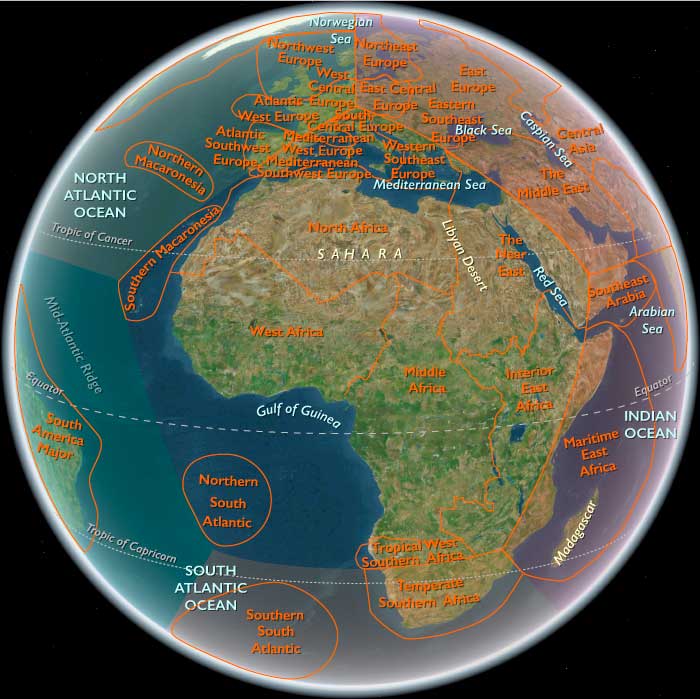
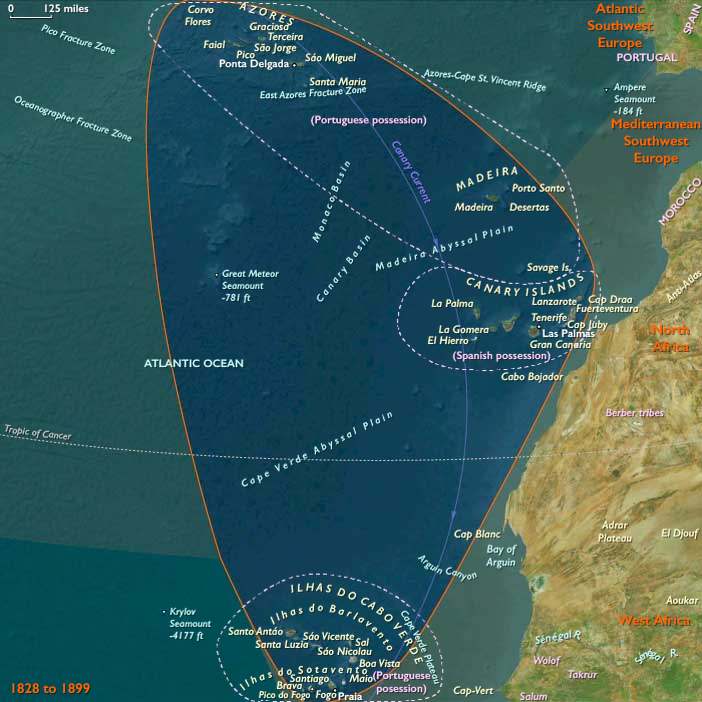
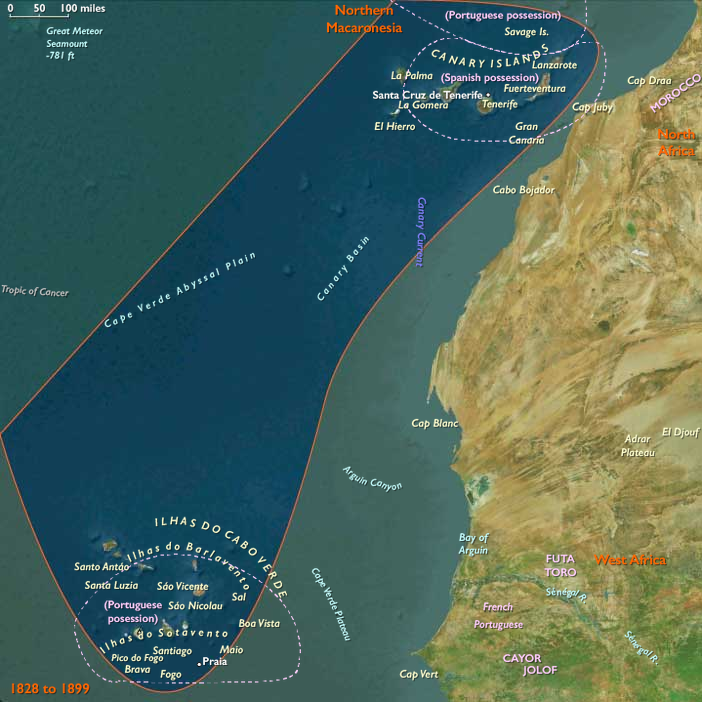
Southern Macaronesia comprises the Canary Islands and Cape Verde, two volcanic archipelagos lying off the western African coast but separated by hundreds of kilometers and by markedly different climatic regimes. The Canaries combine rugged volcanic massifs, ravines, lava fields, cloud-fed northern slopes, surviving laurel forest, highland pasture, dry southern and eastern lowlands, and narrow zones of cultivable soil. Cape Verde is generally hotter and drier, with steep volcanic islands such as Santo Antão and Fogo contrasting with low, arid islands such as Sal, Boa Vista and Maio. Across both archipelagos, northeast trade winds, ocean currents, elevation and rain-shadow effects produced extreme local differences in moisture and productivity.
These environments remained the fundamental structure beneath every later political and economic system. Water availability, cultivable volcanic soil, pasture, fisheries, sheltered anchorages and exposure to drought repeatedly determined where people settled and what kinds of economy could endure. Even when the islands became major Atlantic waypoints, neither archipelago escaped the ecological limitations imposed by small land area, fragmented terrain and highly uneven rainfall.
Indigenous Canarian Worlds and the Long Isolation, 820–c. 1350
At the opening of the epoch, the Canary Islands had already been inhabited for centuries by populations ultimately derived principally from Northwest African Amazigh communities. Cape Verde, by contrast, remained uninhabited.
The indigenous Canarian population did not form a single homogeneous society. Communities on individual islands developed increasingly distinct political, linguistic, economic and ritual traditions as prolonged isolation reduced communication both with mainland Africa and among the islands themselves. Farming was strongest where soils and moisture permitted cultivation of barley, wheat, legumes and other introduced crops, while goats, sheep and pigs supported pastoral economies adapted to steep slopes, highland grazing and dry terrain. Fishing, shellfish collecting and the gathering of wild plants supplemented cultivated and pastoral foods.
Settlement likewise varied. Natural caves were extensively used on some islands, while stone houses, storage facilities, corrals and other structures occurred elsewhere. Ravines, springs, upland pastures and cultivable basins organized local movement. Stone, bone and wood replaced metal for tools, while pottery, basketry, leatherworking and grain processing formed important household technologies.
Political authority remained locally embedded. Rather than an archipelago-wide polity, the Canaries contained separate island societies, some of which were themselves divided into territorial communities or chiefly units. Control of grazing, agricultural land and water intersected with kinship, status and ritual authority.
Religious landscapes were equally diverse. Mountains, caves, springs, burial places and rock-art sites carried ritual significance, but practices differed substantially by island. The indigenous societies of the Canaries were therefore united less by a single “Guanche culture” than by common North African ancestry followed by centuries of divergent adaptation to individual volcanic islands.
Renewed Atlantic Contact and the End of Isolation, c. 1350–1496
During the later Middle Ages, the Canaries gradually reentered the maritime knowledge of Mediterranean Europe. Fourteenth-century voyages initiated a new era of external contact after centuries in which archaeological evidence indicates very little sustained communication with Africa or neighboring islands.
From 1402, European conquest became systematic. The process unfolded unevenly across the archipelago and lasted nearly a century, ending with the Castilian conquest of Tenerife in 1496. Warfare, enslavement, epidemic disease, land seizure and forced political incorporation severely reduced and displaced indigenous populations. Yet conquest did not eliminate Canarian ancestry or all indigenous practice. Survivors entered colonial households and rural communities, and indigenous knowledge of grazing, terrain, crops and water continued beneath the developing Castilian order.
The conquest reorganized the productive landscape. European livestock, crops, property systems, churches, ports and commercial estates expanded, while sugar cultivation became an important export system on suitable islands. The islands also became provisioning and staging points for Iberian movement toward West Africa and, after 1492, the Americas.
At approximately the same historical moment, the previously uninhabited Cape Verde Islands entered permanent human history. Portuguese-sponsored navigators encountered the archipelago around 1460–62, and settlement began on Santiago. Ribeira Grande developed as the earliest major colonial settlement, while Fogo and several other islands acquired smaller populations.
Cape Verde's settlement was inseparable from Portuguese expansion along the Upper Guinea coast. Europeans, enslaved Africans and eventually free African and mixed communities created a new island society. Enslaved Africans supplied local labor but were also trafficked through Cape Verde into wider Atlantic markets. Cotton cultivation and cloth production, food agriculture, livestock and maritime commerce connected the islands directly with mainland West Africa.
Atlantic Island Societies, 1500–1683
During the sixteenth and seventeenth centuries the two archipelagos became deeply embedded in the Atlantic economy, but in different ways.
In the Canaries, the first colonial sugar boom diminished as larger and cheaper plantation systems expanded elsewhere in the Atlantic. Vineyards, cereals, livestock and diversified farming gained importance, while Canary wines became significant exports. Irrigation channels, terraces, cisterns and wells allowed farmers to exploit sharply differentiated volcanic slopes. Las Palmas, Santa Cruz de Tenerife and other ports became maritime nodes without erasing the overwhelmingly rural productive landscape behind them.
Colonial society incorporated European settlers, surviving indigenous Canarians and people of African origin. Catholic institutions became widespread through parishes, shrines, confraternities and festivals, while older practices and local customs were absorbed unevenly into new island identities.
Cape Verde became still more directly connected to the forced movement of people across the Atlantic. Ribeira Grande developed into an important node linking Portugal, Upper Guinea, Brazil and other Atlantic destinations. Enslaved labor sustained households and agriculture as well as commerce, while African and Iberian populations generated an increasingly distinctive Creole society. The emerging Kriolu language, local Catholic institutions, African-derived social practices, craft traditions and maritime occupations produced one of the earliest durable Creole cultural landscapes of the Atlantic world.
This integration brought vulnerability as well as opportunity. Foreign privateers attacked exposed ports; trade routes shifted; and Cape Verde's irregular rainfall repeatedly threatened harvests. The islands' growing Atlantic significance therefore rested on fragile local ecologies.
Wine, Provisioning, Drought, and Migration, 1684–1827
From the later seventeenth through early nineteenth centuries, neither archipelago ceased to be an Atlantic waypoint, but the structure of exchange changed.
Canarian agriculture relied heavily on vineyards, cereals, orchards, potatoes, maize and livestock, with wine remaining a major export. Agricultural terraces climbed suitable valleys and hillsides while dry islands retained extensive pastoral and grain-producing landscapes. Ports provisioned ships moving between Europe, Africa and the Americas, and Canarian migrants increasingly participated in Spanish Atlantic settlement, particularly in the Caribbean and Venezuela.
Cape Verde faced a harsher environmental history. Rain-fed maize, beans, livestock and small irrigated gardens could sustain communities during favorable years, but recurrent drought periodically destroyed harvests. Famine, mortality and movement became recurring features of island life. Households responded through herding, fishing, salt production, local exchange and migration, gradually making mobility itself an important strategy of resilience.
The Atlantic slave trade remained part of Cape Verde's economy, although the archipelago's relative commercial importance changed as larger Atlantic ports and trading networks developed elsewhere. Creole communities nonetheless deepened their local identities while remaining closely connected to the wider Lusophone Atlantic.
By 1827 the central historical contrast was clear: the Canaries had developed a diversified colonial export and provisioning economy under Spain, while Cape Verde had become a Portuguese Creole archipelago whose maritime connections were increasingly vital precisely because its agricultural ecology remained precarious.
Steam, Export Agriculture, and Diaspora, 1828–1971
The nineteenth century introduced a new organizing system: industrial-era Atlantic transportation.
In the Canaries, commercial cultivation of cochineal insects on prickly pear cactus expanded rapidly from the 1830s and created a major export boom. Its collapse later in the century, accelerated by the rise of synthetic dyes, encouraged another round of agricultural adjustment. Bananas, tomatoes, potatoes, wine and other produce entered expanding European markets. Free-port arrangements strengthened the commercial importance of Las Palmas and Santa Cruz de Tenerife, while steamship traffic increasingly tied the islands to Europe, West Africa and the Americas.
Ports, warehouses and packing facilities grew, but older terraces, livestock, fishing communities and household agriculture remained extensive. British commercial and shipping connections became particularly influential in export agriculture and port services.
Cape Verde entered the steam age through a different niche. Porto Grande at Mindelo became an important nineteenth-century coaling, provisioning and communications station. Telegraph cables and steamship routes temporarily transformed São Vicente into a strategic Atlantic service node even though most islands remained agricultural and pastoral.
Environmental insecurity remained severe. Cape Verde suffered devastating nineteenth- and twentieth-century droughts and famines. Migration became a structural component of household survival. Cape Verdeans joined North Atlantic vessels and whaling fleets, established communities in New England, moved through Portuguese African territories and later migrated increasingly toward Europe. Remittances joined fishing, farming and port labor as basic supports of island households.
The twentieth century intensified political and economic divergence. The Canaries remained Spanish, passing through dictatorship, civil conflict and Francoist rule. Roads, ports, electricity and aviation expanded. From the 1950s and especially the 1960s, air travel and Northern European tourism began transforming selected coastal districts, although agriculture and older settlements persisted away from resort corridors.
Cape Verde remained under Portuguese colonial rule. The catastrophic famines of the 1940s exposed the weakness and inequities of colonial administration, while migration continued to drain and support island communities simultaneously. Anticolonial nationalism developed through the wider Portuguese Guinean and Cape Verdean struggle during the 1950s and 1960s.
By 1971 both archipelagos had become deeply interconnected with the modern Atlantic, but neither had escaped its older ecological structure: limited freshwater, rugged terrain, small cultivable areas and strong dependence on external movement.
Independence, Autonomy, Tourism, and Water Stress, 1972–2019
The final age brought a fundamental political transformation in Cape Verde and an equally profound economic transformation in both archipelagos.
Cape Verde became independent from Portugal in 1975. The new state inherited chronic drought, limited cultivable land, weak infrastructure and a population dispersed across a large diaspora. Government, overseas assistance and remittances initially played major roles in sustaining development. Multiparty democracy emerged in the early 1990s, after which political power transferred peacefully through elections.
Transport, education, health services, electricity and communications expanded substantially. Praia grew as the political and demographic center, while Mindelo remained an important cultural and maritime city. Fishing, small-scale agriculture, livestock and remittance-supported household economies continued, but tourism became increasingly important from the 1990s, particularly on Sal and Boa Vista. Airports, hotels and coastal service settlements expanded on selected islands rather than evenly across the archipelago.
The Canary Islands, meanwhile, became an autonomous community of democratic Spain and subsequently an outermost region of the European integration system. The economy shifted decisively toward services and mass tourism. Large resort corridors developed on the warmer southern coasts of Tenerife and Gran Canaria and on Lanzarote and Fuerteventura, while aviation, highways, ports, apartment districts and urban expansion transformed formerly rural areas.
Yet tourism never erased older productive landscapes. Banana plantations, vineyards, potatoes, tomatoes, goat herding, fishing, terraces and historic villages remained embedded between expanding metropolitan and resort systems. Migration also changed direction: islands historically associated with emigration became destinations for mainland Spanish, European, African and Latin American migrants.
The greatest continuing constraint remained water. Population growth, intensive agriculture and mass tourism increased demand while rainfall remained highly uneven. Reservoirs, groundwater extraction and especially seawater desalination became essential components of modern island infrastructure. Cape Verde confronted the same basic problem under even greater aridity, combining wells, reservoirs, irrigation projects and desalination with continuing dependence on food imports.
Environmental consciousness grew alongside development. Protected volcanic landscapes, marine ecosystems, surviving laurel forests and endemic species acquired new institutional protection. Tourism itself increasingly depended upon landscapes whose expansion it could threaten. Soil erosion, aquifer pressure, urbanization, habitat loss, invasive species, wildfire and climate variability therefore became part of the same historical system as conservation and ecological restoration.
Legacy of the Age
Across the twelve centuries from 820 to 2019, Southern Macaronesia moved through an extraordinary reversal of connectivity.
The Canary Islands began the epoch as a set of deeply isolated indigenous island societies whose North African ancestry had developed into distinct local cultures. Cape Verde began with no permanent human population at all. From the fourteenth and fifteenth centuries onward, Iberian maritime expansion pulled both archipelagos abruptly into an Atlantic system of conquest, settlement, commerce, slavery and migration.
Yet incorporation never erased environmental constraint. Sugar, wine, cotton, livestock, grain, cochineal, bananas, tomatoes, coal bunkering, shipping, migration and tourism succeeded one another because island societies repeatedly adjusted productive systems to changing external markets and fragile local ecologies. Cape Verde's droughts made migration and remittances structural features of society; Canarian water scarcity generated increasingly elaborate irrigation and, eventually, desalination. Volcanic terrain continually shaped settlement, agriculture and transport in both archipelagos.
By 2019 Southern Macaronesia had become one of the Atlantic world's clearest landscapes of historical layering. Indigenous Canarian ancestry survived beneath Spanish colonial and modern identities. Cape Verde transformed an involuntary Atlantic crossing point into an independent Creole nation sustained partly by its diaspora. Ports evolved from sailing anchorages into steamship stations, container terminals and airport-linked service economies. Terraces, goat paths, fishing grounds and old villages survived beside motorways, resorts, apartment districts and conservation zones.
The defining continuity was therefore neither empire nor tourism but adaptation to volcanic islands whose opportunities and limits were always mediated by the ocean. Southern Macaronesia entered the modern age intensely connected to Europe, Africa and the Americas, yet its deepest historical systems remained the same ones that had shaped life centuries earlier: water, wind, volcanic soil, pasture, cultivated slope, harbor, migration and the difficult balance between ecological constraint and Atlantic opportunity.
-
{# Image navigates to the detail page; the magnifying-glass chip is the only Fancybox lightbox trigger (kept a separate sibling — anchors can't nest). #}
 The Middle of The Earth
World
-
{# Image navigates to the detail page; the magnifying-glass chip is the only Fancybox lightbox trigger (kept a separate sibling — anchors can't nest). #}
 Macaronesia
Region
-
{# Image navigates to the detail page; the magnifying-glass chip is the only Fancybox lightbox trigger (kept a separate sibling — anchors can't nest). #}
 Southern Macaronesia
Subregion