
Southeastern Asia (1396–1539 CE): Maritime Kingdoms and…
1396 CE to 1539 CE
Southeastern Asia (1396–1539 CE): Maritime Kingdoms and the Dawn of Global Convergence
Geographic & Environmental Context
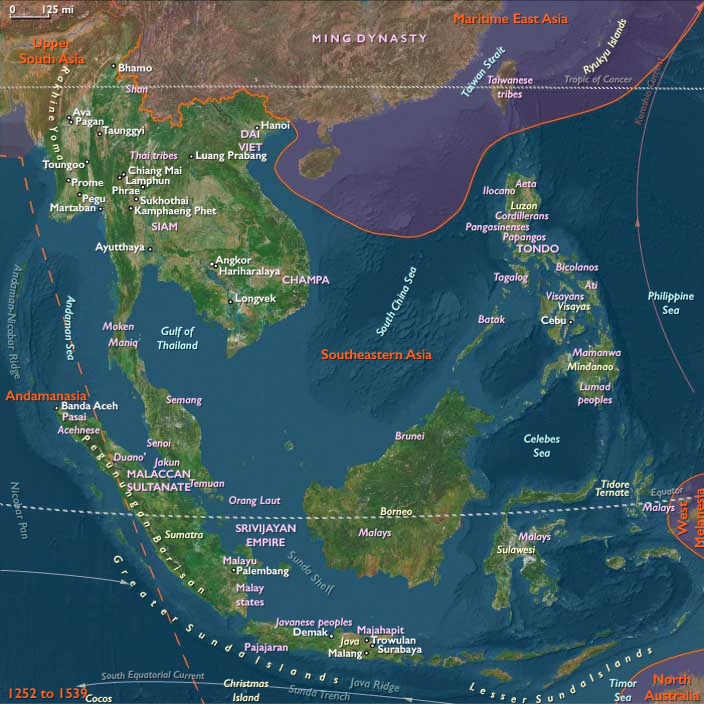
The subregion of Southeastern Asia includes the Indochinese Peninsula (Vietnam, Cambodia, Laos, Thailand, Myanmar), the Malay Peninsula, and the great archipelagos of Sumatra, Java, Borneo, Sulawesi, and the Philippines. Anchoring features included the Mekong and Irrawaddy river valleys, the Strait of Malacca, and the volcanic heartlands of Java and Sumatra. Coastal plains, fertile deltas, and highland forests were bound together by maritime corridors that made this one of the world’s busiest crossroads.
Climate & Environmental Shifts
This age unfolded during the Little Ice Age, bringing modest cooling but strong monsoonal cycles. The Southwest Monsoon (May–September) drove rains and river floods, sustaining wet-rice agriculture in the Mekong and Chao Phraya valleys. The Northeast Monsoon (November–February) opened sea lanes for traders crossing the Bay of Bengal and the South China Sea. ENSO variability occasionally disrupted rainfall, producing droughts and famines, but the overall climate favored agricultural intensification and maritime commerce.
Subsistence & Settlement
Southeast Asia’s population flourished in this age. Wet-rice agriculture dominated lowland valleys, particularly in Vietnam, Thailand, and Java, while uplands produced root crops, fruits, and spices. Coastal communities thrived on fishing, sago, and coconuts. Cities such as Ayutthaya, Malacca, Majapahit’s ports, and Manila became dense settlements tied to global trade. Forest products—sandalwood, resins, and rattan—linked inland villages to coastal markets. Maritime polities relied on tribute systems, ports, and hinterland agriculture to sustain large populations.
Technology & Material Culture
Technological ingenuity defined the age. Irrigation works and rice terraces sustained high yields; bronze and iron tools circulated widely. Shipbuilding advanced: jong, lancaran, and karakoa vessels carried merchants and warriors across seas. Firearms, first arriving via Islamic and later Portuguese channels, transformed military strategies. Material culture blended Hindu-Buddhist traditions with Islamic art, producing temples, mosques, palaces, and refined crafts in wood, metal, and textiles. The spread of batik cloth, brassware, and lacquered goods marked this age of cultural flourishing.
Movement & Interaction Corridors
The Strait of Malacca stood as the linchpin of global trade, funneling spices, silks, and ceramics between the Indian Ocean and the South China Sea. Maritime routes linked the Philippines to China and the Moluccas, Sumatra to India and Arabia, and Ayutthaya to Japan. Merchant diasporas—Arab, Persian, Gujarati, and Chinese—settled in port cities, creating cosmopolitan societies. The spread of Islam followed these corridors, flourishing in Malacca, Sumatra, and coastal Java, while Buddhism and Hinduism persisted inland. By the 1510s, Portuguese fleets entered, reshaping power balances.
Cultural & Symbolic Expressions
Religious and cultural life thrived in plural forms. The Majapahit kingdom (Java) embodied late Hindu-Buddhist statecraft, expressed in epic poetry, temple complexes, and ritual courts. In the mainland, Angkor’s Khmer legacy waned as Theravada Buddhism rose in Cambodia, Laos, and Thailand, producing monasteries and murals that anchored village life. The sultanate of Malacca emerged as a center of Islamic culture, where mosques, schools, and Sufi orders reshaped ritual life. Oral epics, dance-drama (wayang kulit in Java), and court chronicles transmitted history and cosmology, embedding identity in ritual and performance.
Environmental Adaptation & Resilience
Communities adapted to monsoonal variability through diversified agriculture, storage, and trade networks. Rice surpluses buffered drought years, while fishing and forest products diversified diets. Political systems often institutionalized resilience: tribute networks ensured flow of goods to centers, while alliances stabilized volatile frontiers. Maritime polities used shipborne trade to balance local scarcity with imported abundance.
Transition
By 1539 CE, Southeastern Asia was a vibrant maritime and agrarian world: highland valleys sustained wet-rice civilizations, archipelagos thrived on inter-island exchange, and port cities like Malacca and Manila linked the region to India, China, and the Middle East. Portuguese ships had already captured Malacca (1511), foreshadowing centuries of European intrusion. Yet Southeast Asia’s resilience lay in its cosmopolitan networks, religious pluralism, and agricultural wealth—ensuring it remained a vital center of the emerging global world.
Groups
Topics
Commodities
Subjects
Regions
Southeast Asia
View →Subregions
