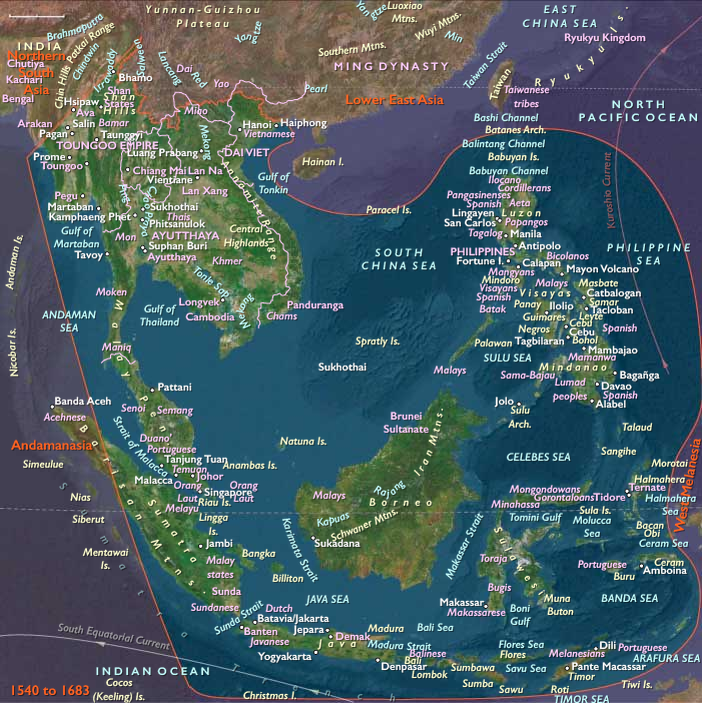
Southeastern Asia (1540–1683 CE) Maritime Crossroads, Trading…
1540 CE to 1683 CE
Southeastern Asia (1540–1683 CE) Maritime Crossroads, Trading Ports, and Imperial Entanglements
Geography & Environmental Context
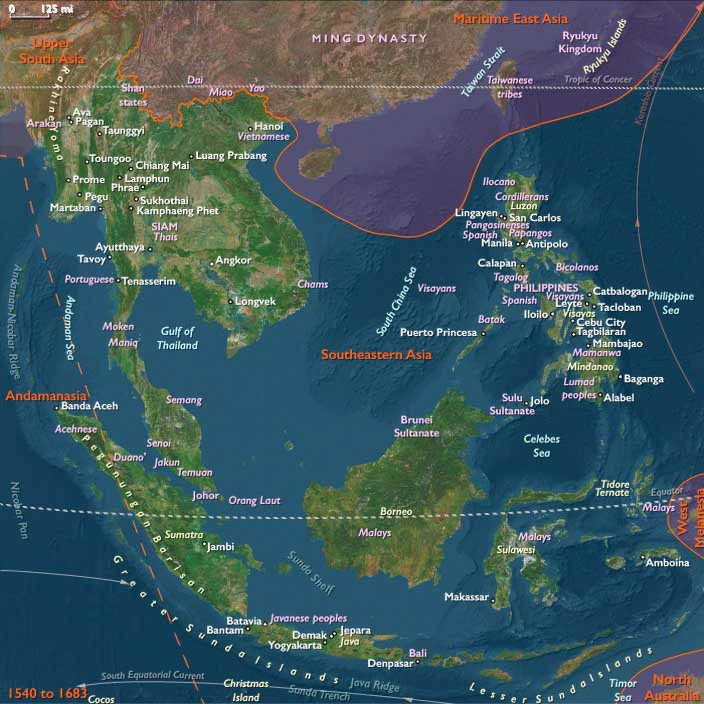
Southeastern Asia stretches from the Indochinese Peninsula (modern Myanmar, Thailand, Laos, Cambodia, and Vietnam) through the Malay Peninsula and across the maritime archipelagos of Sumatra, Java, Borneo, Sulawesi, the Philippines, and countless smaller islands. Anchors include the Irrawaddy and Mekong river valleys, the volcanic core of Java, the Straits of Malacca, the rugged highlands of northern Luzon, and the pepper- and clove-rich Moluccas (Maluku Islands). The region is characterized by fertile floodplains, dense tropical forests, active volcanoes, coral-fringed coasts, and straits that made it one of the most significant trading crossroads of the early modern world.
Climate & Environmental Shifts
The tropical monsoon system structured life, with wet and dry seasons alternating across mainland and island Southeast Asia. The Little Ice Age brought modest cooling, altering rainfall patterns and producing droughts that sometimes undermined rice harvests. El Niño events triggered regional famines, while cyclones struck coastal zones, particularly in the Philippines and South China Sea. Volcanic eruptions in Java and the Moluccas occasionally disrupted agriculture and maritime activity, yet the long-term fertility of volcanic soils sustained dense populations.
Subsistence & Settlement
-
Mainland river valleys (Irrawaddy, Chao Phraya, Mekong, Red River) supported irrigated rice cultivation, feeding powerful kingdoms such as Ayutthaya in Thailand and Nguyen–Trinh polities in Vietnam.
-
In the Malay Peninsula and Sumatra, rice combined with pepper, tin, and gold production, supporting coastal entrepôts.
-
Java was densely settled, with terraced rice fields sustaining large populations under the Mataram Sultanate.
-
Borneo and Sulawesi featured shifting cultivation of rice, sago, and root crops, with coastal communities engaged in trade and inland groups relying on swidden agriculture.
-
Philippines: Coastal settlements combined rice fields with root crops, coconuts, and abundant fishing. Larger chiefdoms developed on Luzon and Visayas.
-
Settlement patterns reflected the maritime orientation of the region, with fortified port cities, inland capitals, and dispersed upland villages tied together by rivers and seas.
Technology & Material Culture
Agricultural technology centered on wet-rice irrigation systems, terracing, and irrigation canals. Metallurgy continued to thrive: iron tools, bronze gongs, and locally cast weapons circulated widely. Shipbuilding reached high sophistication: junks, praus, and lanong warships carried trade and warfare across the seas. Ceramics from China, Japan, and local kilns in Vietnam and Thailand were widely traded. Textiles, including batik from Java and fine woven cloth from the Philippines, served as prestige goods. Monumental architecture persisted: mosques, Buddhist stupas, and Hindu temples testified to the region’s religious pluralism, while woodcarving and bronze casting flourished as expressive arts.
Movement & Interaction Corridors
Southeast Asia was one of the world’s busiest crossroads:
-
The Straits of Malacca linked the Indian Ocean with the South China Sea, carrying spices, silks, ceramics, and silver.
-
The Moluccas (Spice Islands) exported cloves and nutmeg, drawing merchants from across Asia and, increasingly, Europe.
-
The Ayutthaya kingdom became a hub for Chinese, Indian, Persian, and European traders.
-
The Philippines, integrated into the Manila Galleon trade after 1565, connected Asian markets with the Americas, channeling silver from Mexico in exchange for Asian goods.
-
Overland routes through mainland Southeast Asia tied Laos and northern Thailand to Yunnan in China, while maritime routes bound Sumatra, Java, and Borneo into global circuits.
Cultural & Symbolic Expressions
The subregion was marked by religious pluralism and cultural synthesis:
-
Islam expanded rapidly through the Malay world, shaping politics in Malacca, Aceh, and Demak, and influencing art, law, and ritual.
-
Theravada Buddhism remained dominant in mainland Southeast Asia, particularly in Ayutthaya, Lan Xang, and Cambodia, expressed through temples, murals, and festivals.
-
Catholicism entered the Philippines with Spanish conquest and missionary activity after 1565, leading to new rituals, churches, and hybrid practices.
-
Court culture flourished: in Java, wayang (shadow puppet theater) dramatized Hindu epics alongside Islamic stories, while in Ayutthaya, ornate palaces and chronicles legitimized kingship.
-
Oral traditions, music ensembles (gamelan, kulintang), and dance performances marked festivals and reinforced communal identities.
Environmental Adaptation & Resilience
Communities adapted to varied ecologies:
-
Irrigation systems in river valleys buffered rice harvests against seasonal variability.
-
On volcanic islands like Java, terracing and crop diversification reduced risks from drought or eruption.
-
Coastal and island communities relied on reef fishing, mangrove exploitation, and inter-island exchange to stabilize food supplies.
-
Networks of tribute and alliance redistributed resources during famines or disasters.
-
Adaptive seafaring allowed populations on small islands to survive ecological fluctuations by maintaining broad trade links.
Transition
Between 1540 and 1683, Southeastern Asia experienced profound transformations. Indigenous kingdoms like Ayutthaya, Mataram, Aceh, and Makassar flourished, projecting authority through warfare, trade, and ritual. At the same time, European expansion—first Portuguese, then Spanish, Dutch, and English—altered trade dynamics. The Portuguese held Malacca, the Spanish consolidated the Philippines, and the Dutch (VOC) entrenched themselves in Batavia (Jakarta), seeking to dominate the spice trade. The region remained a vibrant crossroads of Asian and global exchange, but by the close of this era, colonial footholds and shifting alliances foreshadowed the profound disruptions of the 17th and 18th centuries.
Groups
Topics
Commodities
Subjects
Regions
Southeast Asia
View →Subregions