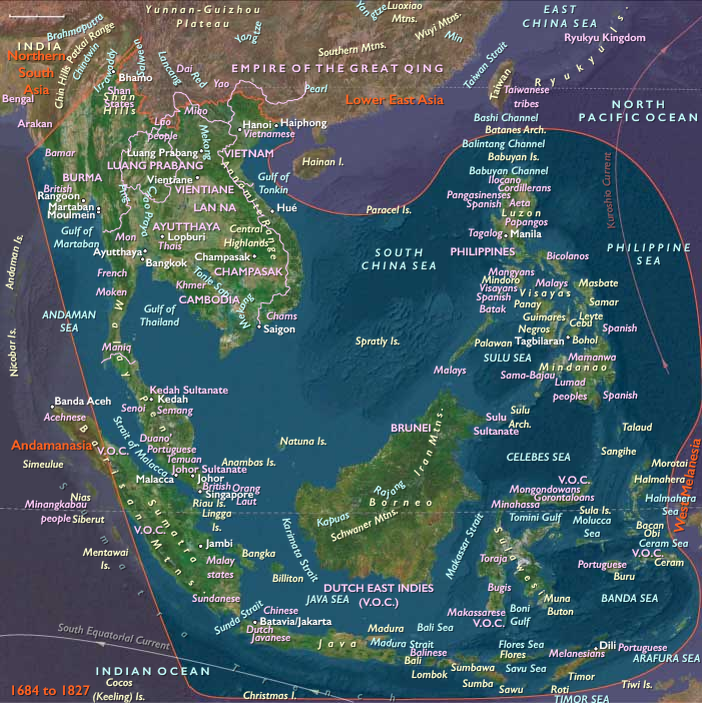
Southeastern Asia (1684–1827 CE): Spice Wars, Maritime…
1684 CE to 1827 CE
Southeastern Asia (1684–1827 CE): Spice Wars, Maritime Empires, and Shifting Mandalas of Power
Geography & Environmental Context
Southeastern Asia spans the Indochinese Peninsula—modern Myanmar, Thailand, Laos, Cambodia, and Vietnam—the Malay Peninsula, and the sprawling maritime archipelagos of Sumatra, Java, Borneo, Sulawesi, the Philippines, and the Moluccas (Spice Islands). Anchors include the Irrawaddy and Mekong river valleys, the Ayutthaya plain of Siam, the volcanic highlands of Java, the pepper forests of Sumatra, the Borneo river deltas, and the fertile valleys and rice terraces of the Philippines. The Straits of Malacca remained the principal maritime artery, connecting the Indian Ocean to the South China Sea, while the Moluccas supplied the coveted cloves and nutmeg that drove global competition.
Climate & Environmental Shifts
The tropical monsoon governed seasonal rhythms: wet summers feeding rice fields and dry winters enabling trade and overland transport. The lingering Little Ice Age brought droughts and cool anomalies, particularly in mainland valleys, sometimes undermining rice harvests. El Niño cycles caused regional famines in Vietnam and the Philippines. Typhoons in the South China Sea and cyclones in the Bay of Bengal periodically devastated coastal towns and shipping fleets, while volcanic eruptions in Java disrupted agriculture but renewed soils.
Subsistence & Settlement
-
Mainland Southeast Asia: Rice remained the foundation. Irrigated systems along the Chao Phraya (Thailand), Irrawaddy (Myanmar), and Mekong (Cambodia, Laos, Vietnam) supported growing populations.
-
Maritime Southeast Asia: Spice groves in the Moluccas, pepper in Sumatra, and tin in the Malay Peninsula became cash crops and tribute goods.
-
Java: Under the Mataram Sultanate, terraced rice systems sustained large villages, while Dutch control of Batavia (Jakarta) turned the island into a colonial hub.
-
Philippines: Rice terraces, coconuts, bananas, and maize (introduced from the Americas) diversified subsistence. Villages clustered around coastal bays and missions after Spanish consolidation.
-
Borneo and Sulawesi: Sago and shifting rice cultivation sustained smaller communities, complemented by extensive coastal fishing and forest products.
Settlement patterns reflected both inland agrarian states and thriving port cities: Ayutthaya, Manila, Batavia, Malacca, and Hue served as political and commercial capitals.
Technology & Material Culture
-
Agriculture: Irrigation canals, terracing, and buffalo plows structured rice cultivation.
-
Shipbuilding: Junks, praus, lanong warships, and Dutch East Indiamen plied seas; shipyards in Sulawesi and the Philippines turned out powerful fleets.
-
Craft industries: Weaving (batik in Java, ikat in the Philippines), ceramics (Vietnamese blue-and-white wares), and bronze casting flourished.
-
Architecture: Wooden palaces, Buddhist stupas, Islamic mosques, and Catholic churches marked cultural diversity. Fortresses and bastions rose in coastal cities under European influence.
-
Firearms and artillery circulated widely, reshaping warfare and fortification.
Movement & Interaction Corridors
Southeast Asia was one of the great crossroads of the early modern world:
-
Maritime arteries: The Straits of Malacca, Makassar Strait, and South China Sea carried spices, textiles, ceramics, and silver.
-
Land corridors: Caravans linked Yunnan to Laos and Vietnam, moving jade, salt, and horses.
-
Global circuits: The Manila Galleons tied the Philippines to Mexico, funneling American silver into Asian markets.
-
Colonial monopolies: The Dutch East India Company (VOC) dominated spice routes from the Moluccas, while the Portuguese clung to enclaves in Malacca and Timor. The English East India Company established footholds in Sumatra and Penang, laying groundwork for expansion.
Cultural & Symbolic Expressions
-
Religion: Theravada Buddhism flourished in Thailand, Laos, Cambodia, Burma, with grand temples and murals; Islam dominated the Malay world, shaping law, learning, and ritual; Catholicism deepened its roots in the Philippines through churches, fiestas, and processions; Confucianism influenced Vietnamese bureaucracy.
-
Court culture: Kings of Ayutthaya and Hue patronized chronicles, court theater, and diplomacy. In Java, shadow-puppet theater (wayang kulit) blended Hindu epics with Islamic teachings.
-
Art and ritual: Music ensembles (gamelan, kulintang), dance traditions, and oral epics celebrated ancestry and cosmology. Feasting and ceremonial exchanges reinforced status and alliance.
Environmental Adaptation & Resilience
-
Diversified agriculture combined rice with secondary crops (yams, maize, bananas) to hedge against climatic variability.
-
Maritime flexibility: Port cities shifted trade loyalties among European, Chinese, and Indian partners to buffer against monopoly pressures.
-
Urban resilience: After floods or volcanic destruction, cities rebuilt with timber and masonry, preserving trade functions.
-
Social redistribution: Buddhist monasteries, Islamic zakat institutions, and Catholic parishes provided relief during famines.
Transition
Between 1684 and 1827, Southeastern Asia was both resilient and turbulent. Indigenous states such as Ayutthaya, Mataram, and Hue wielded authority over rice lands and tribute, while maritime polities in the Malay world navigated shifting alliances. Yet European intrusion intensified: the Dutch entrenched their spice monopoly in the Moluccas and Java, the Spanish cemented control of the Philippines, and the English expanded trade bases. The region’s strategic waterways tied it into global systems, from Mexican silver to Indian cotton, reshaping economies and hierarchies. By the early 19th century, Southeast Asia remained culturally vibrant and diverse, but the balance of power had tilted toward colonial influence, setting the stage for deeper entanglements in the century ahead.
Groups
Topics
Commodities
Subjects
Regions
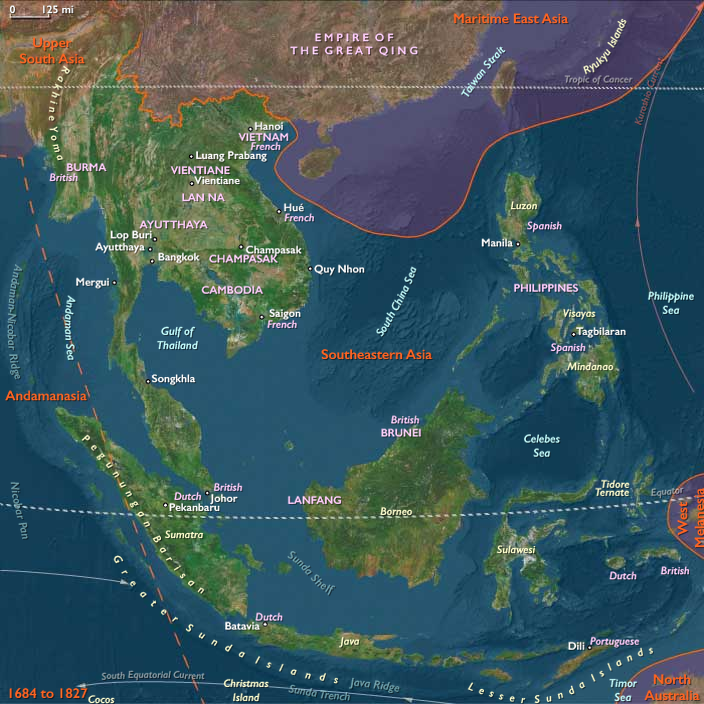
Southeast Asia
View →Subregions