Southeastern Asia (1828–1971 CE): Colonial Transformations, Nationalist…
1828 CE to 1971 CE
Southeastern Asia (1828–1971 CE): Colonial Transformations, Nationalist Revolutions, and Cold War Faultlines
Geography & Environmental Context
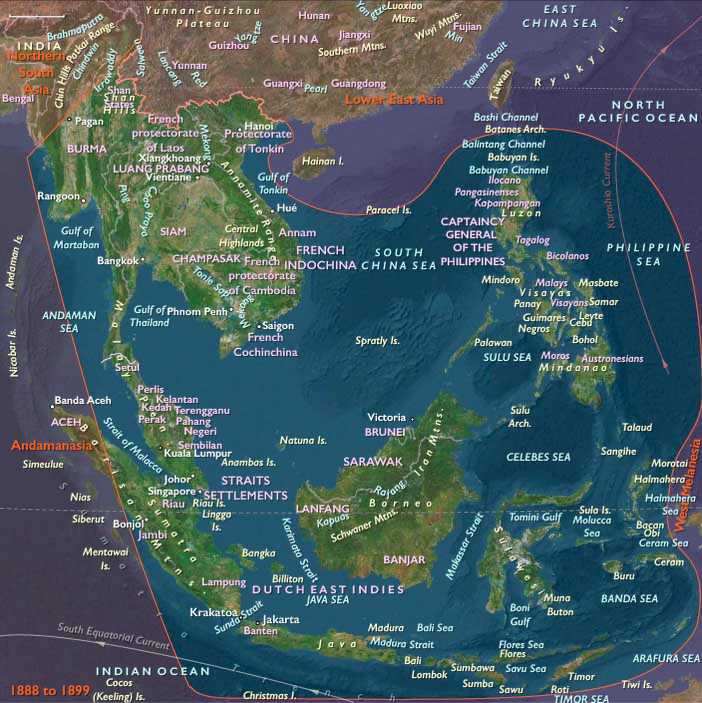
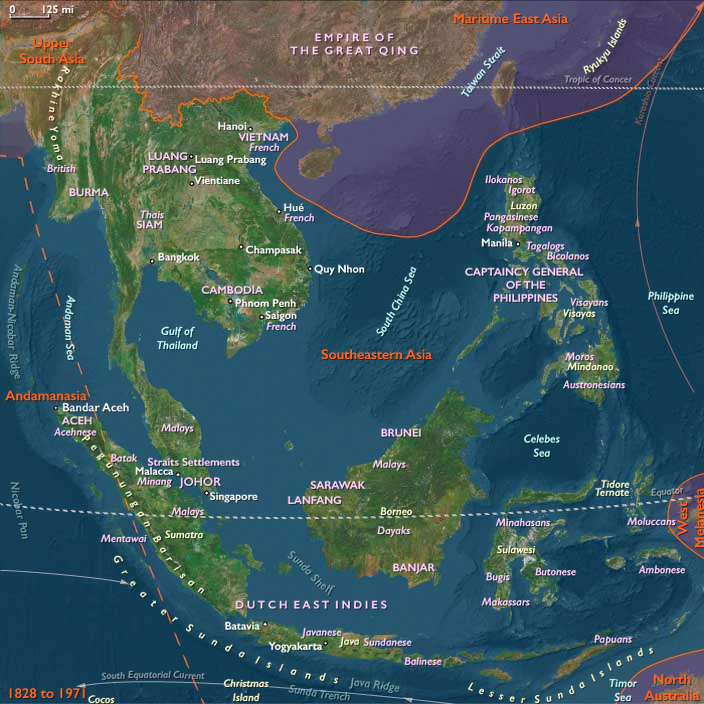
Southeastern Asia spans the mainland river basins of the Irrawaddy, Chao Phraya, Mekong, and Red Rivers, and the island zones of Sumatra, Java, Borneo, Sulawesi, and the Philippines, extending into the Malay Peninsula and Indochina. Anchors include the Mekong Delta, the rice plains of central Thailand and Burma (Myanmar), the volcanic islands of Java and Luzon, and the trading entrepôts of Singapore, Batavia/Jakarta, Saigon/Ho Chi Minh City, Manila, Rangoon/Yangon, and Bangkok. The region’s tropical monsoonal climate alternated between wet and dry seasons, supporting rice cultivation but also exposing populations to floods, droughts, and typhoons.
Climate & Environmental Shifts
The monsoon cycle remained the determinant of agriculture. The 19th century saw forest clearance for rice expansion in Burma, Thailand, and Vietnam. Volcanoes in Java and the Philippines erupted periodically (e.g., Krakatoa, 1883), reshaping coasts and climate globally. Typhoons regularly battered the Philippines and South China Sea littoral. After 1945, population growth and plantation monoculture strained land and forests, while damming and irrigation projects expanded in Thailand and Vietnam.
Subsistence & Settlement
-
Rice agriculture: Wet-rice cultivation dominated lowlands—Burma’s Irrawaddy Delta, Thailand’s Chao Phraya, Vietnam’s Mekong and Red River deltas, and Java’s volcanic plains.
-
Plantations: Colonial regimes expanded sugar, rubber, tea, coffee, and tobacco—especially in Java, Malaya, and the Philippines.
-
Mining: Tin in Malaya, coal in Sumatra, copper in the Philippines fed global industry.
-
Urban centers: Singapore, Manila, Batavia/Jakarta, and Rangoon emerged as cosmopolitan ports, while Saigon, Hanoi, and Bangkok tied hinterlands to trade.
-
20th-century changes: Nationalist regimes and wars reshaped settlement; postwar migration swelled urban populations like Jakarta, Manila, Bangkok, and Saigon.
Technology & Material Culture
-
Colonial era: Railways, canals, and telegraphs integrated rice deltas with ports. Dutch irrigation schemes in Java, French canal works in Cochinchina, and British infrastructure in Burma and Malaya expanded production.
-
20th century: Automobiles, radios, and cinemas spread in cities. After WWII, industrialization began with textile and light industry.
-
Everyday life: Traditional wooden houses on stilts, nipa huts, and kampongs coexisted with colonial villas and postcolonial concrete housing.
Movement & Interaction Corridors
-
Maritime trade: Singapore grew into a global shipping hub after its founding (1819), linking Indian Ocean and South China Sea.
-
Labor migration: Chinese and Indian migrants moved to plantations, mines, and ports under colonial rule.
-
Wartime corridors: Japanese occupation (1941–45) militarized routes across Malaya, Burma, and the Philippines.
-
Postwar flows: Refugee migrations from Vietnam, Cambodia, and Laos; labor migration to cities; overseas migration to Europe, America, and the Gulf began by the 1960s.
Cultural & Symbolic Expressions
-
Religion: Buddhism (Theravāda in Burma, Thailand, Cambodia, Laos), Islam (Indonesia, Malaya, southern Philippines), Catholicism (Philippines, Vietnam), and diverse animist traditions persisted. Postcolonial regimes often linked legitimacy to religious revival.
-
Nationalism: Print culture and schools spread ideas; newspapers in Saigon, Rangoon, and Jakarta mobilized anti-colonial movements.
-
Arts: Javanese gamelan, Thai dance, Burmese drama, Vietnamese opera, and Philippine folk and Catholic festivals endured alongside Western-influenced popular music and film.
-
Identity politics: Anti-colonial nationalism, Islamic reformism, and socialist thought competed in the 20th century.
Environmental Adaptation & Resilience
-
Rice intensification: Multi-cropping and irrigation projects boosted yields.
-
Diversification: Plantations produced cash crops but created vulnerability to global markets.
-
Fishing and foraging: Coastal and island populations relied on fisheries; mountain minorities (Karen, Hmong, Dayak) balanced swidden farming with trade.
-
War resilience: Villages adapted to occupation, bombardment, and displacement by diversifying subsistence and relying on kinship networks.
Political & Military Shocks
-
Colonial domination:
-
Dutch East Indies (Indonesia), British Burma and Malaya, French Indochina, Spanish then American Philippines, Portuguese Timor, and independent Siam/Thailand as a buffer state.
-
-
19th century: Wars of conquest and resistance (Burma vs. Britain, Vietnam under French pressure, Aceh war in Sumatra).
-
20th century:
-
Japanese occupation (1941–45): dismantled colonial order and fueled nationalist movements.
-
Postwar decolonization: Indonesia independence (1945–49), Burma (1948), Malaya (1957), Philippines (1946), Vietnam split after French defeat (1954), Laos and Cambodia independence (1953–54).
-
Wars: Vietnam wars (First Indochina, then U.S. conflict from 1960s); Malayan Emergency (1948–60); insurgencies in Burma.
-
Cold War alignments: Thailand joined SEATO; Indonesia pursued Non-Aligned leadership; Vietnam, Laos, Cambodia torn by war.
-
Transition
Between 1828 and 1971, Southeastern Asia transformed from a patchwork of rice villages and colonial outposts into a battleground of decolonization and Cold War geopolitics. European empires integrated deltas into global markets through plantations and railways. The Japanese occupation shattered colonial dominance and seeded independence movements. Postwar decades brought new states—Indonesia, Burma, Malaya, the Philippines, Vietnam, Cambodia, Laos—each navigating nationalism, development, and conflict. By 1971, the region was divided between Cold War blocs but retained resilient agrarian systems, vibrant port cities, and cultural pluralism rooted in centuries of adaptation to monsoons and trade.
Groups
Topics
Commodities
Subjects
Regions
Southeast Asia
View →Subregions