Southeast Asia (1396–1539 CE) Maritime Kingdoms, Pepper…
1396 CE to 1539 CE
Southeast Asia (1396–1539 CE)
Maritime Kingdoms, Pepper Roads, and the Dawn of Global Convergence
Geography & Environmental Context
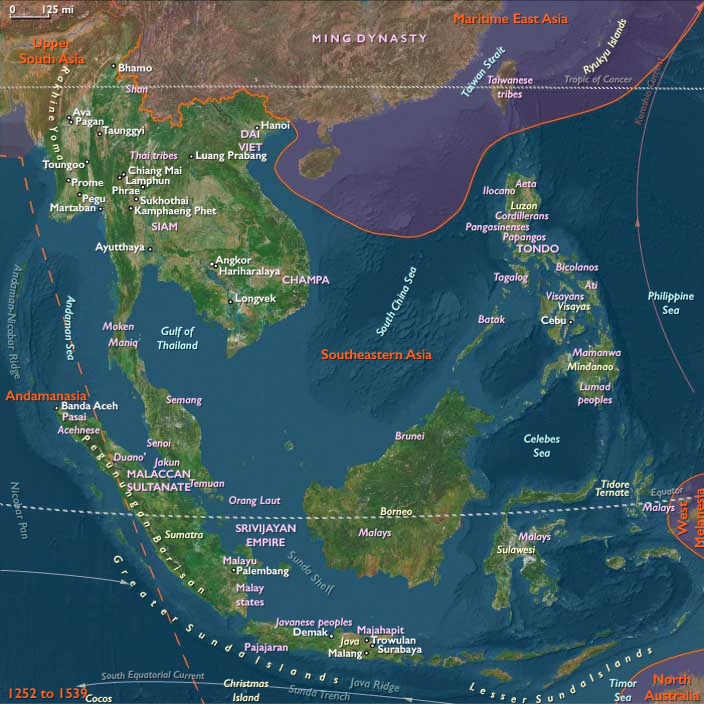
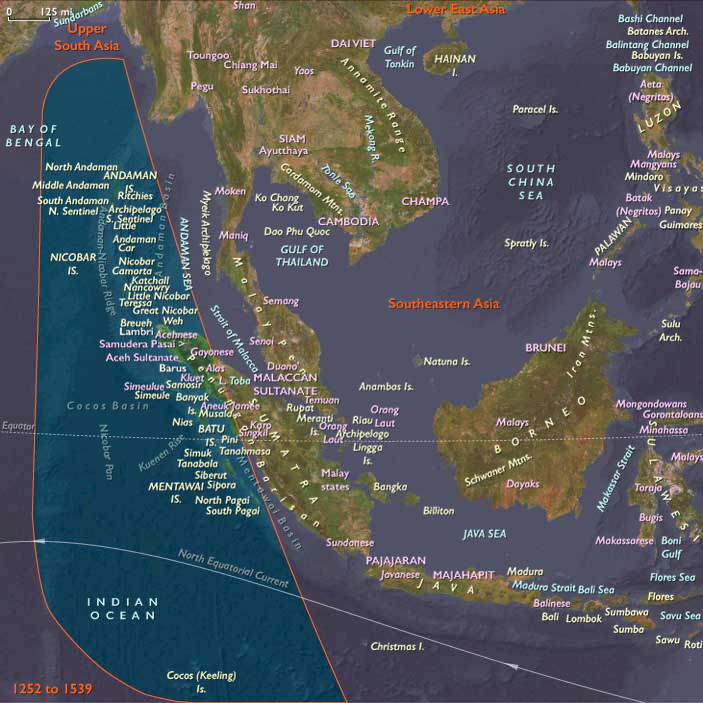
Southeast Asia during this age encompassed two great spheres: Southeastern Asia, including the Indochinese Peninsula (Vietnam, Cambodia, Laos, Thailand, Myanmar), the Malay Peninsula, and the great archipelagos of Sumatra, Java, Borneo, Sulawesi, and the Philippines; and Andamanasia, the outer arc of Aceh, Simeulue, Nias, Batu, Mentawai, the Andaman and Nicobar Islands, Preparis, Coco, and the Cocos (Keeling) atolls.
The region was bound by two maritime arteries: the Mekong–Chao Phraya–Irrawaddy river civilizations on the mainland and the Strait of Malacca linking the Indian Ocean and South China Sea. Volcanic soils, tropical forests, and monsoon-fed deltas sustained dense agrarian populations and prosperous port cities, making this one of the world’s most vibrant crossroads.
Climate & Environmental Shifts
The Little Ice Age brought mild cooling but strengthened monsoon contrasts.
-
The Southwest Monsoon (May–September) delivered heavy rains and floods to lowland paddies, sustaining wet-rice economies.
-
The Northeast Monsoon (November–February) opened the seas for merchants sailing between Arabia, India, and China.
-
ENSO oscillations occasionally triggered droughts or excessive rains, stressing food systems but rarely breaking them.
Overall, monsoon predictability underpinned both agricultural surplus and maritime expansion.
Subsistence & Settlement
Across the region, ecological diversity fostered complementary economies:
-
Mainland valleys: Intensive wet-rice cultivation in the Mekong, Chao Phraya, and Red River basins supported powerful agrarian kingdoms.
-
Highlands: Shifting cultivation of root crops, hill rice, and spices tied upland tribes into lowland trade.
-
Archipelagos: Mixed agriculture—rice, coconut, sago, and bananas—combined with fishing and inter-island trade.
-
Coastal entrepôts: Cities such as Ayutthaya, Malacca, Majapahit’s ports, and Manila became cosmopolitan nodes linking inland surplus with overseas commerce.
-
Forest products: Camphor, sandalwood, rattan, and resins moved from interior forests to maritime markets.
Technology & Material Culture
This was an age of innovation and synthesis:
-
Agriculture: Hydraulic engineering and terraced paddies maximized rice yields; bronze and iron tools circulated widely.
-
Shipbuilding: Large wooden vessels—jong, lancaran, and karakoa—ferried merchants and warriors across the seas.
-
Weaponry: Early firearms entered via Islamic merchants and later Portuguese traders, revolutionizing warfare.
-
Crafts: Blended Hindu-Buddhist and Islamic artistry produced temples, mosques, and palaces adorned with intricate woodwork, batik textiles, and metalwork.
-
Architecture: Brick stupas, walled citadels, and rising minarets testified to spiritual and political power alike.
Movement & Interaction Corridors
Southeast Asia sat astride global trade routes that stitched together the Old World’s richest economies.
-
Strait of Malacca: Served as the hinge of Afro-Eurasian commerce, channeling spices, silks, ceramics, and precious woods between the Indian Ocean and the South China Sea.
-
Maritime routes: Linked Sumatra and Java to India and Arabia, the Philippines to China and the Moluccas, and Ayutthaya to Japan.
-
Merchant diasporas: Arab, Persian, Gujarati, and Chinese traders established permanent enclaves in port cities, fostering hybrid cultures.
-
Religious routes: Islam spread along maritime corridors, taking root in Malacca, Sumatra, and coastal Java, while Buddhism and Hinduism persisted inland.
-
European entry: By the 1510s, Portuguese fleets reached Malacca (1511), introducing gunpowder empires to Asian waters.
Cultural & Symbolic Expressions
The region’s cultural life was plural and radiant:
-
Majapahit (Java): The last great Hindu-Buddhist empire, famed for its courts, poets, and temples, expressed its ideology through epic literature and monumental art.
-
Theravada ascendance: As Angkor’s power waned, Theravada Buddhism rose across Cambodia, Laos, and Thailand, reshaping monastic and village life.
-
Malacca Sultanate: Emerged as a Muslim maritime power and center of Islamic scholarship, where mosques, Sufi orders, and Malay-language chronicles defined the new order.
-
Art and performance: Wayang kulit shadow plays in Java, classical dance in Cambodia and Thailand, and musical ensembles (gamelan, kulintang) embodied sacred harmony.
-
Writing & literature: Javanese, Thai, Khmer, and Tagalog scripts flourished; chronicles, law codes, and epic poetry anchored identity and governance.
Environmental Adaptation & Resilience
Communities managed monsoon uncertainty through flexibility and exchange:
-
Agricultural intensification: Wet-rice systems buffered famine through irrigation and multiple cropping.
-
Diversified diets: Fishing, forest foraging, and interregional trade balanced ecological risks.
-
Political redistribution: Tribute systems moved rice and goods between centers and peripheries.
-
Maritime resilience: Seasonal trade allowed polities to import staples during local shortages, integrating economy and environment.
Technology & Power Shifts (Conflict Dynamics)
-
Aceh’s rise: In Andamanasia, the Sultanate of Aceh consolidated Islamic authority and contested Portuguesepower after their seizure of Malacca.
-
Outer islands: Communities on Simeulue, Nias, and Mentawai maintained autonomy through swidden agriculture and longhouse societies.
-
Andamans & Nicobars: Indigenous hunter-fishers resisted colonization, maintaining isolation while coastal traders skirted their waters.
-
Portuguese intrusion: From 1511 onward, Malacca’s capture reoriented maritime politics, setting the stage for global competition.
Transition (to 1539 CE)
By 1539, Southeast Asia had entered a new epoch of global convergence.
Wet-rice kingdoms and maritime sultanates coexisted with Hindu-Buddhist temples, forest tribes, and island societies.
The Portuguese conquest of Malacca (1511) marked the first wave of European intrusion, yet the region’s commercial vitality, religious pluralism, and agricultural abundance ensured its resilience.
From Ayutthaya and Majapahit to Malacca and Aceh, Southeast Asia stood as one of the early modern world’s great crossroads—its rivers, ports, and straits carrying the pulse of an interconnected planet.
Groups
Topics
Commodities
Subjects
Regions