Southern North America (1684–1827 CE): New Spain,…
1684 CE to 1827 CE
Southern North America (1684–1827 CE): New Spain, Revolts, and Early Independence
Geographic & Environmental Context
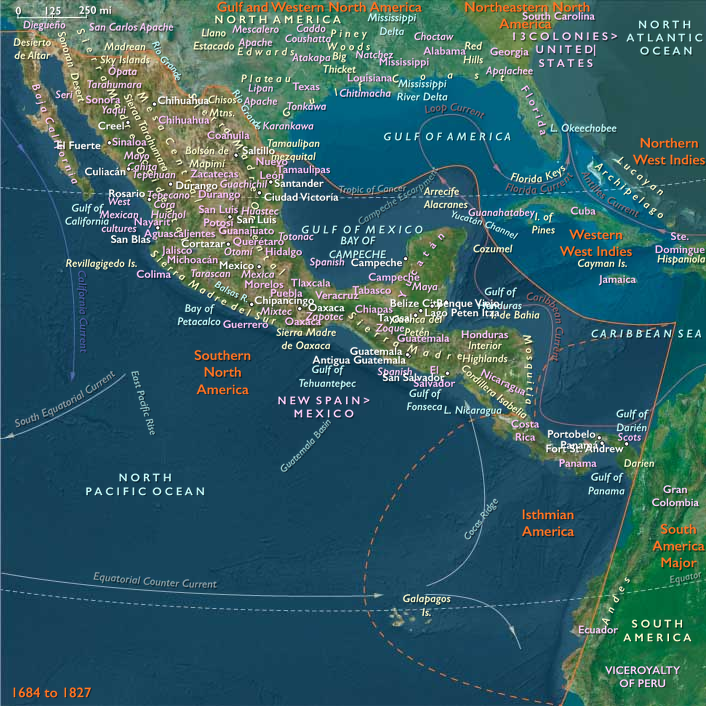
The subregion of Southern North America includes Mexico, Guatemala, Belize, Honduras, El Salvador, and Nicaragua. Anchors included the Valley of Mexico, the Yucatán Peninsula, the Guatemalan volcanic highlands, and the Pacific littoral.
Climate & Environmental Shifts
The Little Ice Age lingered, producing frosts in the Valley of Mexico and drought cycles in Yucatán and Central America. Hurricanes periodically ravaged coasts. Irrigation, terraces, and volcanic soils sustained farming.
Subsistence & Settlement
-
Indigenous farmers continued maize, beans, and squash cultivation, integrated with Spanish-introduced wheat, cattle, sheep, and horses.
-
Encomienda and later hacienda systems dominated, extracting tribute crops, silver, and livestock.
-
Maya communities maintained semi-autonomy in Yucatán and Chiapas, often resisting tribute and labor drafts.
-
Spanish cities like Mexico City, Puebla, and Guatemala City thrived as administrative and economic hubs.
-
By the late 18th century, mestizo populations expanded, blending Indigenous, African, and European lifeways.
Technology & Material Culture
Stone pyramids and temples lay in ruins, but Indigenous crafts—textiles, pottery, and ritual objects—persisted. Spanish technologies of mining, milling, and ranching reshaped economies. Baroque churches, plazas, and aqueducts transformed landscapes. Global trade via Veracruz and Acapulco integrated the region into transatlantic and Pacific networks.
Movement & Interaction Corridors
-
The Camino Real linked Mexico City with Veracruz and northern mines.
-
The Pacific trade tied Acapulco to Manila via galleons.
-
Tribute routes carried maize, cacao, and cotton into Spanish markets.
-
Indigenous footpaths sustained resistance, smuggling, and clandestine rituals.
Cultural & Symbolic Expressions
-
Catholic cathedrals, fiestas, and processions dominated public life, but Indigenous rituals persisted in hidden forms.
-
Maya and Nahua communities preserved languages, oral traditions, and clandestine dances tied to milpa cycles.
-
Creole intellectuals began forging a distinct identity, blending Indigenous and Spanish symbols.
-
By the early 19th century, revolutionary movements invoked both Catholic saints and Indigenous heroes.
Environmental Adaptation & Resilience
Indigenous farmers combined maize and wheat, herding and irrigation, to buffer climatic stress. Forest communities preserved traditional milpa agriculture. Syncretic rituals reinforced resilience under colonial control.
Transition
By 1827 CE, Southern North America was entering a new era. The Mexican War of Independence (1810–1821) toppled Spanish authority; Central America briefly formed the United Provinces of Central America (1823). Spanish colonial power had ended, but Indigenous resilience endured, carried in languages, farming, and ritual beneath new republican states.
Images

Southern North America (with civilization) ©2024-25 Electric Prism, Inc. All rights reserved.
Groups
Commodities
Subjects
Regions
Middle America
View →Subregions