Event
Maritime South Asia (1252–1395 CE): Pandyan Expansion…
Maritime South Asia (1252–1395 CE): Pandyan Expansion and Collapse, Deccan Sultanate Formation, Vijayanagara’s Rise, and Sri Lankan Fragmentation
Geographic Parameters
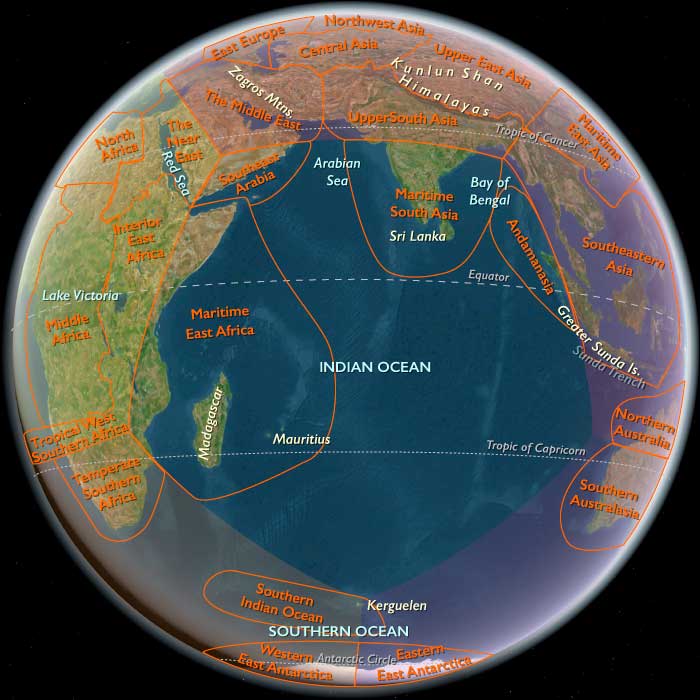
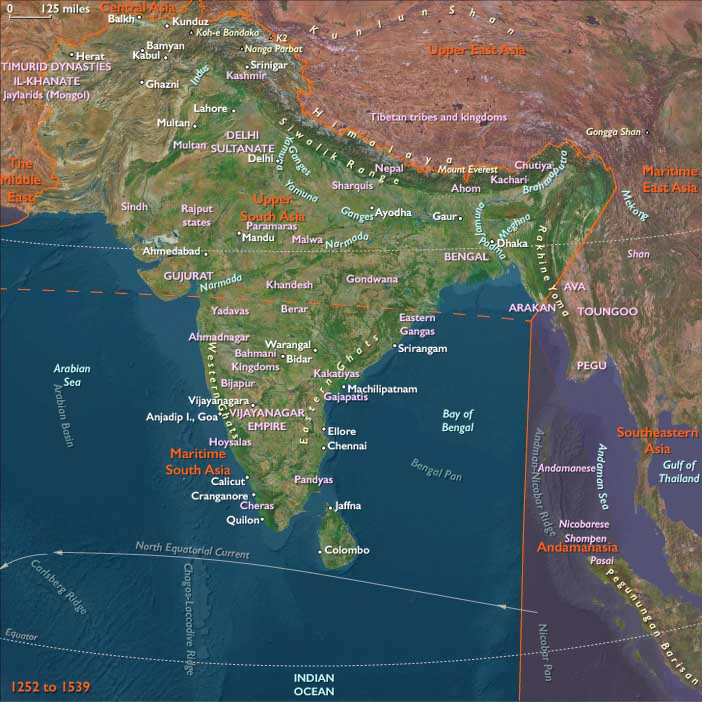
The age encompassed the Deccan plateau and its river corridors, the Tamil, Andhra, Karnataka, and Kerala regions, Sri Lanka’s shifting centers of settlement, and the island chains of Lakshadweep, the Maldives, and Chagos.
Political geography changed rapidly, but productive systems remained locally rooted. Irrigated valleys, rain-fed uplands, spice gardens, fishing coasts, island economies, and merchant ports continued beneath successive regimes.
Climate and Environmental Change
Increasing monsoon variability around the opening centuries of the Little Ice Age brought uneven rainfall, drought risk, and localized agricultural stress. The semi-arid Deccan was particularly vulnerable, while coastal Kerala and major deltas remained comparatively buffered by wetter climates and trade-based access to grain.
Sri Lanka’s northern dry-zone irrigation works experienced declining maintenance as political centers shifted southwestward and into the central highlands. This was not a total abandonment of reservoirs or paddy cultivation, but a geographic redistribution of population and authority toward rainfall-supported and smaller-scale hydraulic landscapes.
The Maldives remained vulnerable to freshwater scarcity, erosion, storm damage, and changing reef conditions. Maritime exchange continued to function as an essential form of ecological insurance.
Societies and Political Development
The Pandyan kingdom became a major power in the later thirteenth century, extending authority across much of Tamilakam and intervening in Sri Lanka. Its wealth derived from agrarian revenue, ports, pearls, horses, temples, and merchant traffic.
Pandyan strength proved unstable. Succession conflict and campaigns by the Delhi Sultanate, including the invasion associated with Malik Kafur, weakened the established political order. The Madurai Sultanate emerged in the fourteenth century but exercised uneven control amid warfare, local resistance, and regional fragmentation.
Delhi Sultanate expansion also contributed to the destruction or absorption of the Yadava, Kakatiya, and Hoysala states. From this upheaval emerged two new major systems: the Vijayanagara Empire, founded in 1336, and the Bahmani Sultanate, founded in 1347.
Vijayanagara developed around the Tungabhadra valley, combining fortified urbanism, irrigated agriculture, temple patronage, military organization, and access to southern ports. The Bahmani state coordinated Deccan cities, cavalry forces, Persianate court traditions, Sufi institutions, and Arabian Sea commerce.
Their rivalry was political and territorial rather than a simple conflict between monolithic religious blocs. Hindu, Muslim, Jain, and other communities served in multiple courts and participated in shared commercial, artistic, and military systems.
Sri Lanka fragmented among the Jaffna kingdom, Gampola, Kotte’s emerging sphere, and other regional powers. Tamil political authority strengthened in the north, while Sinhala centers shifted through the highlands and southwest.
Productive Landscapes
Rice remained central in deltas, valleys, and coastal lowlands. Millets, pulses, cotton, oilseeds, cattle, and mixed farming dominated much of the interior. Irrigation tanks remained vital to Deccan settlement and were repaired or expanded by regional courts, local chiefs, temples, mosques, and village communities.
The Tungabhadra zone became increasingly organized through canals, tanks, fortified settlements, markets, and temple estates associated with Vijayanagara’s rise. Yet the imperial capital remained one node within a much larger regional landscape.
Kerala’s pepper districts and Sri Lanka’s cinnamon, gem, elephant, and paddy-producing zones remained important to long-distance trade. Pearl fisheries and horse imports connected political power to coastal merchants and specialized maritime labor.
Maritime and Commercial Networks
Calicut emerged as a leading Malabar entrepôt under the Zamorin, supported by Muslim merchants, local producers, brokers, shipowners, and inland spice routes. Quilon, Goa, Mangalore, Nagapattinam, and numerous smaller ports remained active.
Arab, Persian, Tamil, Gujarati, Chinese, Jewish, and Southeast Asian merchants participated in the oceanic economy. Under Yuan and early Ming demand, Chinese ships and ceramics remained visible in regional trade.
The Maldives exported cowries, dried tuna, coconuts, and coir. Lakshadweep’s islanders provisioned shipping and maintained ties to Kerala. Chagos remained without permanent settlement, known primarily through the practical knowledge of mariners.
Religion and Cultural Life
Vijayanagara rulers patronized temples, pilgrimage centers, Sanskrit and regional-language scholarship, while Bahmani rulers supported mosques, madrasas, Sufi shrines, Persianate literary culture, and urban institutions.
Religious plurality also remained visible in port communities. Muslim merchant quarters existed beside Hindu temples, Christian settlements, Jewish communities, and local shrines. Commerce and pilgrimage often shared the same roads, ferries, and landing places.
Sri Lankan Buddhism adapted to shifting courts and political fragmentation. Hindu temples remained central in the Jaffna kingdom and Tamil districts. The Maldives consolidated Islamic law, mosque institutions, and sultanic authority.
Violence and Displacement
Northern invasions, succession struggles, inter-state warfare, tribute demands, temple seizure, enslavement, and the collapse of established courts brought substantial disruption. Some urban and irrigation systems declined; others were absorbed into new states.
The age should not be reduced to warfare. Most people continued to farm, fish, weave, trade, maintain waterworks, and participate in religious communities beyond the immediate centers of conquest.
Historical Progression
The principal new organizing system was the emergence of durable Deccan imperial and sultanate networks capable of linking fortified interiors, irrigated basins, military labor, horse imports, merchant ports, and religious institutions.
Legacy of the Age
By 1395 CE, the older Chola, Hoysala, Kakatiya, and Yadava orders had disappeared, the Pandyas had lost their earlier power, and Vijayanagara and the Bahmani Sultanate had become the principal rivals of the Deccan.
Sri Lanka was politically divided, while Calicut and other ports flourished through transoceanic commerce. The Maldives remained a Muslim sultanate embedded in cowrie and tuna networks. The age created a more politically fragmented but commercially resilient maritime world whose port communities survived the repeated reorganization of inland power.

-
{# Image navigates to the detail page; the magnifying-glass chip is the only Fancybox lightbox trigger (kept a separate sibling — anchors can't nest). #}
 The Indian Ocean Lands
World
The Indian Ocean Lands
World
-
{# Image navigates to the detail page; the magnifying-glass chip is the only Fancybox lightbox trigger (kept a separate sibling — anchors can't nest). #}
 South Asia
Region
South Asia
Region
-
{# Image navigates to the detail page; the magnifying-glass chip is the only Fancybox lightbox trigger (kept a separate sibling — anchors can't nest). #}
 Maritime South Asia
Subregion
Maritime South Asia
Subregion