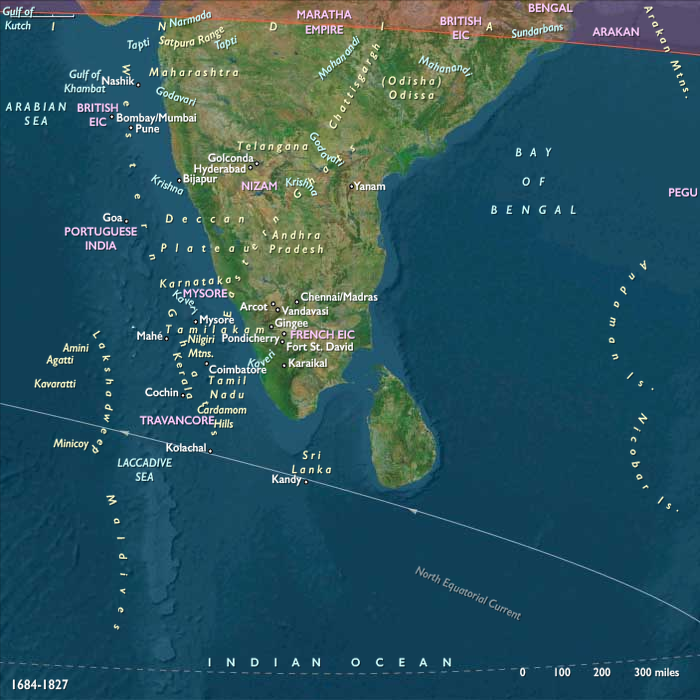
Maritime South Asia (1684–1827 CE): Dutch Supremacy,…
1684 CE to 1827 CE
Maritime South Asia (1684–1827 CE): Dutch Supremacy, British Inroads, and Island Autonomies
Geographic & Environmental Context
The subregion of Maritime South Asia includes southern India, Sri Lanka, the Maldives, Lakshadweep, Diego Garcia, and the Chagos Archipelago. Anchors included the Coromandel and Malabar coasts, the Deccan plateau river valleys of the Krishna, Tungabhadra, and Kaveri, the central highlands of Sri Lanka, and the coral atolls of the Maldives, Lakshadweep, and Chagos. By this period, the Dutch East India Company (VOC) dominated much of the Indian Ocean spice trade, while the British East India Company began carving footholds.
Climate & Environmental Shifts
The later Little Ice Age produced cycles of drought and excess rainfall. The Deccan interior faced famine during drought years, while Kerala’s monsoons nurtured pepper gardens. Sri Lanka’s cinnamon-rich southwest remained fertile, though the dry zone struggled without restored irrigation. Atolls in the Maldives and Lakshadweep balanced fishing and coconut production against erratic monsoons. The Chagos remained uninhabited but ecologically intact until the late 18th century, when it began to draw European interest.
Subsistence & Settlement
-
Southern India: Nayaka and Maratha successor states cultivated rice, millet, cotton, and indigo. Coromandel weavers exported textiles globally.
-
Malabar coast: Villagers tended pepper gardens and rice paddies, tied to Dutch contracts.
-
Sri Lanka: The Dutch ousted the Portuguese (1658) and monopolized cinnamon exports. Kandy preserved upland autonomy with rice terraces and shifting alliances.
-
Maldives and Lakshadweep: Depended on coconuts, reef fishing, tuna, and imported rice; cowrie shells circulated as currency.
-
Chagos (including Diego Garcia): Uninhabited until the French established coconut and sugar outposts in the late 18th century, worked by enslaved laborers from Africa and Madagascar.
Technology & Material Culture
Dutch forts and warehouses lined Colombo, Galle, Cochin, and Nagapattinam. Textile workshops on the Coromandel used handlooms for chintz and calicoes. Maldivians refined coir rope and crafted dhonis (fishing boats). Lakshadweep villages built mosques from coral stone. In Chagos, French planters introduced European sugar mills and coconut presses. Buddhist monasteries in Kandy continued temple painting and manuscript culture.
Movement & Interaction Corridors
-
Dutch VOC: Controlled Malabar pepper and Sri Lankan cinnamon; Colombo and Galle became key entrepôts.
-
British EIC: Expanded influence in southern India, founding Madras (Fort St. George, 1639) and later challenging Dutch monopolies.
-
Textile routes: Coromandel cottons reached Southeast Asia, Africa, and Europe.
-
Maldives: Exported cowries and tuna; supplied Bengal, Southeast Asia, and East Africa.
-
Chagos: Became provisioning stations and plantation sites, linking Mascarenes (Mauritius, Réunion) with India.
Cultural & Symbolic Expressions
-
Southern India: Temples, literary courts, and dance traditions flourished under Nayaka and Maratha patronage. Islamic Sufi shrines drew pilgrims.
-
Sri Lanka: Buddhist rituals reinforced Kandy’s legitimacy; Dutch Reformed churches appeared in coastal towns.
-
Maldives and Lakshadweep: Islamic devotion centered on coral-stone mosques, Qur’anic schools, and dynastic chronicles.
-
Chagos: Plantation workers carried African, Malagasy, and South Indian traditions, forming early creole cultures despite enslavement.
Environmental Adaptation & Resilience
Farmers diversified with millet, rice, cotton, and pepper. Irrigation tanks buffered famine in southern India and Kandy. Islanders relied on coconuts, smoked fish, and inter-island exchange. Dutch garrisons stockpiled grain in forts against scarcity. Chagos plantations exploited coconut and sugar, adapting atoll ecologies into export economies.
Technology & Power Shifts (Conflict Dynamics)
-
Dutch: Maintained control of Malabar and Sri Lanka’s coasts, enforcing monopolies with naval patrols.
-
British: Rose as challengers, using Madras and expanding Bengal influence. By the late 18th century, they fought Mysore and Maratha powers, signaling Dutch decline.
-
Sri Lanka: Kandy survived as an inland buffer until British conquest in 1815.
-
Maldives: Endured occasional Malabar and European raids, but dynasties remained intact.
-
Chagos: French plantation economy built on enslaved labor expanded in the late 18th century, later passing to British hands after the Napoleonic Wars (1814).
Transition
By 1827 CE, Maritime South Asia had been reshaped: Dutch power on the coasts was weakening under British competition; Kandy had fallen to Britain (1815), integrating Sri Lanka into empire. The Maldives and Lakshadweep retained Islamic autonomy but were increasingly drawn into colonial trade. The Chagos had become a plantation archipelago, soon to be integrated into British Mauritius. The region was on the verge of British dominance, which would define the 19th century.
Images

Southern South Asia (with civilization) ©2024-25 Electric Prism, Inc.
Groups
Commodities
Subjects
Regions
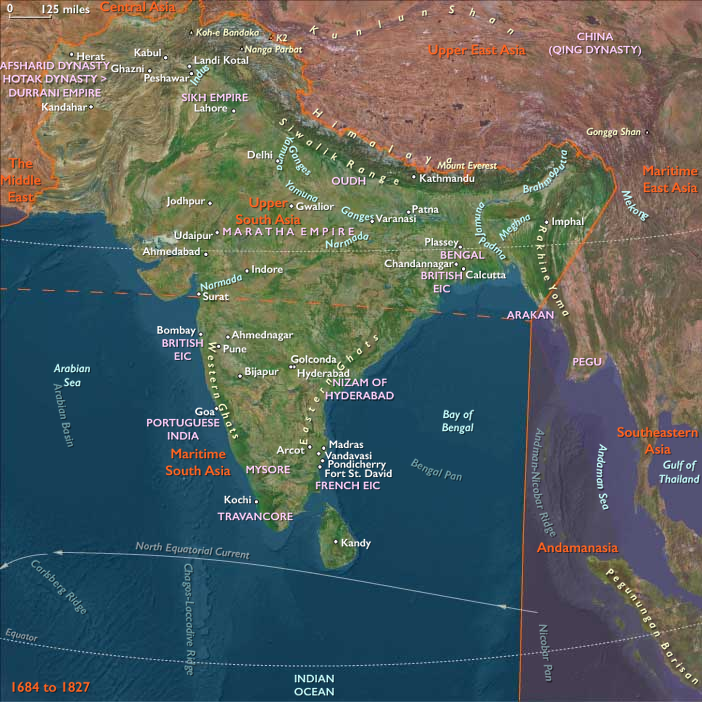
South Asia
View →Subregions