Event
Maritime South Asia (820–963 CE): Pallava Decline,…
Maritime South Asia (820–963 CE): Pallava Decline, Chola Restoration, and Anuradhapura’s Irrigated World
Geographic Parameters
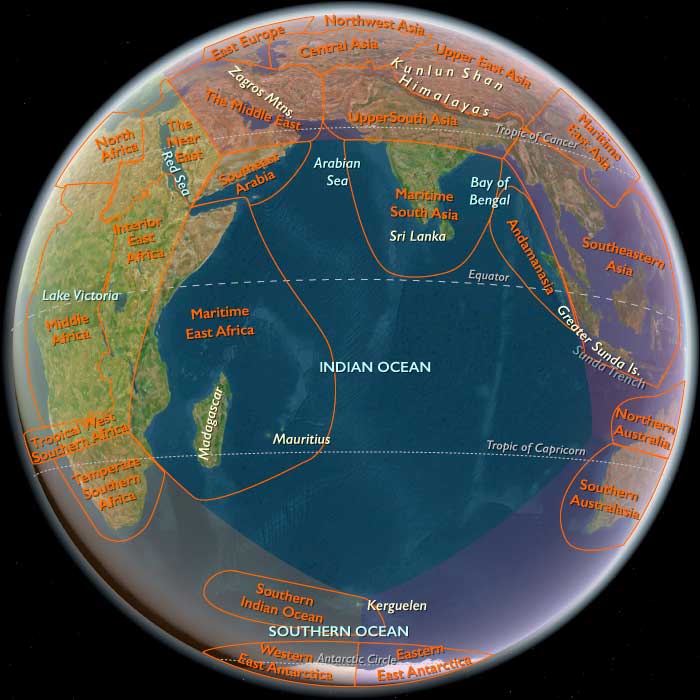
Maritime South Asia included peninsular India south of the Narmada River, Sri Lanka, Lakshadweep, the Maldives, and the Chagos Archipelago. Its principal landscapes were the Deccan plateau, the Krishna–Godavari and Kaveri basins, the Western and Eastern Ghats, the Konkan, Malabar, and Coromandel coasts, Sri Lanka’s wet and dry zones, and the reef islands and atolls extending southwest into the central Indian Ocean.
The region was environmentally diverse rather than uniformly tropical. Humid western coasts and mountain forests contrasted with the drier Deccan interior, while river deltas and irrigation basins supported dense settlement. Lakshadweep and the Maldives depended on reef ecology, coconut cultivation, fishing, and maritime provisioning. Chagos remained without permanent settlement.
Environmental Continuity
Monsoon rainfall, seasonal rivers, reservoirs, tanks, canals, and village water systems formed the productive foundation of the age. Wet-rice cultivation dominated the Kaveri delta, parts of the Andhra coast, Kerala’s lowlands, and Sri Lanka’s irrigated dry zone. Millet, pulses, oilseeds, cotton, and pastoral production sustained the interior plateau.
In Sri Lanka, the hydraulic landscape associated with Anuradhapura reached one of its great historical culminations. Reservoirs, feeder canals, embankments, village tanks, and monastery estates supported extensive cultivation and linked political authority to the maintenance and redistribution of water.
The island chains operated within much narrower ecological limits. Maldivian and Lakshadweep communities relied on shallow groundwater, rainwater storage, coconut palms, reef fish, tuna, coir, and imported grain. Their survival depended upon inter-island navigation and flexible exchange rather than agricultural self-sufficiency.
Societies and Political Development
The Pallavas remained influential around Kanchipuram but were losing authority to competing Tamil and Deccan powers. Their decline did not immediately erase the temple, agrarian, and administrative systems they had supported. Local assemblies, landed elites, Brahman settlements, merchants, cultivators, and temple institutions continued to organize much of rural life.
The Rashtrakutas dominated large parts of the Deccan from their inland political centers. Their authority connected dry upland agriculture, fortified settlements, religious patronage, military corridors, and routes leading toward western and eastern ports. The Eastern Chalukyas remained important in the lower Godavari and Krishna region, while the Chera polities of the western coast participated in Arabian Sea trade.
In the Kaveri basin, the Cholas reemerged under Vijayalaya and his successors. Their early expansion rested on control of productive rice districts, irrigation works, local assemblies, temple patronage, and river-to-port circulation. By the end of the age, Chola authority had become a major force in northern Tamilakam, although the larger imperial system of the following centuries was still developing.
In Sri Lanka, the Anuradhapura kingdom survived periods of internal conflict and external attack while preserving a powerful Buddhist court and monastic order. Sena I faced a Pandyan invasion in the ninth century, after which rulers pursued military recovery, irrigation repair, and renewed religious patronage.
Productive Landscapes
Agricultural landscapes remained more important than monumental centers. Tamil villages combined paddy fields, wells, tanks, orchards, grazing areas, household gardens, and craft production. The Deccan’s mixed economy included millet, pulses, cattle, cotton, and seasonal cultivation adapted to uncertain rainfall.
Temple and monastery endowments accumulated land and revenue, but cultivation depended on village labor, irrigation maintenance, cattle management, and negotiated rights to water. Local institutions often survived changes of dynasty because they were embedded in ordinary productive life.
Kerala’s humid foothills supported pepper, cardamom, coconuts, areca, timber, and rice. These commodities entered maritime markets through numerous small landings and coastal settlements rather than through a single dominant port.
Maritime Exchange
Arabian Sea and Bay of Bengal traffic linked the region with the Persian Gulf, the Red Sea, East Africa, Sri Lanka, and Southeast Asia. Arab and Persian merchants frequented western-coast ports, while Tamil, Sri Lankan, and Southeast Asian vessels moved through eastern waters.
Trade included pepper, textiles, rice, timber, aromatics, gems, pearls, horses, metals, and ceramics. Merchant communities operated through port quarters, religious institutions, brokers, shipowners, and inland supply routes. Maritime exchange was substantial, but most coastal communities remained engaged in fishing, salt making, ferrying, local cargo transport, and boat repair.
Maldivian cowries entered regional exchange networks, while tuna, coconut products, and coir supported island commerce. Lakshadweep served as a connected but locally rooted maritime zone between Kerala and the Maldives.
Religion and Cultural Life
Shaiva, Vaishnava, Jain, and Buddhist communities occupied overlapping religious landscapes. Temples functioned as ritual centers, landholders, employers, storehouses, and nodes of local administration. Monumental structures were important, but they remained dependent upon fields, irrigation systems, workshops, kitchens, gardens, and surrounding settlements.
In Sri Lanka, Theravada Buddhism remained central to kingship and social order. Monasteries maintained sacred sites, agricultural estates, manuscript traditions, educational communities, and ties with other Buddhist regions.
Muslim merchants established durable coastal communities, particularly along the western coast. Their presence was expressed through households, mosques, cemeteries, trading partnerships, and maritime kinship networks rather than political conquest.
Historical Progression
The principal new organizing system of the age was the strengthening coordination of irrigated agrarian districts with temples, courts, merchant communities, and regional maritime routes. Chola restoration was part of this wider process, not yet its sole expression.
Legacy of the Age
By 963 CE, Maritime South Asia remained politically plural but increasingly interconnected. The Pallavas were fading, the Rashtrakutas remained powerful, and the Cholas had established the productive and administrative foundations for major expansion. Anuradhapura preserved one of the region’s largest hydraulic and Buddhist landscapes, while the western coasts and island chains participated in widening monsoon commerce.
The age left a region organized through irrigated agriculture, local assemblies, religious estates, small ports, fishing settlements, and maritime merchant networks. These systems would support the larger imperial and commercial coordination of the following centuries.

-
{# Image navigates to the detail page; the magnifying-glass chip is the only Fancybox lightbox trigger (kept a separate sibling — anchors can't nest). #}
 The Indian Ocean Lands
World
-
{# Image navigates to the detail page; the magnifying-glass chip is the only Fancybox lightbox trigger (kept a separate sibling — anchors can't nest). #}
 South Asia
Region
-
{# Image navigates to the detail page; the magnifying-glass chip is the only Fancybox lightbox trigger (kept a separate sibling — anchors can't nest). #}
 Maritime South Asia
Subregion