Event
Southwest Indian Ocean (964–1107 CE): Terrestrial and…
Southwest Indian Ocean (964–1107 CE): Terrestrial and Nearshore Ecologies in Quiet Maturity
Geographic Parameters
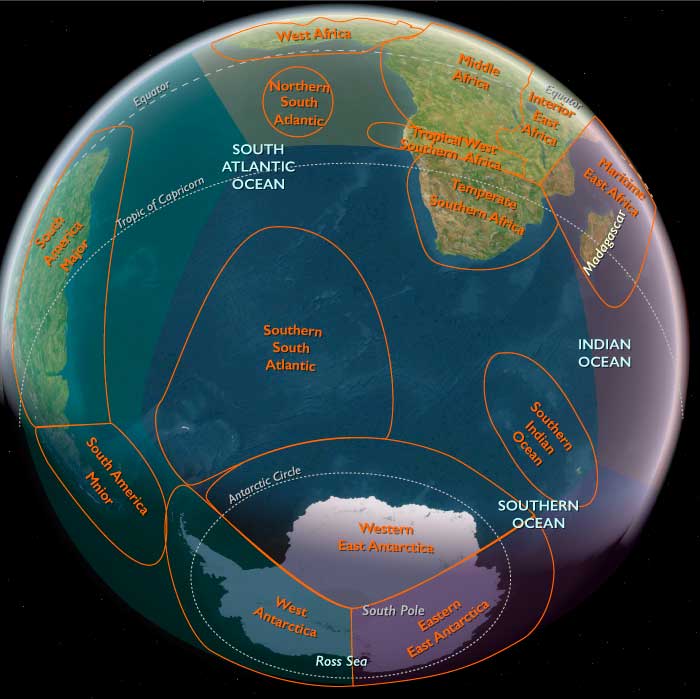
The subregion continued to include western Kerguelen, the Îles Crozet, Prince Edward Island, and Marion Island. Its major contrasts remained between glaciated western Kerguelen uplands, steep Crozet ridges, and the lower peat- and tussock-covered Prince Edward landscapes.
No single island represented the whole region. Glaciers remained principally a Kerguelen feature, while extensive ice-free breeding grounds characterized Crozet, Marion, and Prince Edward.
Climate and Environmental Change
Cool maritime conditions continued under strong westerlies. Seasonal frost, sleet, heavy precipitation, and rapid weather changes structured terrestrial life. Snowlines fluctuated on western Kerguelen, while peat continued accumulating in saturated depressions throughout the island groups.
Rather than introducing a major climatic rupture, this age consolidated environmental patterns established earlier. Protected hollows became wetter and more organic, while exposed surfaces remained subject to erosion, salt spray, and frost disturbance.
Terrestrial Ecological Maturity
Peatlands became more continuous in favorable basins. Moss, lichen, cushion-plant, and graminoid communities expanded across stabilized ground, while tussock developed on sheltered coastal benches. Long-established seabird burrows and guano deposition created localized soils that differed sharply from nutrient-poor exposed slopes.
The terrestrial landscape remained patchy. Rich colony margins existed beside barren basalt, wind-scoured ridges, bogs, and unstable coastal rubble.
Marine Productivity and Wildlife
Kelp forests and rocky reefs continued to support dense nearshore webs. Penguins occupied beaches and low terraces; albatrosses and petrels nested on cliffs and uplands; seals rotated among haul-outs according to breeding and feeding cycles.
The islands’ oceanographic setting continued to produce unusually concentrated populations of marine birds and mammals in an otherwise vast ocean.
Regional Movement
Pelagic feeding circuits linked the islands with broader Southern Ocean frontal systems. Colony movement remained responsive to storm damage, prey variation, and breeding success.
No fixed center organized these movements. Connectivity arose through repeated biological circulation rather than territorial control or settlement.
Human Absence
The islands remained uninhabited and beyond sustained human routes. Distant maritime development elsewhere had no material effect within the subregion. No speculative comparison with European or Asian voyaging changes this central fact: the islands still possessed no human layer.
Environmental Resilience
Peat increased water retention, while mature plant mosaics reduced erosion in sheltered areas. Colony relocation and rapid recolonization after storm scour continued to buffer local losses.
Legacy of the Age
By 1107 CE, terrestrial and nearshore systems had reached a mature but dynamic equilibrium. Deep peat, established vegetation mosaics, stable kelp habitats, and long-used colony terrain gave the islands greater ecological structure without reducing their exposure to storms or their complete isolation from humanity.

-
{# Image navigates to the detail page; the magnifying-glass chip is the only Fancybox lightbox trigger (kept a separate sibling — anchors can't nest). #}
 The African South
World
-
{# Image navigates to the detail page; the magnifying-glass chip is the only Fancybox lightbox trigger (kept a separate sibling — anchors can't nest). #}
 Southern Indian Ocean
Region
-
{# Image navigates to the detail page; the magnifying-glass chip is the only Fancybox lightbox trigger (kept a separate sibling — anchors can't nest). #}
 Southwest Indian Ocean
Subregion