The harsh rule of the Spanish loyalists,…
1816 CE to 1827 CE
More and more members of the Chilean elite are becoming convinced of the necessity of full independence, regardless of who sits on the throne of Spain.
Manuel Rodriguez, as the leader of guerrilla raids against the Spaniards, becomes a national symbol of resistance.
When criollos sing the praises of equality and freedom, however, they mean equal treatment for themselves in relation to the peninsulares and liberation from Spanish rule, not equality or freedom for the masses of Chileans.
The criollos want to assume leadership positions previously controlled by peninsulares without upsetting the existing social and economic order.
In this sense, the struggle for independence is a war within the upper class, although the majority of troops on both sides consist of conscripted mestizos and native Americans.
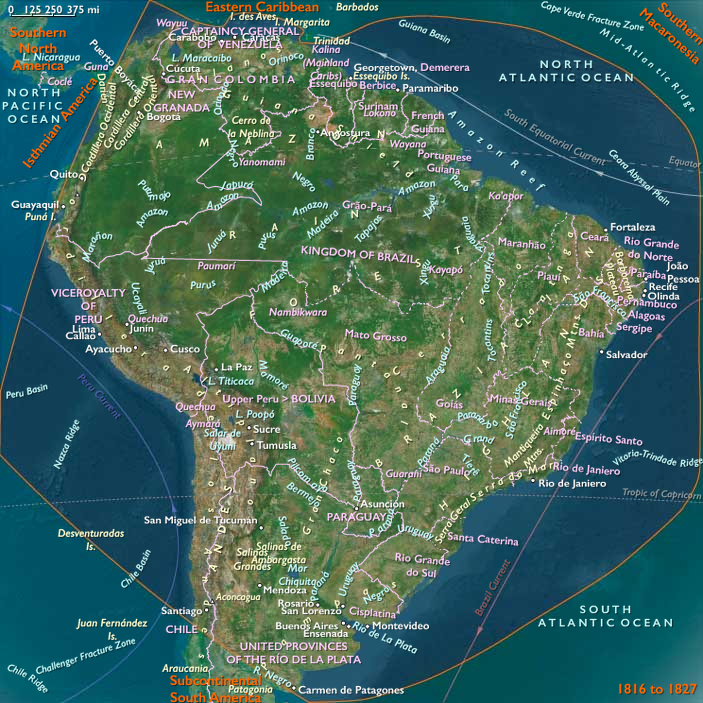
O'Higgins, in exile in Argentina, joins forces with Jose de San Martin, whose army frees Chile with a daring assault over the Andes in 1817, defeating the Spaniards at the Battle of Chacabuco on February 12.
San Martin considers the liberation of Chile a strategic stepping-stone to the emancipation of Peru, which he sees as the key to hemispheric victory over the Spanish.
Chile wins its formal independence when San Martin defeats the last large Spanish force on Chilean soil at the Battle of Maipú on April 5, 1818.
San Martin now leads his Argentine and Chilean followers north to liberate Peru; fighting will continue in Chile's southern provinces, the bastion of the royalists, until 1826., drive more Chileans into the insurrectionary camp.
More and more members of the Chilean elite are becoming convinced of the necessity of full independence, regardless of who sits on the throne of Spain.
Manuel Rodriguez, as the leader of guerrilla raids against the Spaniards, becomes a national symbol of resistance.
When criollos sing the praises of equality and freedom, however, they mean equal treatment for themselves in relation to the peninsulares and liberation from Spanish rule, not equality or freedom for the masses of Chileans.
The criollos want to assume leadership positions previously controlled by peninsulares without upsetting the existing social and economic order.
In this sense, the struggle for independence is a war within the upper class, although the majority of troops on both sides consist of conscripted mestizos and native Americans.
O'Higgins, in exile in Argentina, joins forces with Jose de San Martin, whose army frees Chile with a daring assault over the Andes in 1817, defeating the Spaniards at the Battle of Chacabuco on February 12.
San Martin considers the liberation of Chile a strategic stepping-stone to the emancipation of Peru, which he sees as the key to hemispheric victory over the Spanish.
Chile wins its formal independence when San Martin defeats the last large Spanish force on Chilean soil at the Battle of Maipú on April 5, 1818.
San Martin now leads his Argentine and Chilean followers north to liberate Peru; fighting will continue in Chile's southern provinces, the bastion of the royalists, until 1826.
People
Groups
Mapuche (Amerind tribe)
View →
Christians, Roman Catholic
View →
Spaniards (Latins)
View →
Jesuits, or Order of the Society of Jesus
View →
Peru, Viceroyalty of
View →
Spain, Bourbon Kingdom of
View →
Río de la Plata, Viceroyalty of
View →
France, (first) Empire of
View →
Spain, Bonapartist Kingdom of
View →
Chile, Republic of
View →
Topics
Commodities
Subjects
Regions
South America
View →Subregions