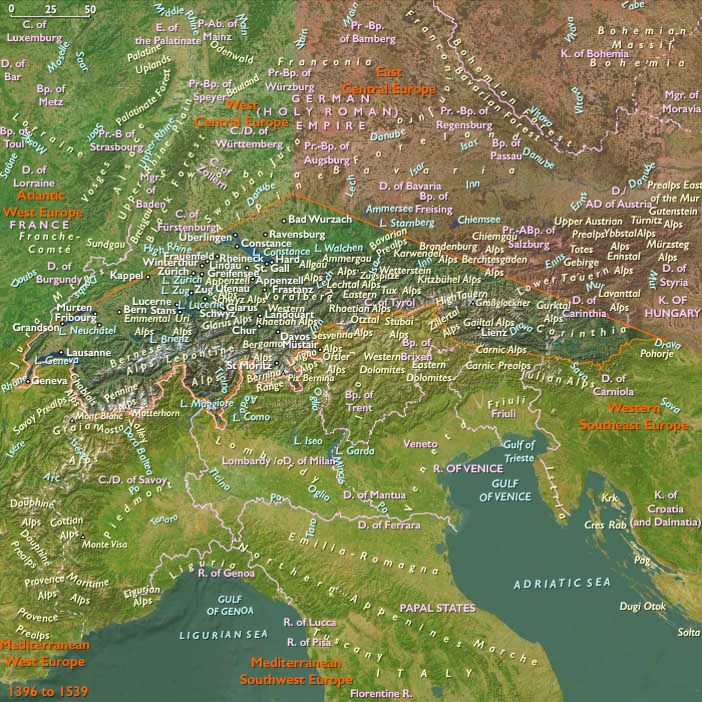
The Swiss Conferates receive all of Locarno…
1516 CE
The Swiss Conferates receive all of Locarno in the Treaty of Freiburg in 1516.
The area around Locarno (and presumably the town) was part of the county Stazzona starting in the Lombard period (after 569), and later the Mark of Lombardy.
Locarno is first mentioned in 807 as Leocarni.
In German, it came to be known as Luggarus, Lucarius, Lucaris.
It is likely that a market existed at or near the lake since the Roman era.
The long history of the town and its location led to the creation of a royal court, which is first mentioned in 866.
During the Middle Ages, Locarno and Ascona formed a community, with several, separate neighborhoods.
The community managed its common goods (alpine pastures, pastures, forests, churches) and tax officials and police.
In the tenth century, Bishop of Milan began to consolidate more and more power to himself at the expense of the Kings of the Germans.
This expansion by Milan had been countered by Henry II, who had incorporated Locarno in 1002/04 with the surrounding areas into the Diocese of Como.
Frederick Barbarossa had granted extensive market rights to Locarno in 1164 and granted imperial immediacy in 1186.
Due to these privileges, Locarno had developed substantial local autonomy, which assisted the development of municipal institutions.
The nobles (Nobili) lost more and more rights to the citizens (borghesi).
By 1224, the borghesi had their own administration and various privileges, including market rights, the right to their own weights, maintenance of mills and grazing rights in Saleggi, in Colmanicchio (Alp Vignasca) and in the Magadino and Quartino valleys.
Locarno is the administrative center of the parish of Locarno.
The Podestà or high government official resided in the Casa della Gallinazza, which had been burned in 1260 during the clashes between the Guelphs and Ghibellines.
Several Locarno families, including members of the Capitanei di Locarno and Simone da Orello, had played an important role in the battles between the two factions.
In 1342, Luchino and Giovanni Visconti conquered the area, which brought Locarno back under the power of Milan.
In 1439, Count Franchino Rusca had been awarded Locarno as a fief.
The rule of the Rusca had ended 1503, when the Swiss Confederates occupied Locarno, but failed to conquer the Visconti castle.
After the battle of Novara in 1513, the French King Louis XII had given the Confederates the castle.
Locations
Groups
Topics
Subjects
Regions
Central Europe
View →Subregions