Event
Southern South Atlantic (2,637–910 BCE): Storm Islands,…
Southern South Atlantic (2,637–910 BCE): Storm Islands, Glacial Coasts, and an Unpeopled Ocean
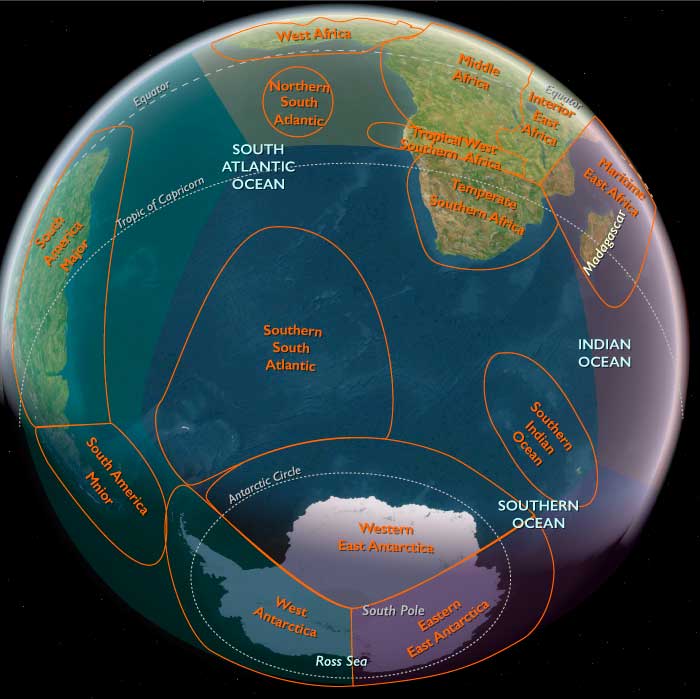
Southern South Atlantic during 2,637–910 BCE comprised the Tristan da Cunha archipelago, Gough Island, Bouvet Island, South Georgia, the South Sandwich Islands, and the South Orkney Islands, including Coronation Island. Saint Helena and Ascension belonged instead to Northern South Atlantic.
Throughout the 1,728 years from 2,637 through 910 BCE, the subregion remained outside permanent human settlement. Its environmental history followed three broad phases: an established later-Holocene regime at the opening of the epoch; a middle phase in which cooling became increasingly visible on South Georgia while the northern islands remained chiefly storm- and rainfall-driven; and a final phase of more pronounced cooling on South Georgia before 910 BCE.
At the northern end, the Tristan da Cunha archipelago formed a compact volcanic group in the central South Atlantic. Tristan itself rose steeply from the sea, while Inaccessible and Nightingale supported cliffs, tussock-covered slopes, fern-rich vegetation, peat, and dense seabird colonies. South-southeast of Tristan, Gough Island was larger, wetter, and more mountainous, with steep ridges, ravines, wet heath, fernbush, tussock, and extensive peatlands.
Farther south, Bouvet Island was a much colder volcanic island dominated by snow, glaciers, steep cliffs, and narrow ice-free coastal margins. South Georgia, the largest and most varied landmass in the subregion, combined high mountains, extensive glaciers, deep bays, fjords, coastal plains, peatlands, and tundra vegetation. East and southeast of it, the South Sandwich Islands formed an active volcanic arc, while the South Orkney Islands, including Coronation Island, lay within a cold maritime Antarctic regime of glaciers, snowfields, exposed rock, mosses, lichens, and seasonal sea ice.
During the first phase, from 2,637 BCE into the early second millennium BCE, Tristan and Gough already possessed mature cool-oceanic ecosystems. Rainfall, storm exposure, landslides, stream erosion, and peat formation reshaped local terrain without changing their basic ecological character. South Georgia had already completed its major early-Holocene glacier retreat; ice-free coastal lowlands supported tundra and peat-forming vegetation, while mountain and valley glaciers remained established. Bouvet, the South Sandwich Islands, and the South Orkneys continued within colder subantarctic and maritime Antarctic conditions.
During the second phase, broadly spanning the middle second millennium BCE, the clearest change occurred on South Georgia. Cooler conditions became more persistent, some glaciers expanded farther within valleys, and snow endured longer in upland settings. Tristan and Gough continued to change mainly through rainfall, erosion, drainage, storminess, and peat accumulation rather than glaciation. The colder southern islands retained their established volcanic, glacial, and sea-ice-dominated environments.
During the third phase, from the later second millennium BCE through 910 BCE, the cooling trend on South Georgia strengthened. Glacier advance became more widespread, snow persisted longer, and some ice-free habitats contracted, although the island had not yet reached its later Holocene maximum glacier extent. Tristan and Gough remained non-glacial, while Bouvet, the South Sandwich Islands, and the South Orkneys continued under persistently severe southern-ocean conditions.
Across all three phases, the surrounding ocean supported immense concentrations of marine life. Penguins occupied beaches and lower slopes, petrels and albatrosses nested on cliffs and exposed ground, and elephant seals and fur seals used suitable beaches and coastal plains for breeding and resting.
The ocean was also the principal connective system. Seabirds ranged across immense distances between feeding grounds and breeding colonies; seals migrated through cold waters; ocean fronts concentrated marine productivity; and storms transported heat and moisture across the basin.
Because no permanent human settlement had yet reached these islands, there were no introduced livestock, deliberate burning, sustained hunting systems, or agricultural transformation of their native ecosystems.
Legacy of the Age
By 910 BCE, Southern South Atlantic remained an entirely unpeopled chain of oceanic island systems. Its clearest environmental trajectory was the progressive cooling of South Georgia, while the northern islands retained mature cool-oceanic environments and the farther-south island groups remained within colder subantarctic and Antarctic regimes.
The subregion entered the succeeding period still linked by wind, currents, seabirds, and marine mammals rather than by human settlement.

-
{# Image navigates to the detail page; the magnifying-glass chip is the only Fancybox lightbox trigger (kept a separate sibling — anchors can't nest). #}
 The African South
World
-
{# Image navigates to the detail page; the magnifying-glass chip is the only Fancybox lightbox trigger (kept a separate sibling — anchors can't nest). #}
 South Atlantic
Region
-
{# Image navigates to the detail page; the magnifying-glass chip is the only Fancybox lightbox trigger (kept a separate sibling — anchors can't nest). #}
 Southern South Atlantic
Subregion