Event
The Treaty of Verdun (843) and the…
The Treaty of Verdun (843) and the Fragmentation of the Carolingian Empire
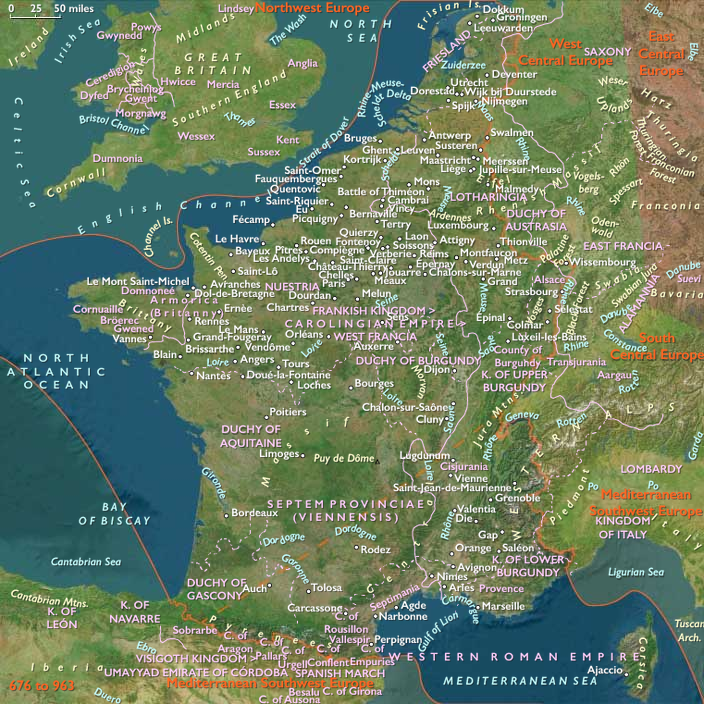
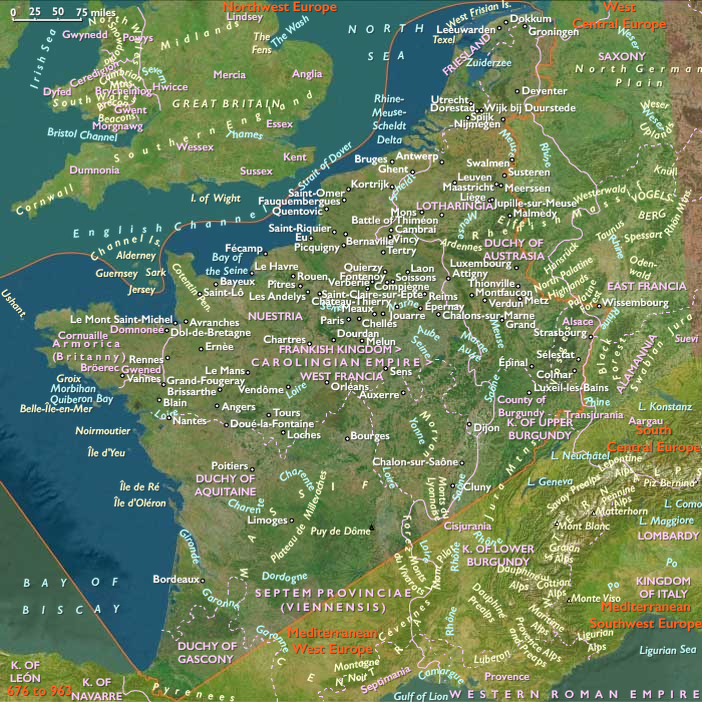
Following the death of Louis the Pious (840), the Carolingian Empire plunges into internecine warfare among his sons, each vying for control over the vast domain their grandfather Charlemagne had established. This conflict is finally resolved by the Treaty of Verdun (843), which divides the empire into three separate kingdoms, laying the geopolitical and cultural foundations for the future territories of France, Germany, and Italy.
The Division of the Carolingian Empire
- West Francia → Ruled by Charles the Bald, this kingdom roughly corresponds to modern France.
- East Francia → Ruled by Louis the German, it encompasses present-day Germany and Austria, forming the precursor to the Holy Roman Empire.
- Middle Francia → Ruled by Lothair I, this kingdom stretches from Frisia to Italy, including Lotharingia (Lorraine), Burgundy, and northern Italy. As emperor, Lothair retains imperial authority, but his kingdom is geographically vulnerable, eventually leading to its partition in later decades.
The Cultural and Linguistic Divide
Beyond political fragmentation, the Treaty of Verdun accelerates a cultural and linguistic split between the eastern and western realms:
- East Francia (Germany & Austria) → The population continues to speak Old High German, preserving a Germanic linguistic identity.
- West Francia (France) → Under the influence of Gallo-Roman Latin, the language evolves into Old French, distinct from the Frankish tongue spoken in earlier centuries.
- Middle Francia (Lotharingia, Burgundy, Italy) → A mix of Germanic and Romance languages, leading to linguistic diversity in Belgium, Switzerland, and northern Italy.
The Imperial Title and the Middle Kingdom
While Charlemagne’s imperial legacy had encompassed all of Western Europe, by the mid-9th century, the imperial title becomes increasingly dependent on control over Italy, particularly Rome. The rulers of East Franciaand West Francia focus on their own realms, leaving Middle Francia (especially Italy) as the symbolic center of the empire.
However, the Middle Kingdom proves too weak to resist the ambitions of its stronger neighbors, leading to its partition after Lothair I’s death (855). This marks the beginning of a long struggle for control over Italy, which remains central to the Holy Roman imperial claim for centuries to come.
Long-Term Consequences
- The Treaty of Verdun sets the political and linguistic boundaries of medieval France and Germany, which persist in various forms to the present day.
- The decline of Middle Francia leads to the rise of regional principalities, particularly in Italy and the Low Countries, further fragmenting Carolingian authority.
- The imperial title, while surviving in East Francia, becomes increasingly symbolic, dependent on control over Rome and Italy, fueling centuries of struggle between German emperors and the papacy.
Thus, the Treaty of Verdun marks the true division of Western Europe, shaping its political, linguistic, and cultural landscape for the medieval period and beyond.
-
{# Image navigates to the detail page; the magnifying-glass chip is the only Fancybox lightbox trigger (kept a separate sibling — anchors can't nest). #}
 The North Atlantic Lands
World
-
{# Image navigates to the detail page; the magnifying-glass chip is the only Fancybox lightbox trigger (kept a separate sibling — anchors can't nest). #}
 The Middle of The Earth
World
-
{# Image navigates to the detail page; the magnifying-glass chip is the only Fancybox lightbox trigger (kept a separate sibling — anchors can't nest). #}
 The Great Crossroads
World
-
{# Image navigates to the detail page; the magnifying-glass chip is the only Fancybox lightbox trigger (kept a separate sibling — anchors can't nest). #}
 Central Europe
Region
-
{# Image navigates to the detail page; the magnifying-glass chip is the only Fancybox lightbox trigger (kept a separate sibling — anchors can't nest). #}
 West Europe
Region
-
{# Image navigates to the detail page; the magnifying-glass chip is the only Fancybox lightbox trigger (kept a separate sibling — anchors can't nest). #}
 Southwest Europe
Region
-
{# Image navigates to the detail page; the magnifying-glass chip is the only Fancybox lightbox trigger (kept a separate sibling — anchors can't nest). #}
 East Central Europe
Subregion
-
{# Image navigates to the detail page; the magnifying-glass chip is the only Fancybox lightbox trigger (kept a separate sibling — anchors can't nest). #}
 South Central Europe
Subregion
-
{# Image navigates to the detail page; the magnifying-glass chip is the only Fancybox lightbox trigger (kept a separate sibling — anchors can't nest). #}
 Mediterranean West Europe
Subregion
-
{# Image navigates to the detail page; the magnifying-glass chip is the only Fancybox lightbox trigger (kept a separate sibling — anchors can't nest). #}
 Mediterranean Southwest Europe
Subregion
-
{# Image navigates to the detail page; the magnifying-glass chip is the only Fancybox lightbox trigger (kept a separate sibling — anchors can't nest). #}
 Atlantic West Europe
Subregion
-
{# Image navigates to the detail page; the magnifying-glass chip is the only Fancybox lightbox trigger (kept a separate sibling — anchors can't nest). #}
 West Central Europe
Subregion