Event
North Africa after the Arab conquest is…
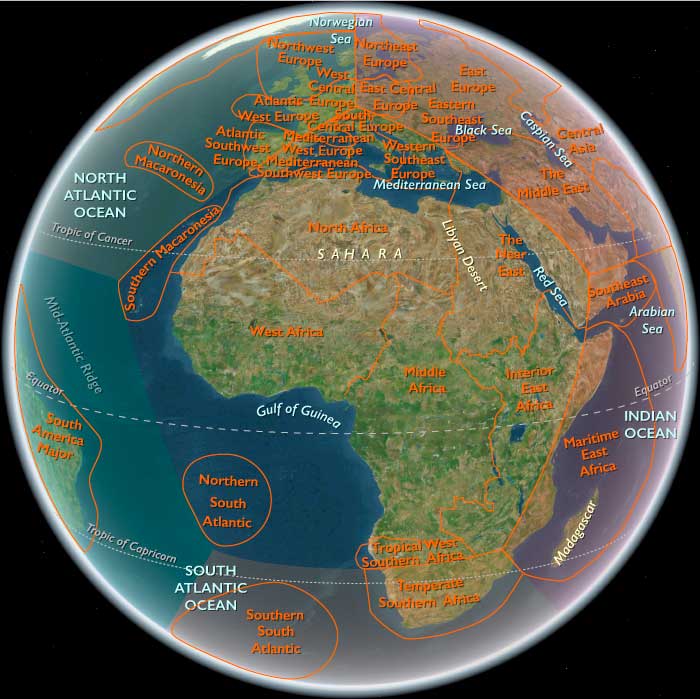
North Africa after the Arab conquest is governed by a succession of amirs (commanders) who are subordinate to the caliph in Damascus and, after 750, in Baghdad.
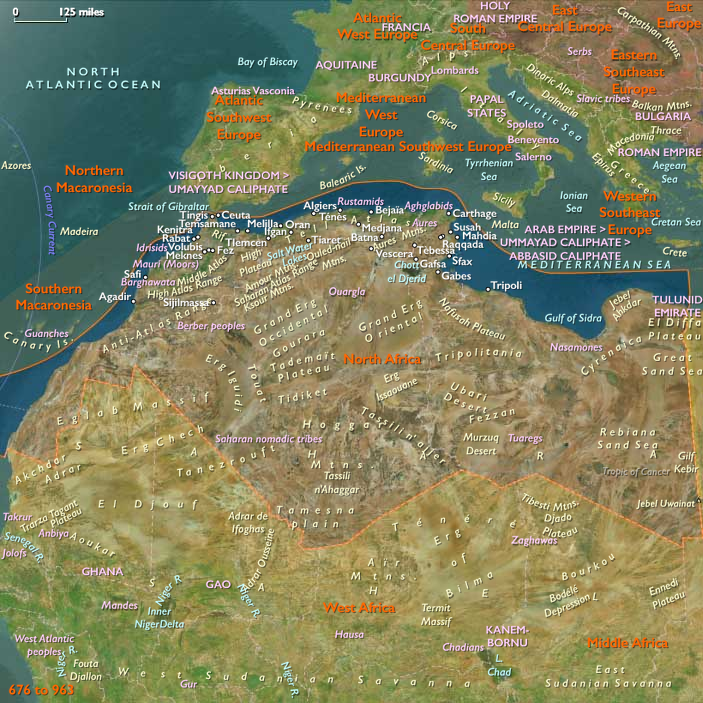
In 800 the Abbasid caliph Harun ar Rashid appoints as amir Ibrahim ibn Aghlab, who establishes a hereditary dynasty at Kairouan that rules Ifriqiya and Tripolitania as an autonomous state that is subject to the caliph's spiritual jurisdiction and that nominally recognizes him as its political suzerain.
The Aghlabid amirs repair the neglected Roman irrigation system, rebuilding the region's prosperity and restoring the vitality of its cities and towns with the agricultural surplus that was produced.
At the top of the political and social hierarchy are the bureaucracy, the military caste, and an Arab urban elite that includes merchants, scholars, and government officials who had come to Kairouan, Tunis, and Tripoli from many parts of the Islamic world.
Members of the large Jewish communities that also reside in those cities hold office under the amirs and engage in commerce and the crafts.
Converts to Islam often retain the positions of authority held traditionally by their families or class in Roman Africa, but a dwindling, Latin-speaking, Christian community lingers on in the towns until the eleventh century.
The Aghlabids contest control of the central Mediterranean with the Roman Empire and, after conquering Sicily, play an active role in the internal politics of Italy.
-
{# Image navigates to the detail page; the magnifying-glass chip is the only Fancybox lightbox trigger (kept a separate sibling — anchors can't nest). #}
 The Middle of The Earth
World
-
{# Image navigates to the detail page; the magnifying-glass chip is the only Fancybox lightbox trigger (kept a separate sibling — anchors can't nest). #}
 North Africa
Region
-
{# Image navigates to the detail page; the magnifying-glass chip is the only Fancybox lightbox trigger (kept a separate sibling — anchors can't nest). #}
 North Africa
Subregion