
Event
Siger of Brabant and the Controversy of…
Siger of Brabant and the Controversy of Latin Averroism (1276–1284)
The Averroists, a school of Aristotelian philosophers, regarded the Islamic philosopher Averroes (Ibn Rushd) as the greatest commentator on Aristotle. In 13th-century Europe, their interpretations of Aristotle, often diverging from Christian doctrine, became the subject of intellectual and theological controversy.
Siger of Brabant: The Foremost Latin Averroist
- Siger de Brabant, a professor of philosophy at the University of Paris, was the leading Latin Averroist of his time.
- He held that philosophy (based on Aristotelian reasoning) demonstrated the impossibility of personal immortality—that is, the human intellect was not individually eternal.
- However, he simultaneously argued that Christian faith teaches personal immortality, and thus, while philosophy and faith seemed to contradict each other, both could still be true in different domains.
The Doctrine of "Double Truth" and Its Critics
- Critics, including Bonaventure and Thomas Aquinas, accused Siger and the Averroists of holding a doctrine of "double truth"—one truth for philosophy (rational, Aristotelian thought) and another for faith (Christian revelation).
- Aquinas, in particular, rejected the idea that philosophy and theology could contradict each other, arguing that reason and faith must ultimately be reconciled.
- In 1276, the Bishop of Paris, Étienne Tempier, condemned a list of Averroist propositions, including those attributed to Siger, and he was summoned before the French Inquisition.
Flight to Italy and Mysterious Death (c. 1284)
- Instead of appearing before the Inquisition, Siger fled to Italy, possibly seeking papal protection in Orvieto.
- Around 1284, he was murdered in unclear circumstances, allegedly by his own insane secretary.
- He died at about the age of 49, marking the end of the Latin Averroist movement’s dominance in Parisian academic circles.
Legacy
- Despite his condemnation, Siger of Brabant’s work remained influential, particularly among later secular philosophers and Renaissance humanists.
- His debates on reason and faith contributed to the intellectual currents of Scholasticism, foreshadowing later discussions on the relationship between philosophy and theology.
The conflict over Latin Averroism was part of the broader struggle over Aristotelian thought in medieval Christian philosophy, illustrating the tensions between reason, faith, and doctrinal orthodoxy in the 13th century.
-
{# Image navigates to the detail page; the magnifying-glass chip is the only Fancybox lightbox trigger (kept a separate sibling — anchors can't nest). #}
 The North Atlantic Lands
World
-
{# Image navigates to the detail page; the magnifying-glass chip is the only Fancybox lightbox trigger (kept a separate sibling — anchors can't nest). #}
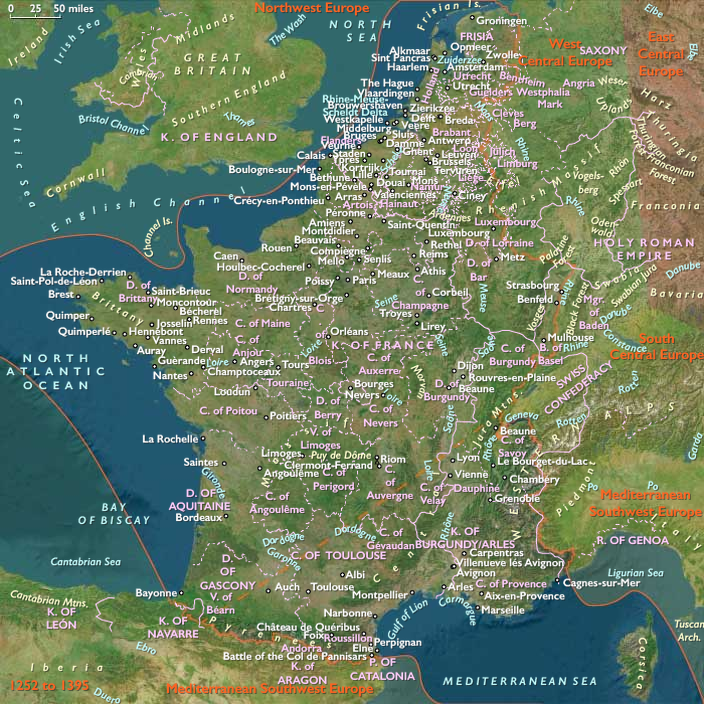 West Europe
Region
-
{# Image navigates to the detail page; the magnifying-glass chip is the only Fancybox lightbox trigger (kept a separate sibling — anchors can't nest). #}
 Atlantic West Europe
Subregion
