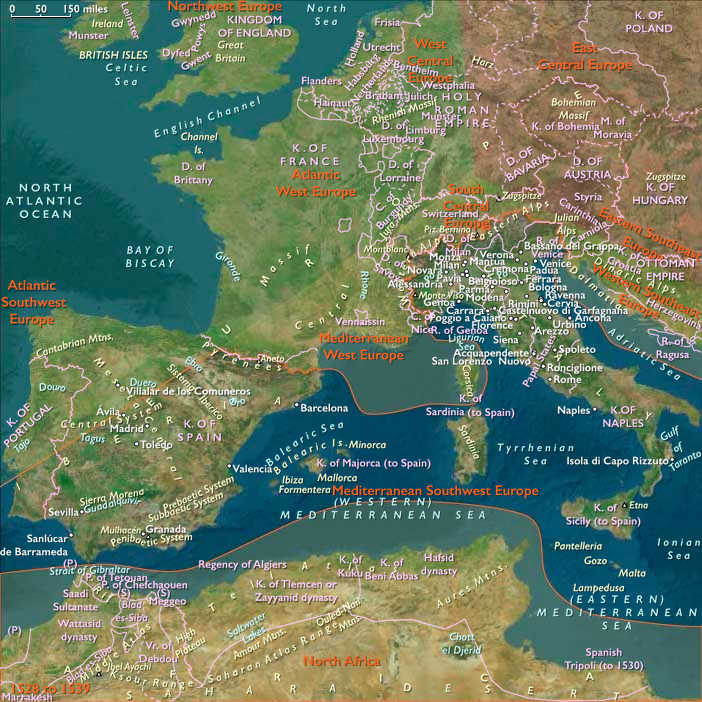
Northern-central Italy in the fourteenth and fifteenth…
1396 CE to 1539 CE
Though many of these city-states are often formally subordinate to foreign rulers, as in the case of the Duchy of Milan, which is officially a constituent state of the mainly Germanic Holy Roman Empire, the city-states generally manage to maintain de facto independence from the foreign sovereigns that had seized Italian lands following the collapse of the Western Roman Empire.
The strongest among these city-states gradually absorbs the surrounding territories, giving birth to the Signorie, regional states often led by merchant families that found local dynasties.
War between the city-states is endemic, and primarily fought by armies of mercenaries known as condottieri, bands of soldiers drawn from around Europe, especially Germany and Switzerland, led largely by Italian captains.
Decades of fighting eventually see Florence, Milan and Venice emerge as the dominant players who agree to the Peace of Lodi in 1454, which sees relative calm brought to the region for the first time in centuries.
This peace will hold for the next forty years.
Groups
Papal States (Republic of St. Peter)
View →
Italy, Kingdom of (Holy Roman Empire)
View →
Germany, Kingdom of (within the Holy Roman Empire)
View →
Florence, Republic of
View →
Venice, (Most Serene) Republic of
View →
Holy Roman Empire
View →
Naples, Angevin Kingdom of
View →
Sicily, Aragonese Kingdom of
View →
Milan, Duchy of
View →
Sicily, Aragonese Kingdom of
View →
Florence, Medici-ruled
View →
Holy Roman Empire
View →
Naples, Aragonese Kingdom of
View →
Milan, Duchy of
View →
Florence, Republic of
View →
Naples, Kingdom of
View →
Naples, Kingdom of
View →
Florence, Medici-ruled
View →
Florence, Republic of
View →
Florence, Medici-ruled
View →
Topics
Subjects
Regions
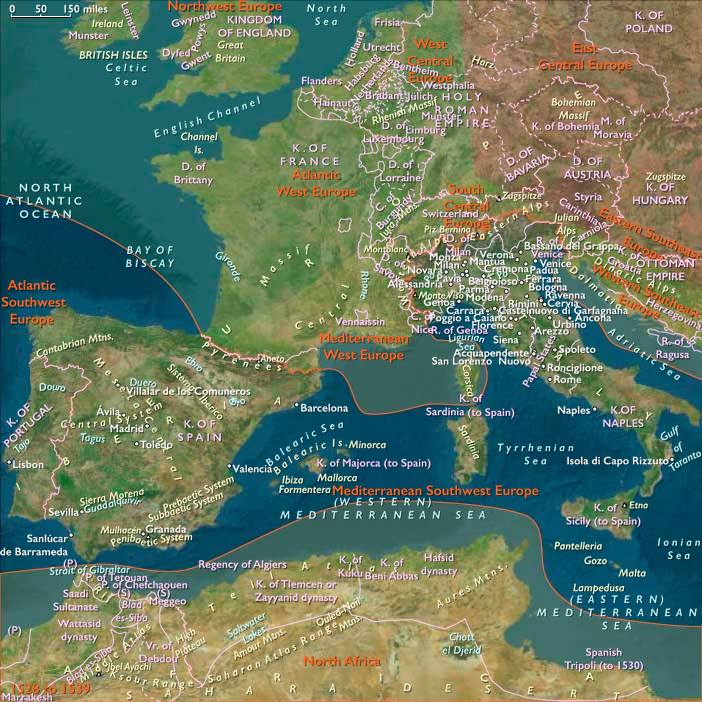
Southwest Europe
View →Subregions