
The Cometopuli brothers, based in the unconquered…
976 CE to 987 CE
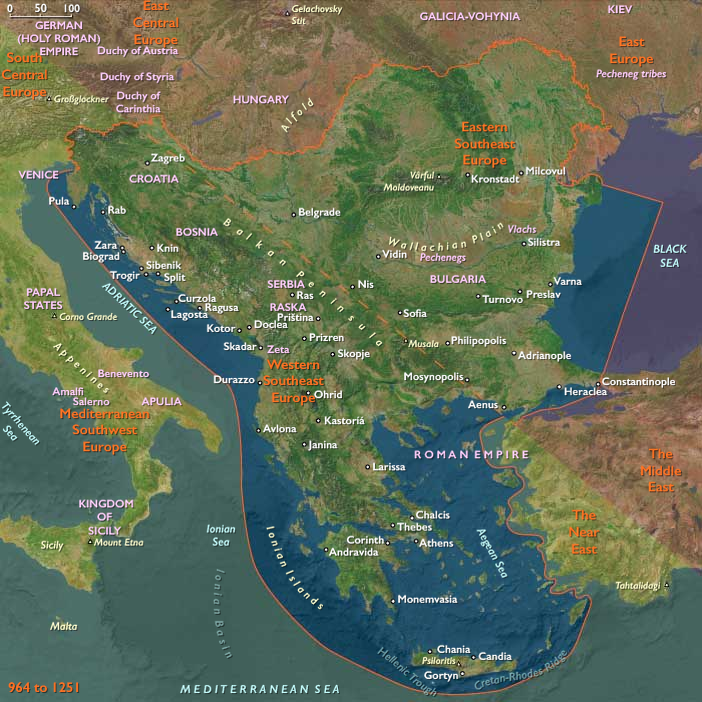
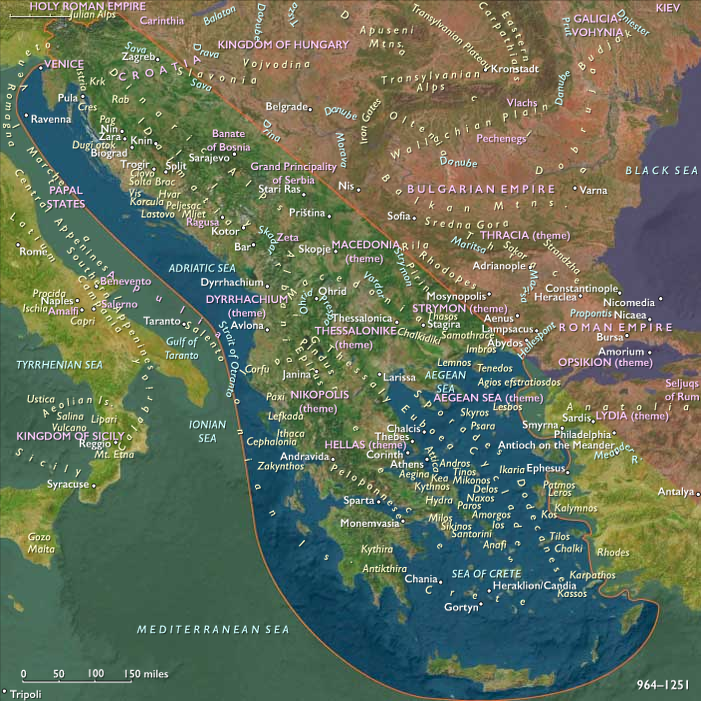
The Cometopuli brothers, based in the unconquered western regions of the Bulgarian Empire, will lead Bulgarian resistance is led until its fall in 1018 under East Roman (Byzantine) rule and its end as a state.
One of the brothers, Samuel, establishes the Macedonian, or Western Bulgarian, Empire.
People
Groups
Topics
Commodities
Subjects
Regions
Southeast Europe
View →Subregions
Western Southeast Europe
View →Related Events
Showing 10 events out of 42 total
The defeat at Stilo had forced Otto II to flee north to Rome.
He now holds an Imperial Diet at Verona on Pentecost, 983.
He had sent his nephew Otto I, Duke of Swabia and Bavaria, back to Germany with the news of the defeat and to call the German nobles to the assembly, but he had died en route on November 1, 982, in Lucca.
News of the battle had crossed the Alps, however, reaching as far as Wessex in Britain, signifying of the magnitude of the defeat.
Duke Bernard I of Saxony had been heading south for the assembly when Danish Viking raids forced him to return to face the Viking threat.
At the assembly, Otto II appoints Conrad (a distant relative of Otto II) and Henry III as the new Dukes of Swabia and Bavaria respectively.
Henry III had previously been exiled by Otto II following his defeat as part of a two-year revolt against Otto II's rule.
The defeat at Stilo had cost the Empire many nobles, forcing Otto II to lift Henry III's banishment in order to stabilize domestic affairs in Germany while he campaigns against the Muslim and Eastern Romans in southern Italy.
Also, the appointment of Conrad I allows the House of the Conradines to return to power in Swabia for the first time since Emperor Otto I in 948.
Otto II and the assembled nobles agree on a strategy of naval blockade and economic warfare until reinforcement from Germany can arrive.
Otto II now prepares for a new campaign against the Muslims and obtains a settlement with the Republic of Venice, whose assistance he needs following the destruction of his army at Stilo.
However, Otto II's death the next year and the resulting civil war will prevent the Empire from appropriately responding to the defeat.
The most important action Otto II takes at the assembly is to secure the "election" of his son Otto III, who is now only three years old, as King of Germany and heir apparent to the Imperial throne.
Otto III thus becomes the only German king elected south of the Alps.
The exact reason for this unusual procedure has been lost to history.
It is possible that the conditions in southern Italy following the defeat required Otto II to act quickly in designating an Imperial heir to ensure connivence in the Empire's future.
It is also conceivable, however, that holding the election in Italy was a deliberate choice on the part of Otto II in order to demonstrate that Italy was an equal part of the Empire on the same level as Germany.
His election secured, Otto III and his mother, the Empress Theophanu, travel north across the Alps heading for Aachen, the traditional coronation site for the Ottonians, in order for Otto III to be officially crowned as king.
Otto II stays in Italy to further address his military campaigns.
Henry arrives at Verona in May, and the Italian circuit is completed.
Medieval Verona is dominated by its forty-eight towers.
The increasing wealth of the burgher families had eclipsed the power of the counts, and in 1100 Verona had been organized as a free commune.
The counts of San Bonifacio, hereditary governors since the late ninth century, could at most hold the office of podestà of the city now and then.
The sculptor Nicholaus and anonymous members of his workshop produce bronze relief panels to cover the entrance doors of San Zeno in Verona, constructed around 1138 in the Lombard Romanesque style.
The local cavalry represented on the portal’s tympanum reflects the civic pride typical of the independent northern Italian communes.
Pope Lucius has disputed with the Holy Roman Emperor Frederick I over the disposal of the territories of the late Countess Matilda of Tuscany.
The controversy over the succession to the inheritance of the Countess had been left unsettled by an agreement of 1177, and the Emperor had proposed in 1182 that the Curia should renounce its claim, receiving in exchange two-tenths of the imperial income from Italy, one-tenth for the Pope and the other tenth for the cardinals.
Lucius had consented neither to this proposition nor to another compromise suggested by Frederick I the next year, nor does a personal discussion between the two potentates at Verona in October 1184 lead to any definite result.
In the meantime, other causes of disagreement had appeared when the Pope refused to comply with Frederick I's wishes as to the regulation of German episcopal elections which had taken place during the schism, especially as regards a contested election to the See of Treves in 1183.
During the conflict between Frederick I and the papacy, the problem of heresy requires a political solution.
In November 1184, Pope Lucius III, aiming to abolish completely Christian heresy, decrees in Ad abolendam that all "counts, barons, rectors, [and] consuls of cities and other places" who do not join in the struggle against heresy when called upon to do so will be excommunicated and their territories placed under interdict—and declares that these provisions join the apostolic authority of the church with the sanction of imperial power.
Among the particular sects mentioned in Ad abolendam are the Cathars, Humiliati, Waldensians, Arnoldists, and Josephines.
More important than the direct attack on heresy, however, is the stipulation of equal measures for those who support heretics, overtly or indirectly.
Those accused of heresy, if they cannot prove their innocence or forswear their errors, or if they backslide into error subsequently, are to be handed over to the lay authorities to receive their animadversio debita ("due penalty").
All those who support heresy are to be deprived of their many rights: the right to hold public office, the right to trial, the right to draft a will, and the hereditability of their fiefs and offices.
For the enforcement of the measures demanded by the decretal, Lucius obligates all patriarchs, archbishops, and bishops to re-announce the excommunication on certain feasts and holidays.
Those who do not observe this for three years consecutively are to be deprived of their ecclesiastical offices.
The bishops are furthermore obligated to "seek out" heretics.
They are to make bi- or triannual rounds of their dioceses, visiting locations of suspicion and question the people about the existence of heresy.
The people will be required to swear under oath (compurgation) anything they know about heretical activity.
All oath-breakers are to be treated as heretics.
Though largely ineffective, the document serves as tinder for the eventual flames of the Albigensian Crusade and the Inquisitions.
Contrary to what is often said, Pope Lucius did not institute the Inquisition, which will not be created until the reign of Pope Gregory IX in 1234.
Lucius, in pursuance of his anti-imperial policy, declines in 1185 to crown Prince Henry, who had married Constance of Sicily, the heiress of the kingdom of Sicily, as Frederick I's destined successor, and the breach between the Empire and the Curia becomes wider on questions of Italian politics.
In 1185, preparations begin for the Third Crusade in answer to the appeals of King Baldwin IV of Jerusalem.
Before they are completed, Lucius dies in Verona on November 25.
Ubaldo Allucingoli had been made cardinal and Archbishop of Milan by Lucius III, whom he succeeds.
He had vigorously taken up his predecessor's quarrels with Holy Roman Emperor Frederick I Barbarossa, including the standing dispute about the disposal of the territories of the countess Matilda of Tuscany.
Even after his elevation to the papacy, Urban continues to hold the archbishopric of Milan, and in this capacity refuses to crown Frederick’s son as King of Italy.
Uberto Crivelli had been made cardinal and Archbishop of Milan by Pope Lucius III, whom he had succeeded on November 25, 1185.
He vigorously takes up his predecessor's quarrels with Holy Roman Emperor Frederick I Barbarossa, including the standing dispute about the disposal of the territories of the countess Matilda of Tuscany.
Even after his elevation to the papacy, Urban continues to hold the archbishopric of Milan, and in this capacity refuses to crown as King of Italy Frederick I's son Prince Henry, who had married Constance of Sicily, the heiress of the kingdom of Sicily.
Prevented by his enemies from entering Rome, the new pope remains in Verona.
Henry in the south of Italy has cooperated with the rebel Senate of Rome, while Frederick I in the north has locked the passes of the Alps and cut off all communication between the Pope, at this time living in Verona, and his German adherents.
Urban III now resolves on excommunicating Frederick I, but the Veronese protest against such a proceeding being resorted to within their walls.
He accordingly withdraws to ...
The emperor returns again to Italy in August 1237, this time aiming to definitely crush the Second Lombard League.
He crosses the Alps to Verona and here his two thousand knights are joined by Ezzelino III da Romano's troops, including soldiers from Treviso, Padua, Vicenza and Verona itself, as well as by Tuscan men led by Gaboard of Arnstein.
Six thousand infantry and horsemen from the Kingdom of Sicily come later, including Apulian Muslim archers.
The rest of the army is formed by Ghibellines from Cremona, Pavia, Modena, Parma and Reggio, for a total of twelve thousand to fifteen thousand men.
Conradin, son of the late Holy Roman Emperor Conrad IV, had assumed the title of King of Jerusalem and Sicily and had taken possession of the Duchy of Swabia in 1262, remaining for some time in his duchy.
Conradin's first invitation to Italy had come from the Guelphs of Florence: they had asked him to take arms against his father's half-brother Manfred, who had been crowned king of Sicily in 1258 on a false rumor of Conradin's death.
Conradin’s uncle and guardian, Louis II, Duke of Upper Bavaria, had refused this invitation on his nephew's behalf.
After Charles I of Anjou had defeated and killed Manfred at Benevento, taking possession of southern Italy, envoys from the Ghibelline cities had then gone to Bavaria and urged Conradin to come and free Italy.
Count Guido de Montefeltro, representing Henry of Castile, Senator of Rome, has offered him the support of the eternal city.
Pledging his lands, Conradin crosses the Alps and issues a manifesto at Verona setting forth his claim on Sicily.
Dante, moving to various centers sympathetic to the Ghibelline cause, has begun to produce a steady stream of literary work.
In his unfinished Convivio (“The Banquet”), written around 1304-07, the poet, apparently immersing himself in the pagan philosophers and cultivation of the Roman tradition, expatiates on his earlier love poetry.
In his pioneering study of linguistics and style, De vulgari eloquentia (“On the Vulgar Speech”), written around 1304-06 in Latin, Dante argues for the use of the vernacular in serious works of literature and for combining a number of Italian dialects to create a new national language.