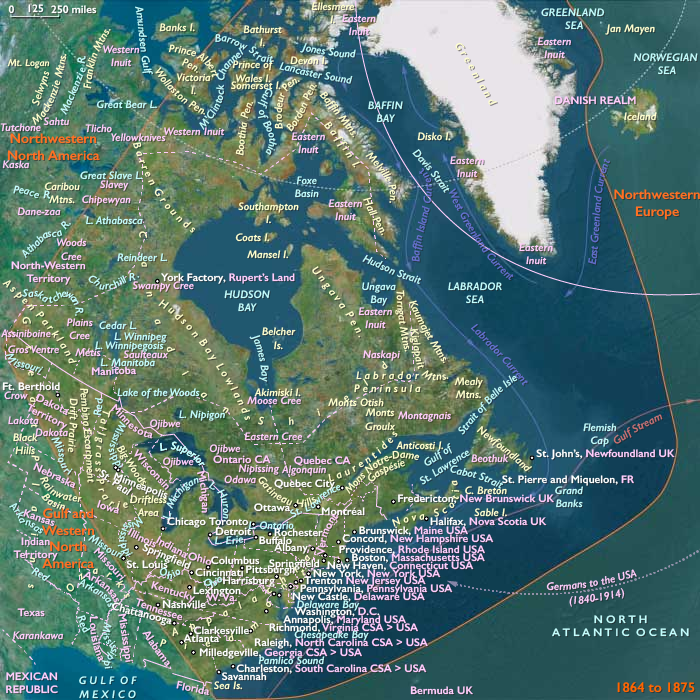
Dozens of oil refineries have been built…
February 1864 CE
Dozens of oil refineries have been built in Cleveland, Ohio, by 1864.
The commercial oil business is in its infancy.
Whale oil has become too expensive for the masses, and a cheaper, general-purpose lighting fuel is needed.
John D. Rockefeller was the second of six children born in Richford, New York, to William Avery Rockefeller (November 13, 1810 – May 11, 1906) and Eliza (Davison; September 12, 1813 – March 28, 1889).
Genealogists trace some of his ancestors to French Huguenots who fled to Germany in the seventeenth century.
His father, first a lumberman, then a traveling salesman, had billed himself as a “botanic physician” and sold elixirs.
The locals referred to the mysterious but fun-loving man as "Big Bill," and "Devil Bill".
He was a sworn foe of conventional morality, who had opted for a vagabond existence and who returned to his family infrequently.
Throughout his life, William Avery Rockefeller had gained a reputation for shady schemes rather than productive work.
Eliza, a homemaker and devout Baptist, had struggled to maintain a semblance of stability at home, as William was frequently gone for extended periods.
She also put up with his philandering and his double life, which included bigamy.
Thrifty by nature and necessity, she had taught her son that "willful waste makes woeful want."
Young Rockefeller had done his share of the regular household chores and earned extra money raising turkeys, selling potatoes and candy and eventually lending small sums of money to neighbors.
He followed his father’s advice to "trade dishes for platters" and always get the better part of any deal.
Big Bill once bragged, "I cheat my boys every chance I get. I want to make ‘em sharp."
When he was a boy, his family had moved to Moravia, New York, and, in 1851, to Owego, where he attended Owego Academy.
In 1853, his family had moved to Strongsville, a suburb of Cleveland, Ohio.
Rockefeller had attended Cleveland's Central High School and had then taken a ten-week business course at Folsom's Commercial College where he studied bookkeeping.
In spite of his father’s absences and frequent family moves, young Rockefeller was a well-behaved, serious and studious boy.
His contemporaries described him as reserved, earnest, religious, methodical, and discreet.
He was an excellent debater and expressed himself precisely.
He also had a deep love of music and dreamed of it as a possible career.
Early on, he displayed an excellent mind for numbers and detailed accounting.
In September 1855, when Rockefeller was sixteen, he got his first job as an assistant bookkeeper, working for a small produce commission firm called Hewitt & Tuttle.
He was particularly adept at calculating transportation costs, which serves him well later in his career.
The full salary for his first three months' work was $50 (50 cents a day).
From the beginning, he has donated about 6% of his earnings to charity, which had increased to 10% by the age of twenty, when he tithes to his Baptist church.
As a youth, Rockefeller reportedly said that his two great ambitions were to make $100,000 and to live one hunfred years.
In 1859, Rockefeller had gone into the produce commission business with a partner, Maurice B. Clark, and they had raised $4,000 in capital.
Rockefeller had gone steadily ahead in business from there, making money each year of his career.
Chemist Samuel Andrews had already had some experience in shale-oil production in the newly discovered oilfields of western Pennsylvania when in 1862 he approached Rockefeller and Clark ,who saw the potential in Andrews' plan and invested in the venture.
With this capital, Andrews had designed and begun a small refinery in "The Flats", Cleveland's burgeoning industrial area.
The refinery is directly owned by Andrews, Clark & Company, which is composed of Clark & Rockefeller, Andrews, and M. B. Clark's two brothers.
While his brother Frank fights in the Civil War, Rockefeller tends his business and hires substitute soldiers.
He gives money to the Union cause, as do many rich Northerners who avoid combat.
People
Commodities
Regions
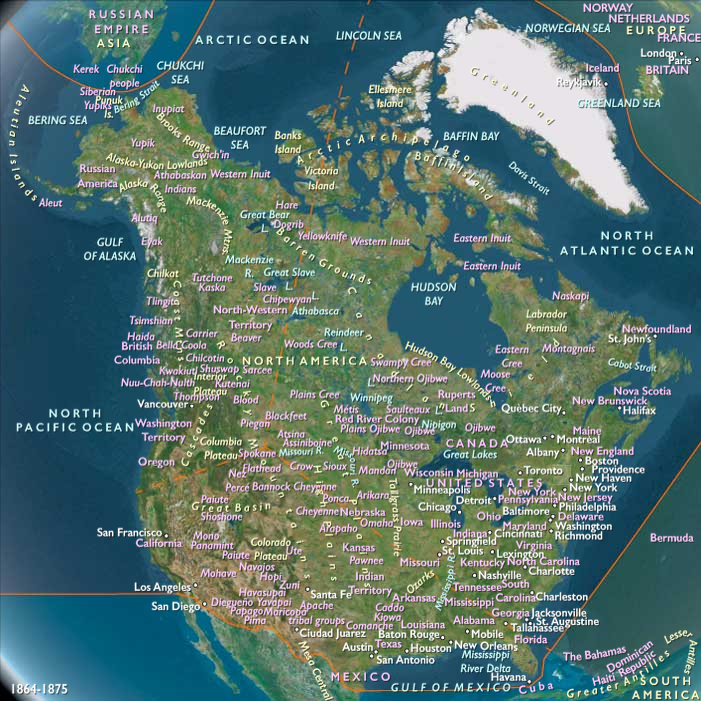
Northern North America
View →Subregions