John D. Rockefeller
American industrialist and philanthropist
1839 CE to 1937 CE
John Davison Rockefeller (July 8, 1839 – May 23, 1937) is an American industrialist and philanthropist.
He is the founder of the Standard Oil Company, which dominates the oil industry and is the first great U.S. business trust.
Rockefeller revolutionizes the petroleum industry and defines the structure of modern philanthropy.
In 1870, he founds the Standard Oil Company and aggressively runs it until he officially retires in 1897.
Standard Oil begins as an Ohio partnership formed by John D. Rockefeller, his brother William Rockefeller, Henry Flagler, Jabez Bostwick, chemist Samuel Andrews, and a silent partner, Stephen V. Harkness.
As kerosene and gasoline grow in importance, Rockefeller's wealth soars, and he becomes the world's richest man and the first American worth more than a billion dollars.
Adjusting for inflation, he is often regarded as the richest person in history.
Rockefeller spends the last 40 years of his life in retirement.
His fortune is mainly used to create the modern systematic approach of targeted philanthropy.
He is able to do this through the creation of foundations that have a major effect on medicine, education, and scientific research.
His foundations pioneer the development of medical research, and are instrumental in the eradication of hookworm and yellow fever.
He is also the founder of both the University of Chicago and Rockefeller University.
He is a devoted Northern Baptist and supports many church-based institutions throughout his life.
Rockefeller adheres to total abstinence from alcohol and tobacco throughout his life.
He has four daughters and one son; John D. Rockefeller, Jr. "Junior" is largely entrusted with the supervision of the foundations.
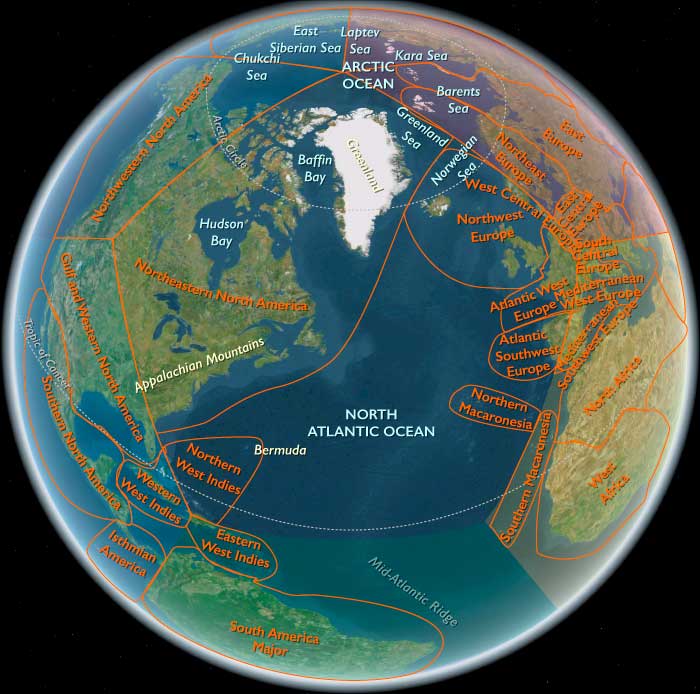
World
The Atlantic Lands
View →Related Events
Showing 10 events out of 25 total
Dozens of oil refineries have been built in Cleveland, Ohio, by 1864.
The commercial oil business is in its infancy.
Whale oil has become too expensive for the masses, and a cheaper, general-purpose lighting fuel is needed.
John D. Rockefeller was the second of six children born in Richford, New York, to William Avery Rockefeller (November 13, 1810 – May 11, 1906) and Eliza (Davison; September 12, 1813 – March 28, 1889).
Genealogists trace some of his ancestors to French Huguenots who fled to Germany in the seventeenth century.
His father, first a lumberman, then a traveling salesman, had billed himself as a “botanic physician” and sold elixirs.
The locals referred to the mysterious but fun-loving man as "Big Bill," and "Devil Bill".
He was a sworn foe of conventional morality, who had opted for a vagabond existence and who returned to his family infrequently.
Throughout his life, William Avery Rockefeller had gained a reputation for shady schemes rather than productive work.
Eliza, a homemaker and devout Baptist, had struggled to maintain a semblance of stability at home, as William was frequently gone for extended periods.
She also put up with his philandering and his double life, which included bigamy.
Thrifty by nature and necessity, she had taught her son that "willful waste makes woeful want."
Young Rockefeller had done his share of the regular household chores and earned extra money raising turkeys, selling potatoes and candy and eventually lending small sums of money to neighbors.
He followed his father’s advice to "trade dishes for platters" and always get the better part of any deal.
Big Bill once bragged, "I cheat my boys every chance I get. I want to make ‘em sharp."
When he was a boy, his family had moved to Moravia, New York, and, in 1851, to Owego, where he attended Owego Academy.
In 1853, his family had moved to Strongsville, a suburb of Cleveland, Ohio.
Rockefeller had attended Cleveland's Central High School and had then taken a ten-week business course at Folsom's Commercial College where he studied bookkeeping.
In spite of his father’s absences and frequent family moves, young Rockefeller was a well-behaved, serious and studious boy.
His contemporaries described him as reserved, earnest, religious, methodical, and discreet.
He was an excellent debater and expressed himself precisely.
He also had a deep love of music and dreamed of it as a possible career.
Early on, he displayed an excellent mind for numbers and detailed accounting.
In September 1855, when Rockefeller was sixteen, he got his first job as an assistant bookkeeper, working for a small produce commission firm called Hewitt & Tuttle.
He was particularly adept at calculating transportation costs, which serves him well later in his career.
The full salary for his first three months' work was $50 (50 cents a day).
From the beginning, he has donated about 6% of his earnings to charity, which had increased to 10% by the age of twenty, when he tithes to his Baptist church.
As a youth, Rockefeller reportedly said that his two great ambitions were to make $100,000 and to live one hunfred years.
In 1859, Rockefeller had gone into the produce commission business with a partner, Maurice B. Clark, and they had raised $4,000 in capital.
Rockefeller had gone steadily ahead in business from there, making money each year of his career.
Chemist Samuel Andrews had already had some experience in shale-oil production in the newly discovered oilfields of western Pennsylvania when in 1862 he approached Rockefeller and Clark ,who saw the potential in Andrews' plan and invested in the venture.
With this capital, Andrews had designed and begun a small refinery in "The Flats", Cleveland's burgeoning industrial area.
The refinery is directly owned by Andrews, Clark & Company, which is composed of Clark & Rockefeller, Andrews, and M. B. Clark's two brothers.
While his brother Frank fights in the Civil War, Rockefeller tends his business and hires substitute soldiers.
He gives money to the Union cause, as do many rich Northerners who avoid combat.
An advertising slogan is "The holy lamps of Tibet are primed with Astral Oil."
Born in Watertown, Massachusetts, Pratt was one of eleven children.
His father, Asa Pratt, was a carpenter.
Of modest means, he had spent three winters as a student at Wesleyan Academy, and is said to have lived on a dollar a week at times.
In nearby Boston, Massachusetts, Pratt had joined a company specializing in paints and whale oil products.
In 1850 or 1851, he had come to New York City, where he worked for a similar company handling paint and oil.
In 1861, the then twenty-one-year-old Henry had pooled his savings of approximately US$600 with a friend, Charles P. Ellis.
They had set out to western Pennsylvania and its newly discovered oil fields.
Borrowing another US$600, the young partners had begun a small refinery at McClintocksville near Oil City, naming their new enterprise Wamsutta Oil Refinery.
The old Native American name "Wamsutta" had apparently been selected in honor of their hometown area of New England, where Wamsutta Company in nearby New Bedford had opened in 1846, and is a major employer.
The Wamsutta Company had been the first of many textile mills that had gradually come to supplant whaling as the principal employer in New Bedford.
In their first year of operation, Rogers and Ellis and their refinery had made US$30,000, an amount greater than the earnings of three whaling ship trips during an average voyage of more than a year's duration.
When Rogers returned home to Fairhaven for a short vacation the next year, he had been greeted as a success.
While vacationing in Fairhaven in 1862, Rogers had married his childhood sweetheart, Abbie Palmer Gifford, who was also of Mayflower lineage, and who had returned with him to the oil fields where they lived in a one-room shack along Oil Creek where her young husband and Ellis worked the Wamsutta Oil Refinery.
While living in Pennsylvania, their first daughter, Anne Engle, had been born in 1865.
They will have five surviving children together, four girls and a boy.
Although Ellis and Rogers have no wells and are dependent upon purchasing crude oil to refine and sell to Pratt, the two young men had agreed to sell the entire output of their small Wamsutta refinery to Pratt's company at a fixed price.
This had worked well at first until, a few months later, crude oil prices suddenly increased due to manipulation by speculators.
The young entrepreneurs had struggled to try to live up to their contract with Pratt, but soon their surplus had been wiped out, and they became heavily in debt to Pratt.
Charles Ellis had given up, but in 1866, Henry Rogers had gone to Pratt in New York and told him he would take personal responsibility for the entire debt.
This had so impressed Pratt that he had immediately hired him for his own organization, making Rogers foreman of his Brooklyn refinery, with a promise of a partnership if sales run over $50,000 a year.
The Rogers' family had moved to Brooklyn, and Rogers had moved steadily from foreman to manager, and then superintendent of Pratt's Astral Oil Refinery.
Henry Huttleston Rogers, the son of Rowland Rogers, a former ship captain, bookkeeper, and grocer, and Mary Eldredge Huttleston Rogers, was born in Mattapoisett, Massachusetts, on January 29, 1840.
Both parents were of English descent and were descended from the Pilgrims who arrived in the seventeenth century aboard the Mayflower.
His mother's family had earlier used the spelling "Huddleston" rather than "Huttleston."
Harkness will become its second largest shareholder; the company's success will make him enormously wealthy.
Born in Fayette, New York, Stephen is the son of Dr. David Harkness and his first wife who died in 1820.
His father had relocated to the Western Reserve region of Northeast Ohio, settling in Milan, where he had remarried to Elizabeth Caldwell Morrison.
David Harkness had died in 1825 and his widow later returned to Seneca County, New York where she remarried to the Reverend Isaac Flagler, a Presbyterian minister in Milton, New York with whom she had a son, Henry Flagler.
David Harkness had a younger brother, Lamon Harkness, who was also a doctor but who became a successful businessman in Bellevue, Ohio.
Stephen Harkness had moved to Bellevue, Ohio at age twenty-one after finishing his apprenticeship as a harnessmaker.
He had worked for a time in harnessmaking but in 1855 had set up a distillery in Monroeville, Ohio that was a success.
Within a few years, he had organized a bank and in 1864 had formed a partnership with Wmilliam Halsey Doan to provide crude oil to refineries; this had made him a rich man.
Harkness sells his Monroeville businesses in 1866 and moves to Millionaires Row in Cleveland.
He organizes The Euclid Avenue National Bank and is president of Belt Mining Company.
Cleveland, by the war's end, had become one of the five main refining centers in the U.S. (besides Pittsburgh, Philadelphia, New York, and the region in northwestern Pennsylvania where most of the oil originated).
Cleveland had obtained its name on July 22, 1796, when surveyors of the Connecticut Land Company laid out Connecticut's Western Reserve into townships and a capital city they named "Cleaveland" after their leader, General Moses Cleaveland.
Cleaveland had overseen the plan for what would become the modern downtown area, centered on Public Square, before returning home, never again to visit Ohio.
The first settler in Cleaveland had been Lorenzo Carter, who had built a cabin on the banks of the Cuyahoga River.
The Village of Cleaveland was incorporated on December 23, 1814.
In spite of the nearby swampy lowlands and harsh winters, its waterfront location had proven to be an advantage.
The area had begun rapid growth after the 1832 completion of the Ohio and Erie Canal.
This key link between the Ohio River and the Great Lakes connects the city to the Atlantic Ocean via the Erie Canal and later via the St. Lawrence Seaway; and the Gulf of Mexico via the Mississippi River.
Growth had continued with added railroad links.
Cleveland had incorporated as a city in 1836.
In 1836, the city, then located only on the eastern banks of the Cuyahoga River, had nearly erupted into open warfare with neighboring Ohio City over a bridge connecting the two.
Ohio City had remained an independent municipality until its annexation by Cleveland in 1854.
The city's prime geographic location as transportation hub on the Great Lakes has played an important role in its development as a commercial center.
Cleveland serves as a destination point for iron ore shipped from Minnesota, as well as coal transported by rail.
John D. Rockefeller had bought out the Clark brothers for $72,500 at auction and established the firm of Rockefeller & Andrews in February 1865, in what will later be described by oil industry historian Daniel Yergin as a "critical" action. (Yergin, Daniel. The Prize: The Epic Quest for Oil, Money, and Power. New York: Simon & Schuster, 1991.)
Rockefeller is well-positioned to take advantage of the coming postwar prosperity and the great expansion westward, fostered by the growth of railroads and an oil-fueled economy.
He borrows heavily, reinvests profits, adapts rapidly to changing markets, and fields observers to track the quickly expanding industry.
In 1866, his brother William Rockefeller builds another refinery in Cleveland and brings John into the partnership.
The firm of Rockefeller, Andrews and Flagler had been established in 1867, when Henry M. Flagler became a partner with John D. Rockefeller.
By 1868, with Rockefeller continuing practices of borrowing and reinvesting profits, controlling cost and using refineries' waste, the company owns two Cleveland refineries and a marketing subsidiary in New York; it is the largest oil refinery in the world.
He is granted U.S. Patent # 120,539 on October 31, 1871.
In the past few years, Rogers has become, in the words of Elbert Hubbard, Pratt's "hands and feet and eyes and ears" (Little Journeys to the Homes, 1909)
As their family grows, Henry and Abbie continue to live in New York City, but vacation frequently at Fairhaven.
Standard Oil absorbs twenty-two of its twenty-six Cleveland competitors in less than four months in 1872, in what will later be known as "The Cleveland Conquest" or "The Cleveland Massacre".
John D. Rockefeller had in January 1870 formed Standard Oil of Ohio, which had rapidly become the most profitable refiner in Ohio and has grown to become one of the largest shippers of oil and kerosene in the country.
The railroads are fighting fiercely for traffic and, in an attempt to create a cartel to control freight rates, had formed the South Improvement Company, a Pennsylvania corporation, in the fall of 1871, in collusion with Standard and other oil men outside the main oil centers.
The cartel receives preferential treatment as a high-volume shipper, which includes not just steep rebates of up to fifty percent for their product, but also rebates for the shipment of competing products.
Founded by Thomas A. Scott, president of the Union Pacific Railroad in 1871-1872, the South Improvement Company had issued two thousand shares of stock, of which nine hundred are controlled by Rockefeller and his partners.
Rockefeller had then started negotiations to collude with the three major railroads running through Cleveland: the Pennsylvania Railroad, the Erie, and the New York Central.
The result of these secret negotiations were as follows: (1) The official rate per barrel from Cleveland to New York will be $2.56, but South Improvement will receive a $1.06 rebate; (2) The railroads will also pay South Improvement $1.06 per barrel of oil shipped that is not produced by South; (3) The railroads will also give reports of the shipping destinations, costs, and dates of all of South's competitors; (4) The commerce will be divided evenly among the railroads, with a double share going to Pennsylvania Railroad; and (5) South will provide tank cars and loading facilities.
The secret concessions would have helped lessen the "vicious" competition among the railroad lines by giving a steady, standardized flow of commerce, but word leaks out of the South Improvement Scheme, and the proposed one hundred percent increase in rail shipping rates inflames the independent producers and many smaller refineries.
Following a summit and vocal protest by the independent oil producers and refiners led by Pratt and Rogers of the Charles Pratt and Company refining interests of Brooklyn, New York, which comes close to physical warfare, including boycotts and vandalism, in western Pennsylvania in March 1872 (and comes to be known as the "Oil War"), the railroads soon agree to back down.
Pennsylvania revokes the cartel’s charter and equal rates are restored for the time being.
Although Rockefeller will become the target of many who decry Standard Oil's ruthlessness in subsequent years, the South Improvement rebate scheme had been Flagler's idea.
Undeterred, though vilified for the first time by the press, Rockefeller continues with his self-reinforcing cycle of buying competing refiners, improving the efficiency of his operations, pressing for discounts on oil shipments, undercutting his competition, making secret deals, raising investment pools, and buying rivals out.
Even Charles Pratt and Henry H. Rogers, Rockefellers’ former antagonists, eventually see the futility of continuing to compete against Standard Oil: in 1874, they make a secret agreement with their old nemesis to be acquired.
Pratt and Rogers become Rockefeller's partners.
Rogers, in particular, becomes one of Rockefeller's key men in the formation of the Standard Oil Trust.
Pratt's son, Charles Millard Pratt, will eventually become Secretary of Standard Oil.
For many of his competitors, Rockefeller has merely to show them his books so they can see what they are up against, then make them a decent offer.
If they refuse his offer, he tells them he will run them into bankruptcy, then cheaply buy up their assets at auction.
He sees himself as the industry’s savior, "an angel of mercy", absorbing the weak and making the industry as a whole stronger, more efficient, and more competitive.
