The Mount Ebal structure is considered by…
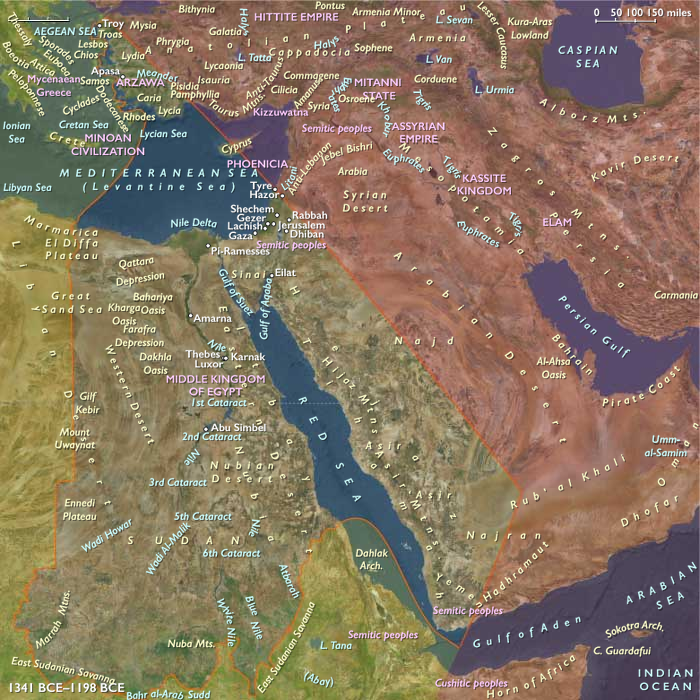
1341 BCE to 1198 BCE
The Mount Ebal structure is considered by its excavator, Adam Zertal, to be the biblical altar built by Joshua.
According to the Book of Joshua, chapter 8, the Israelites under the leadership of Joshua had built an altar on Mount Ebal, as had instructed earlier by Moses.
During the ceremony that followed, Joshua renewed the covenant between Yahweh and the Israelites enacted on Mount Sinai.
According to Zertal, it is possible to identify the structure as an altar, because it closely matches the biblical and Mishnaic descriptions of altars
Found within a naturally shaped amphitheater in 1980, the site will yield pottery fragments from the Iron Age I, whole pottery vessels from this period, pieces of peeled plaster, worship vessels including incense vessels, thousands of kosher animal bones, fate cubes, two Egyptian scarabs and two earrings.
Baruch Brandl will date the scarabs to the last quarter of the thirteenth century BCE, the time of Ramesses II.
One scarab contains an ornament reminiscent of a Hyksos style and the other is engraved in a cartouche with the name of Thutmose III, which dates back to the fifteenth century BCE, and according to the researcher, it is a memorial scarab issued by Ramesses II in memory of Thutmose.
Dozens of trapezoidal stone seals dating to the end of the Late Bronze Age are engraved with lines and dots in a style that is also revealed on the handles of the pottery vessels that are brought to the site with the offerings to God.
This style has been identified throughout the eastern part of Mount Manasseh and in the northern part of Mount Ephraim.
This marking method has no parallels in other areas at the same time.
These markings were created, according to the excavator, to identify the presenters—the family or the tribe who placed them at the site of the altar.
The excavation will find a large walled structure, seemingly built direct into the bedrock without a doorway or floor, and infilled by layers of stone, ash, and earth; on the southwest are two paved areas, split apart by a further wide wall higher at one end than the other and with a surrounding oval wall.
Slowly burnt bones found at the site will be discovered to originate from bullocks, goats, and fallow deer.
Excavations, conducted by the University of Haifa and the Israel Exploration Society, lasted eight seasons between 1982 and 1989.
Baruch Brandl will date the scarabs to the last quarter of the thirteenth century BCE, the time of Ramesses II.
One scarab contains an ornament reminiscent of a Hyksos style and the other is engraved in a cartouche with the name of Thutmose III, which dates back to the fifteenth century BCE, and according to the researcher, it is a memorial scarab issued by Ramesses II in memory of Thutmose.
Dozens of trapezoidal stone seals dating to the end of the Late Bronze Age are engraved with lines and dots in a style that is also revealed on the handles of the pottery vessels that are brought to the site with the offerings to God.
This style has been identified throughout the eastern part of Mount Manasseh and in the northern part of Mount Ephraim.
This marking method has no parallels in other areas at the same time.
These markings were created, according to the excavator, to identify the presenters—the family or the tribe who placed them at the site of the altar.
The excavation will find a large walled structure, seemingly built direct into the bedrock without a doorway or floor, and infilled by layers of stone, ash, and earth; on the southwest are two paved areas, split apart by a further wide wall higher at one end than the other and with a surrounding oval wall.
Slowly burnt bones found at the site will be discovered to originate from bullocks, goats, and fallow deer.
Excavations, conducted by the University of Haifa and the Israel Exploration Society, lasted eight seasons between 1982 and 1989.
Locations
Regions
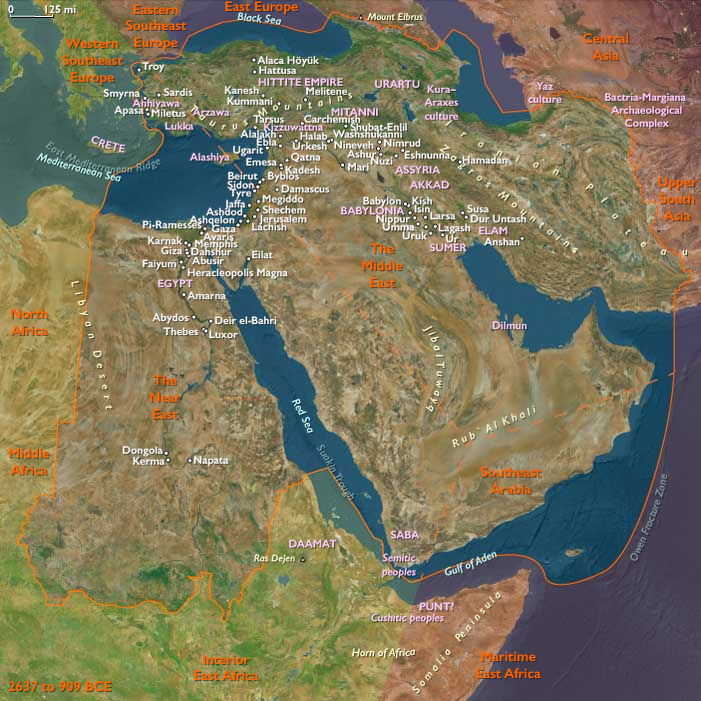
The Near and Middle East
View →Subregions