The conquistador Panfilo de Narváez, who had…
June 1527 CE
The conquistador Panfilo de Narváez, who had returned to Spain after two years of imprisonment in Mexico by Hernán Cortés, had on December 25, 1526, been commissioned by Charles V to subdue and colonize vast lands from Florida westward along what is now the Gulf Coast of the United States for Spain, with numerous governing titles bestowed on the colonial official.
The contract had given him one year to gather an army, leave Spain, establish at least two towns of one hundred people each, and garrison two additional forts at any point along the coast.
Appointed adelantado of Florida, Narváez, who has had to secure the funding for the expedition, has recruited investors by marketing the promise of riches comparable to those found by Hernán Cortés.
He also calls in many debts owed to him, and uses this money to pay for major expenses of the expedition.
Álvar Núñez Cabeza de Vaca, appointed by the Crown as treasurer and sheriff, is to serve as the king's eyes and ears, and is second in command.
He is to ensure the Crown receives five percent of any wealth acquired during the expedition.
Other members include Alonso de Solís as royal inspector of mines, Alonso Enríquez as comptroller, an Aztec prince named by the Spanish as Don Pedro, and a contingent of Franciscan and diocesan priests led by Padre Juan Suárez (sometimes spelled "Xuárez").
Most of the six hundred men are troops, chiefly men from Spain and Portugal, including some of mixed African descent, and some twenty-two from Italy.
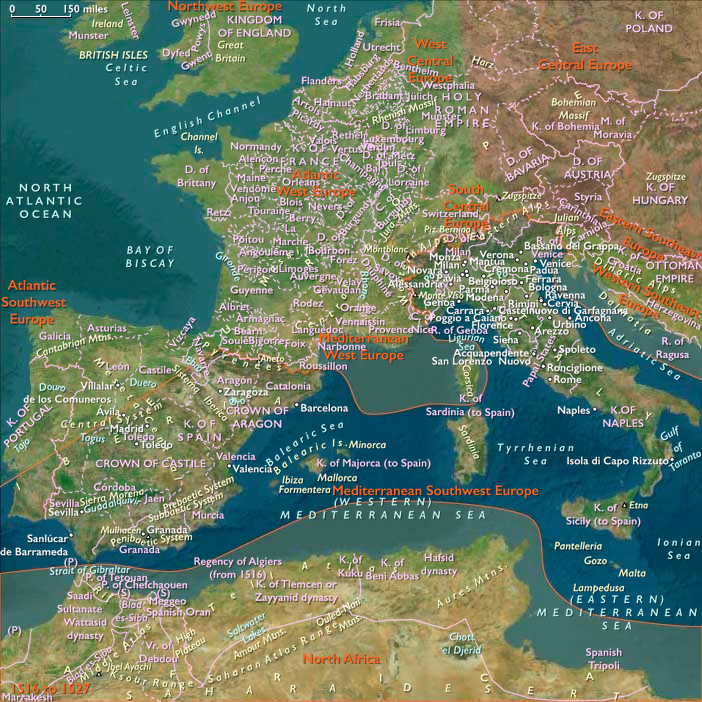
The five-ship expedition departs Spain from the port of Sanlúcar de Barrameda at the mouth of the Guadalquivir River on June 17, 1527.
Among the force are about four hundred and fifty troops, officers, and enslaved men.
About one hundred and fifty others are sailors, wives (married men may not travel without their wives to the Indies), and servants.
People
Groups
Topics
Commodities
Subjects
Regions
Southwest Europe
View →Subregions