
Event
The credit boom, supported by merchants and…
The credit boom, supported by merchants and bankers, has facilitated the expansion of manufacturing, mining and internal improvements in both Britain and the thirteen colonies.
Until the outbreak of the credit crisis, the period from 1770 to 1772 is considered prosperous and politically calm in both Britain and the American colonies.
As the result of the Townshend Act and the breakdown of the Non-importation Act, the period is marked with a tremendous growth in exports from Britain to the American colonies.
Exports to North America have increased rapidly compared to imports to North America between 1750-72.
These massive exports are supported by credit that British merchants grant to American planters.
Problems, however, lie behind the credit boom and the prosperity of both British and colonial economies: speculation and the establishment of dubious financial institutions.
For example, in Scotland, bankers have adopted "the notorious practice of drawing and redrawing fictitious bills of exchange…in an effort to expand credit".
For the purpose of increasing the supply of money, the bank of Douglas, Heron & Company, known as the "Ayr Bank", had been established in Ayr, Scotland in 1769; however, after the original capital was exhausted, the firm had raised money by a chain of bills.
Henry Hamilton has explained how a chain of bills works, "A, say in Edinburgh, drew a bill on his agent B in London, payable in two months. Before payment was due B redrew on A for the same sum plus interest and commission. Meantime A discounted his bill in Edinburgh and before the two months were up he drew another bill on B and so on". ("The Failure of the Ayr Bank, 1772"; The Economic History Review. New Series, Vol. 8, No. 3 (1956), pp. 405-417 )
This method can only temporarily support economic development, yet it promotes false optimism in the market. The warning signals of the impending crisis, such as the overstocked shelves and warehouses in the colonies, ware completely overlooked by British merchants and American planters
-
{# Image navigates to the detail page; the magnifying-glass chip is the only Fancybox lightbox trigger (kept a separate sibling — anchors can't nest). #}
 The North Atlantic Lands
World
-
{# Image navigates to the detail page; the magnifying-glass chip is the only Fancybox lightbox trigger (kept a separate sibling — anchors can't nest). #}
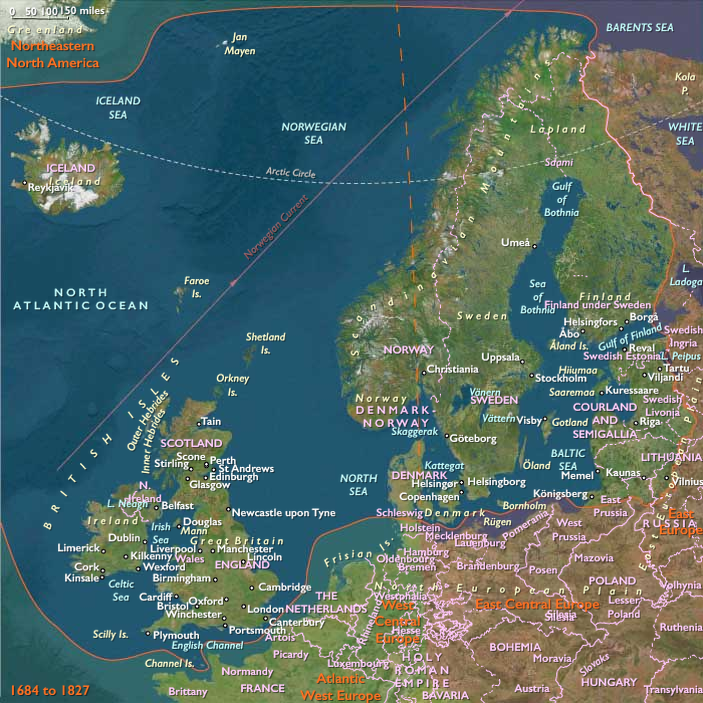 North Europe
Region
-
{# Image navigates to the detail page; the magnifying-glass chip is the only Fancybox lightbox trigger (kept a separate sibling — anchors can't nest). #}
 Northwest Europe
Subregion
