
The Cumans (or Kumans), a nomadic people…
1061 CE
The Cumans (or Kumans), a nomadic people of Turkish origin, initiate their conquest of Southern Russia (where they are called Polovtsi) in about 1055.
Groups
Commodities
Subjects
Regions
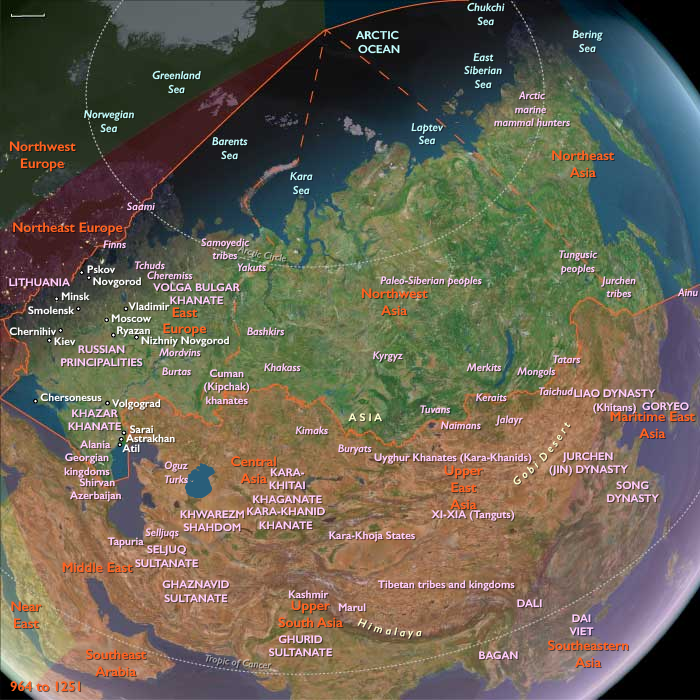
Northeastern Eurasia
View →Subregions
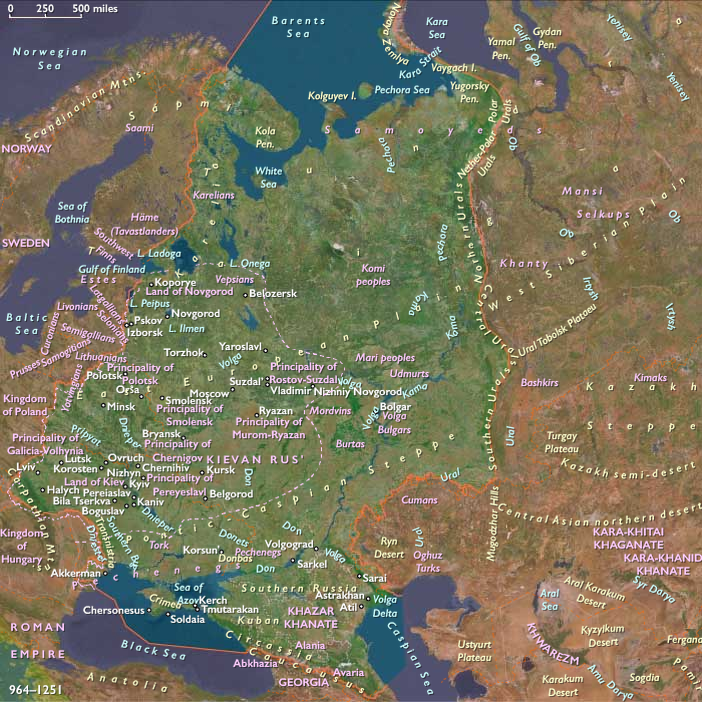
East Europe
View →Related Events
No active filters.
Showing 10 events out of 51010 total
The two-year-old son of Emperor Jingzong of Western Xia had succeeded his father in 1048 as Emperor Yizong.
His mother had become the regent and a year later, the Liao Dynasty had launched an invasion of Western Xia, causing Western Xia to submit to the Liao Dynasty as a vassal state.
In 1056, the Dowager is killed and Yizong's uncle becomes the regent.
Yizong, discovering a plot against him by his uncle and cousin in 1061, has them executed and assumes direct control of Western Xia.
Pereiaslav-Khmelnytskyi, which is to play a significant role in the history of Ukraine, is mentioned for the first time in the text of the Rus' treaty with Constantinople (911) as Pereyaslav-Ruskyi, to distinguish it from Pereyaslavets in Bulgaria.
Vladimir I, Prince of Kiev, had built a large fortress here in 992 to protect the southern limits of Kievan Rus' from raids of nomads from steppes of present southern Ukraine.
The Cumans, as Constantinople calls the non-Moslem, northern Oghuz Turks, had first encountered the Rus' in 1055, which had resulted in a peace agreement.
In 1061, however, the Cumans invade and devastate the Pereiaslav principality, supposedly breaching the earthworks and palisades that had been constructed by Princes Vladimir (d. 1015) and Yaroslav (d. 1054).
Spytihnev II, Duke of Bohemia, dies on January 28, 1061.
Svatobor, his son by Ida of Wettin, enters the church and becomes Patriarch of Aquileia.
Vratislaus, who had fallen out with his brother Spytihněv II and had been exiled to Hungary, had regained his Moravian ducal throne with Hungarian assistance and eventually reconciled with his brother and succeeds him as duke of Bohemia Vratislaus in turn entrusts Moravia to his brother Conrad.
The new emperor, Constantine X Doukas, had quickly associated two of his young sons in power, Michael VII Doukas and Konstantios Doukas, appointed his brother John Doukas as kaisar (Caesar), and embarked on a policy favorable to the interests of the court bureaucracy and the church.
Severely undercutting the training and financial support for the armed forces, Constantine X fatally weakens imperial defenses by disbanding the Armenian local militia of fifty thousand men at a crucial point of time, coinciding with the westward advance of the Seljuqs and their Turkmen allies.
Undoing many of the necessary reforms of Isaac I, he has bloated the military bureaucracy with highly paid court officials and crowded the Senate with his supporters.
His decisions to replace standing soldiers with mercenaries and leaving the frontier fortifications unrepaired have led Constantine to become naturally unpopular with the supporters of Isaac within the military aristocracy, who attempt to assassinate him in 1061.
He also becomes unpopular with the general population after he raises taxes to try to pay the army.
The Mirdasids are members of the Banu Kilabi, an Arab tribe that had been present in northern Syria for several centuries.
Unlike other Arab tribes of Syria that managed to establish their autonomy or independence in the late tenth/early eleventh centuries, the Mirdasids had focused their energies on urban development.
As a result, Aleppo has prospered during their reign.
The Mirdasids demonstrate a high degree of tolerance to Christians, favoring Christian merchants in their territories and employing several as viziers.
This policy, no doubt influenced by comparatively good relations with the Christian East Roman Empire, often upsets the Muslim population.
The early history of the Mirdasid dynasty is characterized by constant pressure from both the Greeks of Constantinople and the Fatimids of Egypt.
By mixing diplomacy (the Mirdasids have been vassals of both the East Romans and Fatimids several times) and military force, the Mirdasids have been able to survive against these two powers.
Troubles with the Kilab had caused Amir Thimal to give up Aleppo to the Fatimids in exchange for several coastal towns.
The Kilab had thrown their support behind Thimal's nephew Rashid al-Daula Mahmud, who had taken Aleppo in 1060.
Thimal was in Cairo when he was informed by the caliph that his nephew had seized Aleppo, and as a result the caliph would be retaking the coastal provinces allotted to him.
Thimal had decided to return to Aleppo, but found Mahmud unwilling to yield control, while another Mirdasid, 'Atiyya ibn Salih, Thimal's brother, had become independent in Rahba.
After several military engagements between Thimal and Mahmud, the Kilab come up with a compromise.
Mahmud gives up Aleppo to his uncle, in exchange for cash and grain.
Thimal therefore reenters Aleppo in 1061.
Guiscard invades Sicily with his brother Roger, capturing Messina in 1061 with comparable ease: Roger's men land unsighted during the night and surprise the Saracen army in the morning, while Guiscard's troops land unopposed and find Messina abandoned.
Guiscard immediately fortifies Messina and allies himself with Ibn at-Timnah, one of the rival emirs of Sicily, against Ibn al-Hawas, another emir.
The armies of Guiscard, his brother, and his Muslim friend march into central Sicily by way of Rometta, which has remained loyal to al-Timnah.
The Norman forces pass through Frazzanò and the pianura di Maniace, where George Maniakes and the first Hautevilles had distinguished themselves twenty-one years prior.
Guiscard assaults the town of Centuripe, but resistance is strong, and he moves on.
Paternò falls, and …