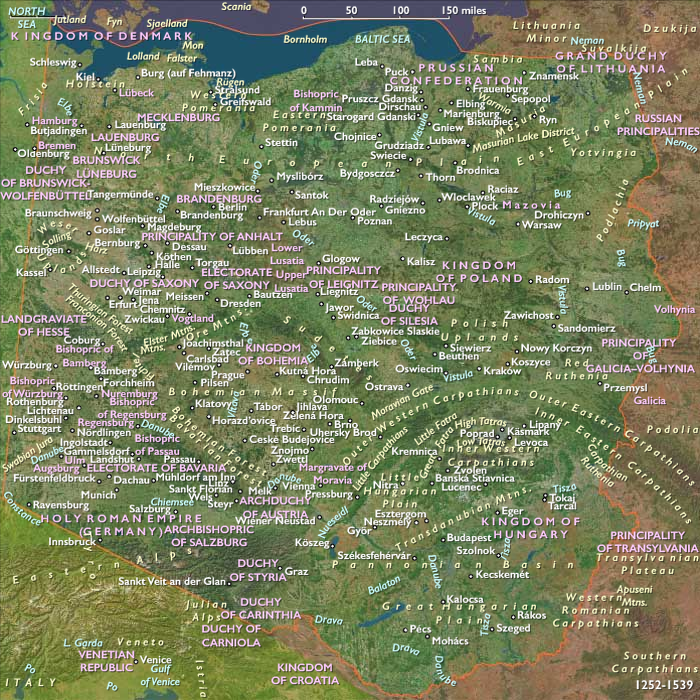
The Duchy of Pomerelia on the Baltic…
1324 CE to 1335 CE
The Duchy of Pomerelia on the Baltic coast, stretching from the border with the Imperial Duchy of Pomerania in the west to the Prussian territory of the Order state at the Vistula river in the east, had been held by the Samborides dynasty, liensmen of the Polish Piast rulers, until the death of Duke Mestwin II in 1294.
Przemysł II, King of Poland since 1295, had incorporated Pomerelia (Pomorze Gdańskie) into the Lands of the Polish Crown—against the protest of the Imperial Margraviate of Brandenburg, referring to the Treaty of Arnswalde signed with Duke Mestwin in 1269.
The next year, the Ascanian margraves had instigated the kidnapping and killing of King Przemysł, probably backed by King Wenceslaus II of Bohemia, who aimed for the Polish crown.
King Wenceslaus II had prevailed against his Piast rival Władysław I the Elbow-high and was crowned King of Poland in 1300.
He ruled in Pomerelia with the assistance of the local Swenzones noble family.
Upon the assassination of his son Wenceslaus III in 1306, the Přemyslid dynasty became extinct and Duke Władysław was able to occupy the Pomerelian lands.
The Swenzones, fearing for their assets and sinecures, called for Margrave Waldemar of Brandenburg, whose troops occupied the territory up to the city of Gdańsk.
Władysław reacted by calling the forces of the Teutonic Order, who under the command of Heinrich von Plötzke in 1308 re-conquered Gdańsk and most of Pomerelia.
However, after the Teutonic takeover they denied the handover to Władysław, as the duke refused to pay the requested expense allowance.
Instead they concluded the 1309 Treaty of Soldin with Margrave Waldemar, whose resistance from the beginning had been relatively weak and who now is willing to sell off his claims to Pomerelia.
Władysław, chafing under his defeat, had unsuccessfully sued the Teutonic Order at the Roman Curia.
However, he was crowned Polish king in 1320 and forged new alliances with the Kingdom of Hungary and the Grand Duchy of Lithuania, when he married his daughter Elisabeth to King Charles I in 1320 and his son Casimir to Aldona of Lithuania, daughter of Grand Duke Gediminas.
On the other hand, the Kingdom of Bohemia, since 1310 under the rule of the mighty House of Luxembourg, has risen again and King John the Blind himself claims the Polish crown as a heritage from the Přemyslids.
The Teutonic Knights support King John, who joins them in crusades against the pagan Lithuanians, and furthermore are allied with Władysław's enemy in Masovia, Duke Wenceslaus of Płock.
Locations
People
Groups
Subjects
Regions
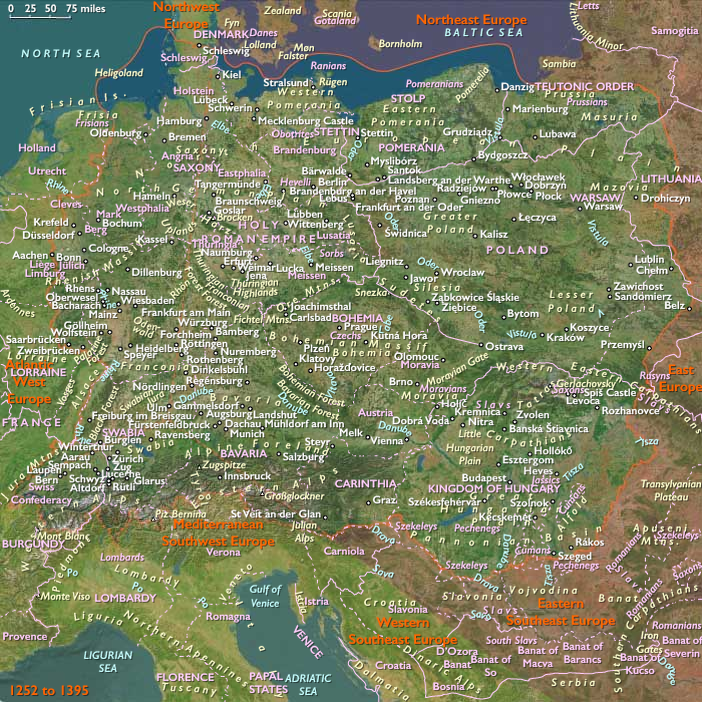
Central Europe
View →Subregions