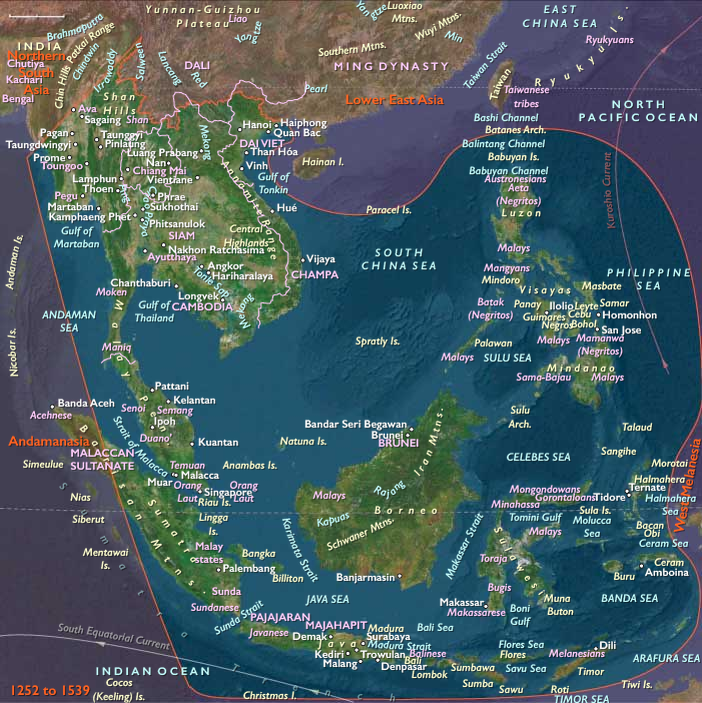
The early people in the Visayas, one…
March 1521 CE
The early people in the Visayas, one of the three principal geographical divisions of the Philippines, along with Mindanao and Luzon, were Austronesians and Negritos who migrated to the islands about six thousand to thirty thousand years ago.
These early settlers were animist tribal groups.
In the twelfth century, settlers from the collapsing empire of Srivijaya led by the Datu, Datu Puti and his retinue, had settled in the island of Panay and its surrounding islands.
It was also during the twelfth century that Visayans are said to have made a series of raids along the coast of China.
They were said to have a fearsome reputation, and the mention of their name would cause many to flee in terror.
By the fourteenth century, Arab traders and their followers, venturing into Maritime Southeast Asia, had converted some of these tribal groups to Islam.
These tribes practice a mixture of Hinduism, Buddhism, Islam and animist beliefs.
There is evidence of trade among other Asian peoples.
The Visayas were subsequently home to several Prehispanic kingdoms like the Kedatuan of Bohol, the Kedatuan of Madja-as, and the Rajahnate of Cebu.
(Kedatuana are historical semi-independent city-states or principalities throughout ancient Maritime Southeast Asia in present-day Indonesia, Malaysia, and parts of the Philippines) The Visayans are thought to have kept close diplomatic relations with Malaysian and Indonesian kingdoms since the tribal groups of Cebu are able to converse with Enrique of Malacca using the Malay language when the Portuguese explorer Ferdinand Magellan arrives to claim the Philippine Islands for Spain.
Native society is generally divided into barangays (kinship units); there is no central government to mount effective resistance against European colonization.
Magellan, with with one hundred and fifty crew members remaining, sights the mountains of what is now Samar on March 16, 1521 (Spanish calendar), while on his mission to find a westward route to the Moluccas Islands for Spain.
This event marks the arrival of the first Europeans in the Archipelago.
The following day, Magellan orders his men to anchor their ships on the shores of Homonhon Island, where his crew manages o gather some food despite Homonhon being uninhabited at this time.
However, he is detected by the boats of Rajah Culambu of Limasawa, an ally of the Datu of Cebu.
Magellan relies on Enrique, his Malay interpreter, to communicate with the native tribes.
Enrique had been enslaved or indentured by Magellan in 1511 after the colonization of Malacca, and has accompanied him through subsequent adventures.
Magellan intends to build a power base here in a plan that involves overawing the native rulers and converting them to the Christian faith.
They trade gifts with Rajah Siaiu of Mazaua, who guides them to Cebu on April 7.
People
Groups
Topics
Commodities
Subjects
Regions
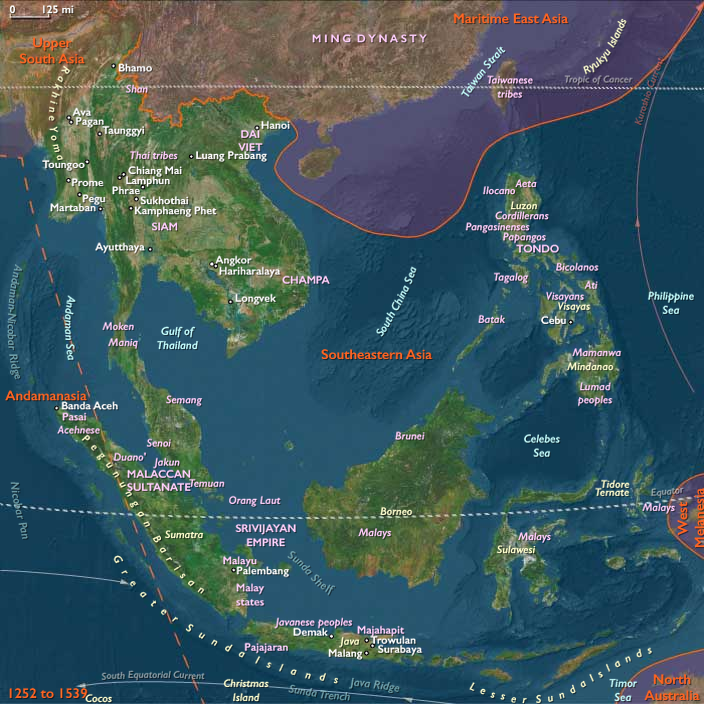
Southeast Asia
View →Subregions