
The Garamantes, a tribal people who had …
Years: 45BCE - 99
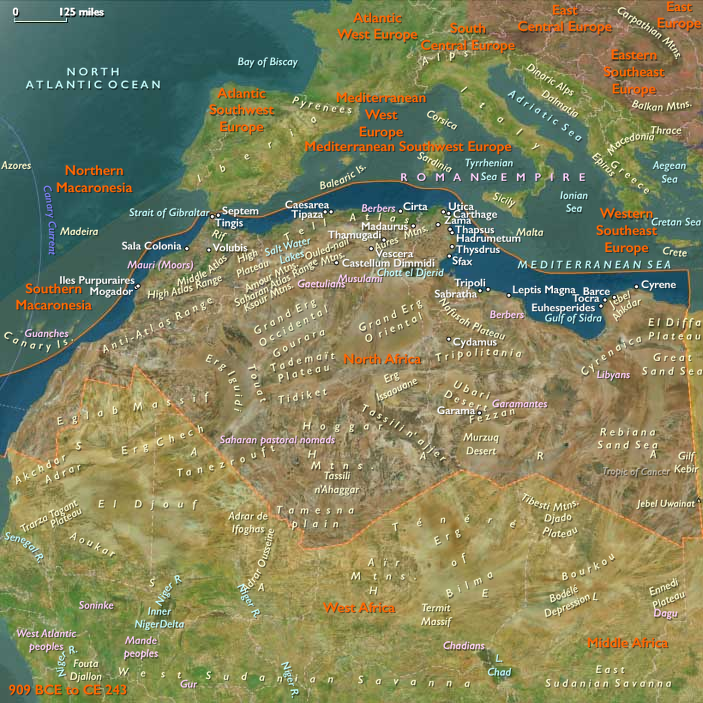
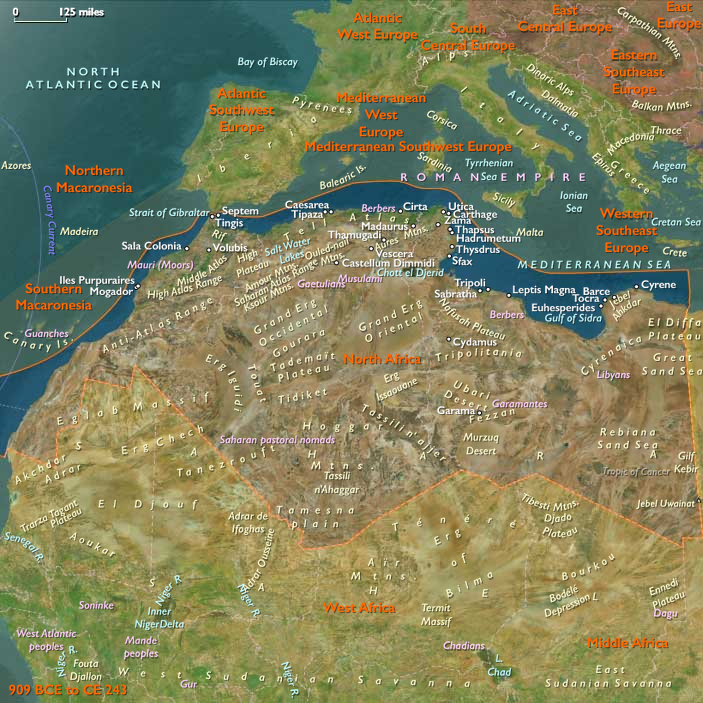
The Garamantes, a tribal people who had entered the area known as Fezzanr sometime before 1000 BCE, dominate the region hroughout the period of Punic and Greek colonization of the coastal plain.
In the desert they establish a powerful kingdom astride the trade route between the western Sudan and the Mediterranean coast.
The Garamantes leave numerous inscriptions in tifinagh, the ancient Berber form of writing still used by the Tuareg.
Beyond these and the observations of Herodotus and other classical writers on their customs and dealings with the coastal settlements, little is known of this extraordinary and mysterious people until the advent of modern archaeological methods.
The Garamantes' political power is limited to a chain of oases about four hundred kilometers long in the Wadi Ajal, but from their capital at Germa they control the desert caravan trade from Ghadamis south to the Niger River, eastward to Egypt, and west to Mauretania.
The Carthaginians employed them as carriers of goods—gold and ivory purchased in exchange for salt—from the western Sudan to their depots on the Mediterranean coast.
The Garamantes are also noted as horsebreeders and herders of long-horned cattle.
They succeed in irrigating portions of their arid lands for cultivation by using foggares, vast underground networks of stone-lined water channels.
Their wealth and technical skill are also attested to by the remains of their towns, which are built of stone, and more than fifty thousand of their pyramidal tombs.
Rome sends several punitive expeditions against the Garamantes before concluding a lasting commercial and military alliance with them late in the first century CE.
Locations
Groups
- Berber people (also called Amazigh people or Imazighen, "free men", singular Amazigh)
- Greeks, Classical
- Cyrene
- Roman Republic
- Garamantes
- Greece, Hellenistic
- Egypt, Ptolemaic Kingdom of
- Roman Principate (Rome)
- Roman Empire (Rome): Julio-Claudian dynasty
- Roman Empire (Rome): Flavian dynasty
- Roman Empire (Rome): Nerva-Antonine dynasty
Commodoties
Subjects
Regions
Subregions
Years: 45BCE - 99
Locations
Groups
- Berber people (also called Amazigh people or Imazighen, "free men", singular Amazigh)
- Greeks, Classical
- Cyrene
- Roman Republic
- Garamantes
- Greece, Hellenistic
- Egypt, Ptolemaic Kingdom of
- Roman Principate (Rome)
- Roman Empire (Rome): Julio-Claudian dynasty
- Roman Empire (Rome): Flavian dynasty
- Roman Empire (Rome): Nerva-Antonine dynasty
Commodoties
Subjects
Regions
Subregions