
Atlantic Southwest Europe: Consolidation, Conflict, and Global…
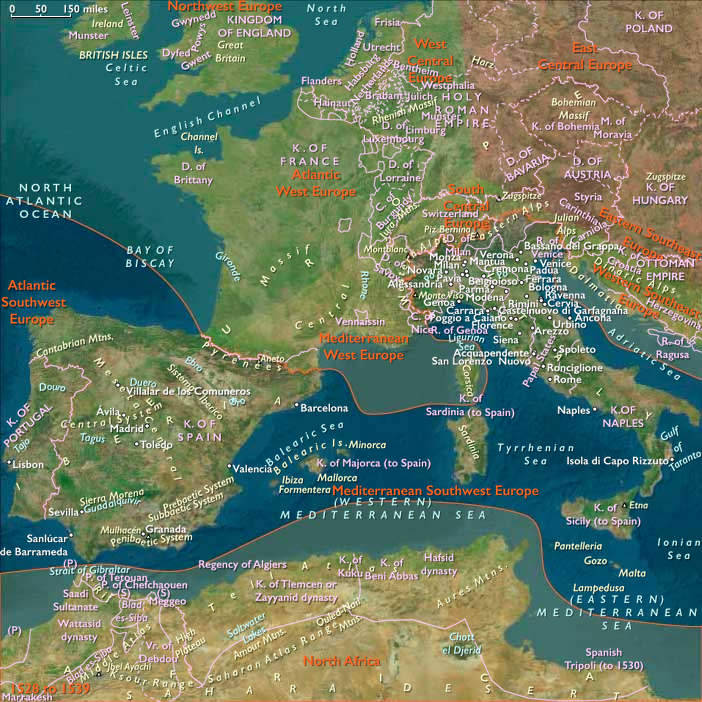
1528 CE to 1539 CE
Atlantic Southwest Europe: Consolidation, Conflict, and Global Horizons (1528–1539)
From 1528 to 1539, Atlantic Southwest Europe underwent profound transformations marked by political consolidation, rising imperial competition, and increased global trade. Spain, now firmly under Habsburg rule, asserted itself as a dominant European power under Charles V, extending its influence across Europe and the Americas. Portugal, led by João III, solidified its vast colonial empire while grappling with internal reforms and external challenges. Navarre's autonomy continued to erode, cementing its fate between Spanish and French powers.
Political and Military Developments
-
Spain (Unified Habsburg Domains):
- Charles V (1516–1556), also Holy Roman Emperor, consolidated power across his Spanish territories, firmly establishing the Habsburg dominion. His governance centralized royal authority, particularly impacting Basque territories and northern Navarre, aligning local fueros with broader imperial policies.
- Charles’s rivalry with Francis I of France intensified, culminating in ongoing conflicts throughout the 1530s, particularly along the Navarrese and Basque frontier. The Treaty of Cambrai (1529), however, brought temporary stability, formalizing Spanish control south of the Pyrenees.
-
Portugal:
- Under João III (1521–1557), Portugal pursued significant administrative and ecclesiastical reforms. His reign emphasized centralization of royal power, closer alignment with Catholic orthodoxy, and the establishment of the Portuguese Inquisition (1536).
- João’s foreign policy remained committed to global expansion, deepening colonial rule in Brazil and reinforcing Portuguese presence along critical trade routes in Africa and Asia.
-
Navarre:
- Navarre’s remaining territories north of the Pyrenees increasingly became integrated into French royal administration, though local autonomy persisted. Southern Navarre was now firmly under Spanish rule, marking a definitive political partition that would endure for centuries.
Economic and Maritime Expansion
-
Spanish Colonial Prosperity:
- Spanish ports along the northern coast, including Bilbao and Santander, expanded dramatically as transatlantic trade boomed, bringing immense wealth through precious metals, especially silver from the Americas.
- Economic prosperity bolstered urban development, commercial sophistication, and the rise of powerful merchant classes, notably in Basque cities.
-
Portugal’s Commercial and Colonial Apex:
- Portuguese maritime trade achieved unprecedented wealth, dominating global spice markets and solidifying extensive trade networks stretching from Lisbon to Goa and Malacca.
- João III's strategic investments enhanced Portugal's naval power, commercial influence, and colonial presence, particularly in Brazil, where sugar plantations began transforming the colonial economy.
-
Navarre’s Economic Integration:
- Northern Navarre’s economy increasingly relied on trade with southern France, while southern Navarre integrated into Castile’s thriving transatlantic economy, shifting local economic dynamics and orientations.
Cultural and Social Developments
-
Spanish Renaissance Flourishes:
- Charles V’s court attracted renowned artists, architects, and scholars, reinforcing Spain’s Renaissance splendor. Artistic masterpieces, such as those by Alonso Berruguete, exemplified the fusion of Italian Renaissance styles with local Spanish traditions.
- Increasing religious uniformity under Charles’s rule heralded greater cultural conservatism, foreshadowing the intensification of the Spanish Counter-Reformation.
-
Portuguese Cultural Vibrancy:
- João III’s reign saw the culmination of the Portuguese Renaissance, blending Manueline architecture with newer classical influences. Lisbon emerged as a vibrant cultural hub, enriched by global contacts and intellectual exchange.
- The establishment of the University of Coimbra (1537) marked a significant cultural and intellectual milestone, fostering humanist scholarship and theological debate.
-
Navarrese Cultural Resilience:
- Despite external political pressures, northern Navarre maintained its distinct Basque cultural traditions, language, and local governance, reflecting resilience amid shifting political realities and the broader influence of France and Spain.
Significance and Legacy
Between 1528 and 1539, Atlantic Southwest Europe experienced significant consolidation of political authority, economic prosperity through global maritime trade, and rich cultural developments reflecting Renaissance ideals. Spain's imperial ambitions under Charles V decisively shaped the region’s political landscape, reinforcing its global ascendancy. Portugal’s empire reached its zenith, embedding its global economic and cultural influence for generations. The definitive partition of Navarre signified a lasting geopolitical shift, embodying the tension between local autonomy and imperial centralization. This era set enduring patterns in governance, economy, and culture, profoundly influencing Atlantic Southwest Europe’s trajectory into the early modern age.
People
Groups
Topics
Commodities
Regions
Southwest Europe
View →Subregions
