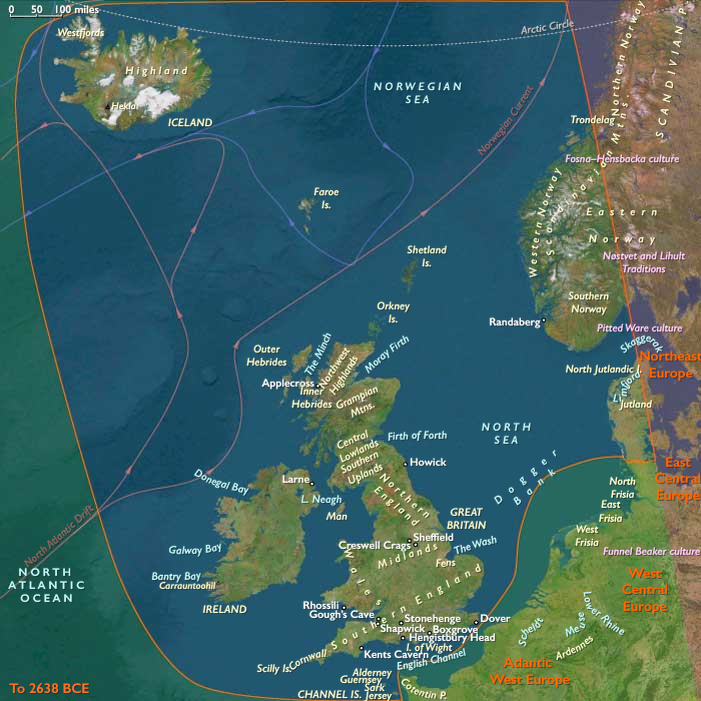
The first monument at Stonehenge consists of…
3213 BCE to 3070 BCE
The first monument at Stonehenge consists of a circular bank and ditch enclosure made of Late Cretaceous (Santonian Age) Seaford Chalk, measuring about one hundred and ten meters (three hundred and sixty feet) in diameter, with a large entrance to the north east and a smaller one to the south.
It stands in open grassland on a slightly sloping spot.
The builders place the bones of deer and oxen in the bottom of the ditch, as well as some worked flint tools.
The bones are considerably older than the antler picks used to dig the ditch, and the people who buried them had looked after them for some time before burial.
The ditch is continuous but had been dug in sections, like the ditches of the earlier causewayed enclosures in the area.
The chalk dug from the ditch is piled up to form the bank.
This first stage is dated to around 3100 BCE, after which the ditch begins to silt up naturally.
Within the outer edge of the enclosed area is a circle of fifty-six pits, each about a meter (three foot three inches) in diameter, known as the Aubrey holes after John Aubrey, the seventeenth-century antiquarian who was thought to have first identified them.
The pits may have contained standing timbers creating a timber circle, although there is no excavated evidence of them.
A recent excavation has suggested that the Aubrey Holes may have originally been used to erect a bluestone circle.
If this were the case, it would advance the earliest known stone structure at the monument by some five hundred years.
A small outer bank beyond the ditch could also date to this period.
Topics
Commodities
Regions
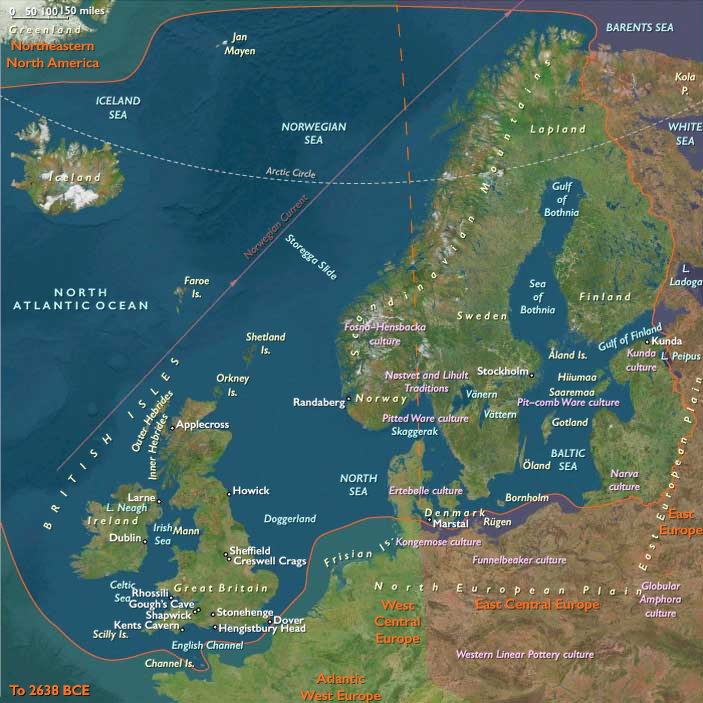
North Europe
View →Subregions