
The future Pope Alexander VI was born …
Years: 1492 - 1492
August
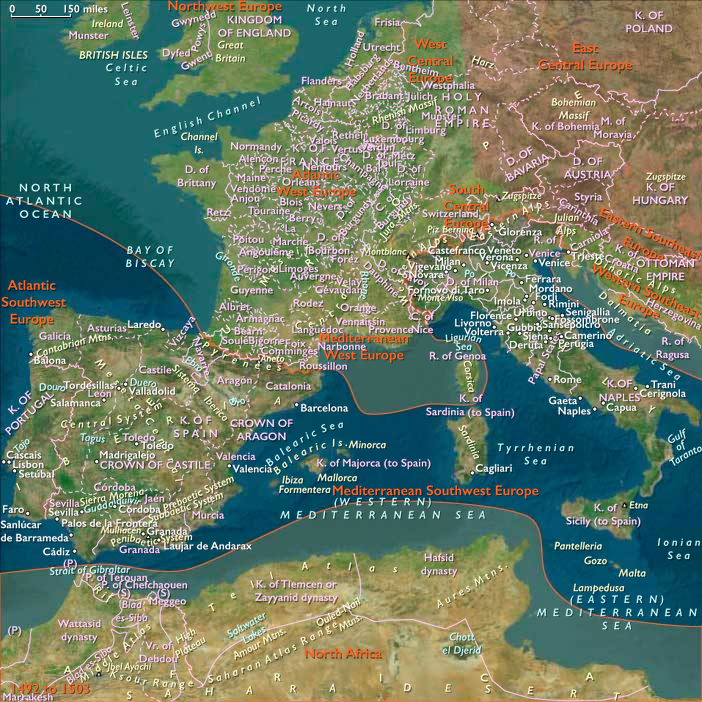
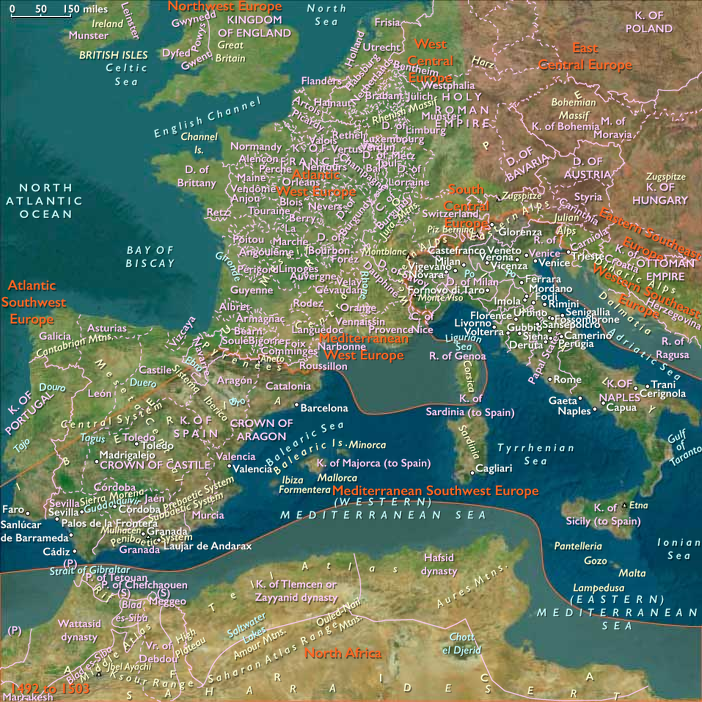
The future Pope Alexander VI was born Roderic Llançol on January 1, 1431, in the town of Xativa near Valencia, Spain, one of the component realms of the Crown of Aragon, in what is now Spain.
His parents were Jofré Llançol i Escrivà, who died before March 24, 1437, and his Aragonese wife and distant cousin Isabel de Borja y Cavanilles, who died October 19, 146).
His family name is written Llançol in Catalan and Lanzol in Castillian Spanish.
Rodrigo adopted his mother's family name of Borja in 1455 following the elevation to the papacy of maternal uncle Alonso de Borja (Italianized to Alfonso Borgia), bishop of Valencia, as Calixtus III.
Rodrigo Borgia studied law at Bologna where he graduated, not simply as Doctor of Law, but as "the most eminent and judicious jurisprudent."
After the election of his uncle as Pope, he had been ordained deacon and created Cardinal-Deacon of San Nicola in Carcere at the age of twenty-five in 1456.
The following year, he was appointed vice-chancellor of the Holy Roman Church.
Both nepotistic appointments are characteristic of the age.
Each pope during this period inevitably finds himself surrounded by the servants and retainers of his predecessors who often owe their loyalty to the family of the pontiff who had appointed them.
In 1468, he had been ordained to the priesthood and, in 1471, had been consecrated bishop and appointed Cardinal-Bishop of Albano.
Serving in the Roman Curia under five popes—Calixtus III, Pius II, Paul II, Sixtus IV and Innocent VIII—Rodrigo Borgia has acquired considerable administrative experience, influence and wealth.
Contemporary accounts suggest that Rodrigo was "handsome, with a very cheerful countenance and genial bearing.
He was gifted with the quality of being a smooth talker and of choice eloquence.
Beautiful women were attracted to him and excited by him in quite a remarkable way, more strongly than how "iron is drawn to a magnet."
Rodrigo Borgia is also an intelligent man with an appreciation for the arts and sciences and an immense amount of respect for the Church.
He is capable and cautious, considered a "political priest" by some.
He is a gifted speaker and a great conversationalist.
Of Rodrigo Borgia’s many mistresses, the one for whom passion had lasted longest was Vannozza (Giovanna) dei Cattanei, born in 1442, and wife of three successive husbands.
The connection began in 1470, and she has had four children whom he openly acknowledges as his own: Cesare (born 1475), Giovanni, afterwards duke of Gandia (born 1476), Lucrezia (born 1480), and Goffredo or Giuffre (born 1481 or 1482).
Five other children, Girolama, Isabella, Pedro-Luiz, and Bernardo, are of uncertain maternal parentage.
A daughter, Laura, was born to his mistress, Giulia Farnese; paternity was officially attributed to Orsino Orsini, Farnese's husband.
There had been a change in the constitution of the College of Cardinals during the course of the fifteenth century-especially under Sixtus IV and Innocent VIII.
Of the twenty-seven cardinals alive in the closing months of the reign of Innocent VIII no fewer than ten are cardinal-nephews, eight are crown nominees, four are Roman nobles and one other had been given the cardinalate in recompense for his family's service to the Holy See; only four are able career churchmen.
On the death of Pope Innocent VIII on July 25, 1492, the three likely candidates for the Papacy were the sixty-one-year-old Borgia, seen as an independent candidate, Ascanio Sforza for the Milanese, and Giuliano della Rovere, seen as a pro-French candidate.
Johann Burchard, the conclave's master of ceremonies and a leading figure of the papal household under several popes, records in his diary that the 1492 conclave was a particularly expensive campaign.
Della Rovere was bankrolled to the cost of two hundred thousand gold ducats by King Charles VIII of France, with another one hundred thousand supplied by the Republic of Genoa.
Borgia is elected on August 11, 1492, assuming the name of Alexander VI (due to confusion about the status of Pope Alexander V elected by the Council of Pisa).
When his uncle was elected Pope, Rodrigo had "inherited" the former’s post of bishop of Valencia.
Sixteen days before the death of Pope Innocent VIII, he had proposed Valencia as a metropolitan see and he became the first archbishop of Valencia.
When Rodrigo de Borja is elected pope, it is the turn of his son Cesare to "inherit" the post as second archbishop of Valencia.
The third and the fourth archbishops of Valencia will be Juan de Borja and Pedro Luis de Borja, grandnephews of Alexander VI.
Locations
People
- Ascanio Sforza
- Cesare Borgia
- Charles VIII of France
- Gioffre Borgia
- Giovanni Borgia
- Johann Burchard
- Lucrezia Borgia
- Pope Alexander VI
- Pope Innocent VIII
- Pope Julius II
Groups
- Papal States (Republic of St. Peter)
- Genoa, (Most Serene) Republic of
- Christians, Roman Catholic
- Aragon, Crown of
- Valencia, Kingdom of
- France, (Valois) Kingdom of
- Milan, Duchy of
Topics
Subjects
Regions
Subregions
Years: 1492 - 1492
August
Locations
People
- Ascanio Sforza
- Cesare Borgia
- Charles VIII of France
- Gioffre Borgia
- Giovanni Borgia
- Johann Burchard
- Lucrezia Borgia
- Pope Alexander VI
- Pope Innocent VIII
- Pope Julius II
Groups
- Papal States (Republic of St. Peter)
- Genoa, (Most Serene) Republic of
- Christians, Roman Catholic
- Aragon, Crown of
- Valencia, Kingdom of
- France, (Valois) Kingdom of
- Milan, Duchy of
Topics
Subjects
Regions
Subregions