
The Great Berber Revolt of 739/740-743 is…
736 CE to 747 CE
The Great Berber Revolt of 739/740-743 is probably the largest military setback in the reign of Caliph Hisham and marks the first successful secession from the Arab caliphate (ruled from Damascus).
The Berbers in Tangiers, fired up by Kharijite puritan preachers in 740, revolt against their Arab rulers.
The revolt soon spreads through the rest of the Maghreb (North Africa) and across the straits to al-Andalus (Spain).
The Umayyads scramble and manage to prevent the core of Ifriqiya (Tunisia) and al-Andalus from falling into rebel hands, but the rest of the Maghreb is never recovered.
The Berber rebel armies dissolve after failing to capture the Umayyad provincial capital of Kairouan, and the western Maghreb fragments into a series of small Berber statelets, ruled by tribal chieftains and Kharijite imams, and representing some of the first Muslim states outside the Caliphate.
The Great Berber Revolt is sometimes also regarded as the beginning of Moroccan independence, as Morocco will never again come under the rule of an eastern Caliph, or any other foreign power, until the twentieth century.
Groups
Subjects
Regions
North Africa
View →Subregions
North Africa
View →Related Events
No active filters.
Showing 10 events out of 55506 total
Mount Tambora, a stratovolcano on Sumbawa island, Indonesia, estimated to have erupted within a few hundred years of 3910 BCE and in 3050 BCE, erupts again within one for years between about 590 and about 890.
These three events share similar eruptive characteristics: central vent eruption and explosive eruption with pyroclastic flows.
The Abbasids, rivals of the Umayyads, are members of the Hashim clan, but the word "Hashimiyya" seems to refer specifically to Abu Hashim, a grandson of Ali and son of Muhammad ibn al-Hanafiyya.
Hashimiyya missions beginning around 719 had begun to seek adherents in Khorasan, their campaign framed as one of proselytism (dawah).
They seek support for a "member of the family" of Muhammad, without making explicit mention of the Abbasids.
These missions meet with success both among Arabs and non-Arabs (mawali), although the latter may have played a particularly important role in the growth of the movement.
Abu Muslim around 746 assumes leadership of the Hashimiyya in Khorasan.
He successfully initiates an open revolt in 747, organized under the sign of the black flag, against Umayyad rule.
He soon establishes control of Khorasan, expelling its Umayyad governor, and dispatches an army westwards.
East Central Europe (736–747 CE): Saxon Dominance, Bavarian Expansion, Slavic Consolidation, and Persistent Regional Stability
Between 736 and 747 CE, East Central Europe—encompassing Poland, Czechia, Slovakia, Hungary, and those portions of Germany and Austria lying east of 10°E and north of a line stretching from roughly 48.2°N at 10°E southeastward to the Austro-Slovenian border near 46.7°N, 15.4°E—underwent substantial political developments. Saxon tribes consolidated control east of the Elbe River, while emerging Slavic principalities in Bohemia and Moravia continued evolving toward stable state structures. Significantly, the Duchy of Bavaria, though nominally under Frankish influence, expanded its authority eastward by establishing a protectorate around 743 CE over the Slavic principality of Carantania (modern-day Carinthia and Slovenia). This Bavarian expansion created a strategic buffer, effectively separating the southern Slavs from their northern and eastern kin. Meanwhile, the Avar Khaganatemaintained internal stability, and Thuringia preserved its autonomy amid declining Merovingian power.
Political and Military Developments
Bavarian Protectorate over Carantania (743 CE)
-
Around 743 CE, responding to a request from Carantanian Prince Boruth for protection against Avar incursions, Duke Odilo of Bavaria established a protectorate over Carantania.
-
This political move extended Bavarian influence deeply into Slavic territories, strategically dividing the southern Slavic tribes from their relatives to the north and east, altering long-term regional geopolitical dynamics.
Saxon Eastward Consolidation
-
Saxon influence peaked east of the Elbe, consolidating their dominance across eastern Germany, western Poland, and northern Czechia, significantly shaping political, cultural, and economic relations throughout the region.
Continued Slavic Political Development
-
Principalities in Bohemia and Moravia further stabilized, moving toward more centralized governance and clearer territorial definition, laying the groundwork for medieval Slavic states.
Persistent Thuringian Autonomy
-
Thuringian dukes continued their effective independence from weakened Merovingian authority, highlighting Frankish decentralization and regional power dynamics.
Stability within the Avar Khaganate
-
The Avars retained diplomatic equilibrium and territorial stability within the Carpathian Basin, carefully managing relationships with Bavarians, Saxons, Slavs, and Franks.
Economic and Technological Developments
Regional Economic Networks
-
Trade networks flourished, facilitating prosperous exchanges of agricultural goods, metals, textiles, and luxury items among Saxon, Slavic, Bavarian, Thuringian, Avar, and Frankish territories.
Expansion of Fortifications
-
Defensive fortifications and settlements continued evolving, reflecting increased regional stability, technological sophistication, and demographic growth across Saxon, Slavic, Bavarian, and Avar communities.
Cultural and Artistic Developments
Saxon and Bavarian Cultural Influence
-
The expansion of Saxon and Bavarian influence introduced distinct Germanic cultural elements into Slavic territories, significantly shaping regional artistry, metalwork, jewelry, and burial customs.
Distinctive Slavic Identities
-
Slavic groups in Bohemia, Moravia, and now Carantania refined unique regional identities, evident in archaeological remains of ceramics, jewelry, settlements, and burial practices.
Continued Avar Cultural Traditions
-
Avar artistic and cultural traditions persisted strongly within the region, particularly evident in elaborate metalwork, decorative arts, and equestrian equipment.
Settlement and Urban Development
Saxon and Bavarian Territorial Growth
-
Saxon settlements developed into fortified, prosperous centers across eastern Germany, western Poland, and northern Czechia. Bavarian influence similarly fostered growth in Carantania, integrating these Slavic territories into wider regional economic and political networks.
Expansion of Slavic Political and Urban Centers
-
Bohemian, Moravian, and now Carantanian urban and administrative centers grew significantly, reflecting stable governance, increased population, and economic productivity.
Stability and Prosperity in Thuringia
-
Thuringian towns remained prosperous and stable, benefiting from peaceful trade networks and minimal external threats, maintaining regional significance and economic strength.
Social and Religious Developments
Bavarian and Saxon Hierarchies
-
Bavarian and Saxon societies reinforced their hierarchical structures under influential warrior aristocracies, consolidating political and military power within their expanded territories.
Slavic Centralization and Integration
-
Slavic political structures increasingly centralized leadership, integrating territories such as Carantania under Bavarian protection, and fostering more cohesive administrative and military capabilities.
Avar Sociopolitical Continuity
-
The Avars maintained cohesive societal hierarchies and effective governance structures, enabling continued internal stability and external diplomatic balance.
Long-Term Consequences and Historical Significance
The era 736–747 CE was pivotal in shaping East Central Europe's geopolitical landscape, notably marked by Bavaria’s establishment of a protectorate over Carantania, effectively redefining Slavic territorial alignments. Concurrent Saxon dominance, Slavic political consolidation, ongoing Thuringian independence, and sustained Avar stability collectively created foundational patterns influencing the medieval historical trajectory of the region.
The duchy of Bavaria, only nominally a Frankish dependency, establishes a protectorate over the Slavic tribes of the immediate East stretching nearly to the Avars of the Hungarian Plain, thus effectively separating the southern Slavs from their northern and eastern kin.
Eastern Southeast Europe (736–747 CE): Military Reforms and Imperial Stabilization
Settlement and Migration Patterns
Stability and Population Consolidation
From 736 to 747 CE, Eastern Southeast Europe experienced sustained demographic stability and settlement consolidation. The continued integration of Slavic and Bulgar communities supported regional cohesion, reinforcing imperial frontier stability through strategic settlements.
Political and Military Developments
Emperor Leo III's Military and Administrative Reforms
Emperor Leo III, an energetic soldier-emperor, personally led his troops in battle, greatly improving military morale and effectiveness. His notable victory at the Battle of Akroinon significantly reduced Arab threats in Asia Minor. Leo's successful reorganization of the empire’s military themes, subdividing large armies to prevent commanders from threatening the throne, significantly enhanced internal political stability.
Strategic Alliances and Frontier Security
Leo strengthened frontier security by inviting Slavic settlers into previously depopulated regions, enhancing the empire's defensive posture. His alliances with the Khazars and Georgians further reinforced the empire’s strategic positions, contributing to sustained regional stability and security.
Economic and Technological Developments
Economic Prosperity through Enhanced Security
The improved efficiency and strategic stability of Leo’s reorganized military themes boosted regional economic prosperity. Enhanced security measures protected key trade routes and supported agricultural productivity, underpinning the region's overall economic resilience.
Military Innovation and Fortifications
Continued advancements in military infrastructure, particularly fortifications and logistics systems, played a critical role in defending imperial territories from external threats. These military enhancements significantly reduced the empire's vulnerability to foreign invasions.
Cultural and Artistic Developments
Cultural Continuity and Resilience
Despite military pressures, cultural and artistic life continued to thrive, reflecting ongoing stability and resilience within Byzantine society. Artistic expression and religious life remained robust, reinforcing communal and cultural identity.
Scholarly Persistence
Intellectual and scholarly institutions persisted in their roles, preserving classical and theological knowledge, ensuring continuous cultural and educational resilience despite external pressures.
Social and Religious Developments
Strengthened Eastern Orthodox Identity
Eastern Orthodoxy continued to solidify its central societal role, shaping cultural identity and community cohesion. Religious institutions played an increasingly significant part in supporting societal stability and resilience.
Continued Debate over Iconoclasm
Although Emperor Leo III’s military successes reinforced his commitment to Iconoclasm, opposition persisted, particularly from monastic circles. The theological and cultural tensions surrounding religious imagery continued to shape societal dynamics significantly.
Long-Term Consequences and Historical Significance
The period from 736 to 747 CE saw critical military reforms, strategic frontier consolidation, and imperial stabilization under Leo III. His military victories, strategic settlements, and administrative reorganizations significantly reduced external threats and internal political instability, profoundly shaping the region’s future stability and imperial trajectory.
The Middle East: 736–747 CE
Umayyad Decline and the Rise of Internal Strife
Waning Umayyad Authority
The years 736 to 747 see increasing signs of internal unrest and weakening authority within the vast Umayyad Caliphate, centered in Damascus. The caliphate, while still powerful, struggles with internal dissent, tribal conflicts, and emerging regional autonomy, foreshadowing its eventual decline.
Kharijite Revolts and Regional Uprisings
During this era, Kharijite rebellions intensify, particularly in Iraq and Persia. The Azraqi Kharijites remain prominent insurgents, opposing centralized Umayyad control. Their radical interpretation of Islam continues to fuel revolts and rebellions, contributing to the empire’s instability.
Turmoil in Iraq and Persia
Internal conflicts worsen, especially around Basra and Kufa. These urban centers become hotbeds of dissent against Umayyad authority, driven by both religious grievances and resentment over perceived economic exploitation by Damascus. Such tensions significantly weaken the caliphate’s grip over eastern provinces.
Economic Pressures and Administrative Struggles
Economic difficulties, exacerbated by the costs of maintaining extensive military operations and infrastructure, place additional strain on Umayyad governance. Attempts at fiscal reforms prove inadequate, failing to resolve long-standing administrative inefficiencies.
Prelude to the Abbasid Revolution
By 747, widespread discontent and rebellion across Persia and eastern territories set the stage for the imminent Abbasid Revolution. The Abbasids skillfully exploit popular dissatisfaction, presenting themselves as champions of religious authenticity and justice against perceived Umayyad corruption and decadence.
Thus, this era marks the beginning of the end for Umayyad dominance, paving the way for dramatic political transformation in the decades to come.
Mediterranean Southwest Europe (736–747 CE): Lombard Cultural Synthesis and Continued Iberian Transformation
The era 736–747 CE in Mediterranean Southwest Europe is marked by significant cultural synthesis in Lombard Italy, characterized by the blending of Roman and Germanic traditions, alongside ongoing developments in Moorish-controlled Iberia.
Lombard Cultural Integration under Liutprand
By the death of King Liutprand in 744 CE, the Lombards have embraced numerous aspects of Roman culture, including orthodox Christianity and the Latin language. Lombard governance, legal traditions, and administrative systems now clearly reflect an intricate fusion of Roman and Germanic influences, underscoring a significant cultural transformation within the Lombard kingdom.
Lombard Law and Administration
Lombard laws increasingly integrate Roman legal concepts, creating a robust administrative framework that combines traditional Germanic customs with sophisticated Roman legal traditions. This synthesis enhances governance stability, legitimizing Lombard rule and fostering societal cohesion across northern and central Italy.
Moorish Iberia and Mozarab Continuity
In Iberia, Moorish dominance persists, with Mozarab communities continuing their distinctive cultural existence under Islamic rule. These Christian populations maintain their religious and administrative autonomy, governed by their tribunals under dhimmi provisions, while absorbing Moorish linguistic and cultural elements. Major centers like Córdoba, Seville, and Toledo flourish as vibrant hubs of cross-cultural exchange.
Cultural Innovations and Artistry
The ongoing Moorish presence promotes further cultural exchanges, notably in art and crafts such as rug-making, characterized by the intricate geometric designs of Islamic tradition. Iberian cities become renowned for their craftsmanship, highlighting the dynamic interactions between Islamic and Latin-Christian cultures.
Ecclesiastical Stability and Papal Diplomacy
The papacy continues to navigate regional complexities, particularly through diplomatic relations with Lombard rulers and Byzantine authorities. Ecclesiastical institutions provide enduring stability and cultural continuity, reinforcing doctrinal orthodoxy and mediating regional political tensions.
Legacy of the Era
The era 736–747 CE highlights the deepening cultural synthesis within Lombard Italy, reflecting a significant milestone in medieval cultural formation. Simultaneously, the ongoing evolution of Mozarab identity and Moorish cultural influences in Iberia underscores the region’s rich and complex historical transformation, setting enduring foundations for Mediterranean Southwest Europe's medieval development.
The Lombards have accepted many elements of Roman culture in addition to orthodox Christianity, including the Latin language, by the time of the death in 744 of king Liutprand, King of Italy; Lombard law and administration now reflect both Roman and Germanic influences.
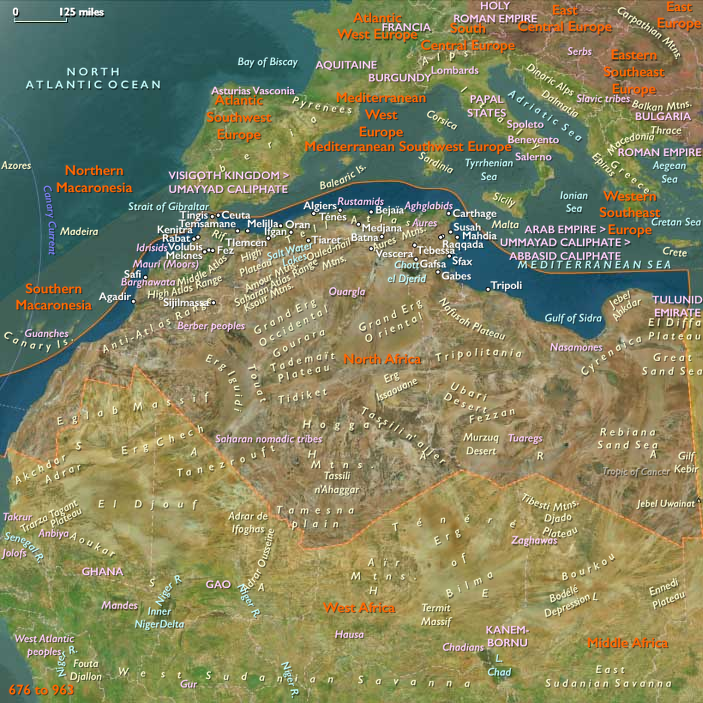
North Africa (736–747 CE)
Berber Revolt, Kharijite Uprisings, and Fragmentation of Umayyad Authority
Between 736 and 747 CE, North Africa experiences profound turmoil as indigenous Berber resentment erupts into widespread rebellion against the Umayyad Caliphate, known as the Berber Revolt (739–743 CE). This period marks a critical turning point, reshaping regional politics and paving the way for independent Berber dynasties.
The initial spark igniting widespread revolt occurs in 739 CE, driven by accumulated grievances including oppressive taxation, discriminatory practices, forced conscription, and the enslavement of Berber converts. This unrest quickly coalesces around the egalitarian ideals of the radical Islamic Kharijite sect, which advocates equality among all Muslims, irrespective of ethnic background, in stark contrast to Umayyad policies favoring Arab supremacy.
Berber groups across the Maghreb rise in unison, significantly challenging Umayyad control. Tribes from the mountainous Aurès, along with powerful confederations such as the Austoriani, Leutae, and the fiercely autonomous Laguatan, unite under Kharijite leadership, notably figures such as Maysara al-Matghari, whose forces gain rapid success.
Amid the chaos, the western coastal Barghawata confederation establishes itself as an independent entity, adopting a distinctive form of Islam deeply infused with local Berber traditions. Their unique religious identity underscores the fragmentation of religious authority during this period.
Simultaneously, oasis cities like Ouargla flourish economically despite regional instability, maintaining prosperous trade connections across Saharan routes controlled largely by influential Tuareg tribes. This economic autonomy bolsters local Berber power, further weakening central Umayyad authority.
The Berber Revolt severely destabilizes Umayyad dominance, forcing Arab forces to retreat to strongholds in Ifriqiya, primarily around Kairouan. Though the Umayyads eventually regain partial control by 743 CE, their grip on North Africa remains tenuous, significantly diminished in comparison to previous decades.
By 747 CE, North Africa is fundamentally transformed. The Berber Revolt, despite its eventual suppression, profoundly weakens centralized Umayyad governance, leading directly to the rise of independent Berber-ruled dynasties and deepening regional fragmentation. The era concludes with North Africa entering a new phase marked by vibrant local autonomy, diverse religious interpretations, and shifting political alliances.
Atlantic Southwest Europe (736–747 CE): Asturian Expansion, Islamic Pressures, and Regional Identity
Between 736 and 747 CE, Atlantic Southwest Europe—covering Galicia, northern and central Portugal, Asturias, Cantabria, and northern Spain south of the Franco-Spanish border (43.05548° N, 1.22924° W)—further stabilized under the early rulers of the Kingdom of Asturias. The region solidified its role as the primary center of Iberian Christian resistance against Islamic rule, reinforcing political organization, strengthening regional economies, and fortifying a distinct cultural identity. Yet the kingdom continued to face periodic military pressure from al-Andalus, testing the resilience of these emerging structures.
Political and Military Developments
Asturian Expansion under Alfonso I
After the brief reign of King Favila (737–739 CE), who maintained continuity but achieved little expansion, the Asturian kingdom experienced significant growth under King Alfonso I (739–757 CE). Alfonso, a capable military leader, expanded Asturian territories significantly, pushing southward into Galicia, northern Portugal, and territories bordering the Cantabrian Mountains. His policy of depopulating border regions—creating a strategic defensive "Desert of the Duero"—limited Islamic incursions and provided a defensible buffer zone.
Continuing Regional Resistance
Galician and northern Lusitanian aristocrats supported Asturian military efforts, effectively maintaining regional autonomy while acknowledging Alfonso’s authority. Frequent skirmishes with Islamic forces continued, but the mountainous terrain and fortified settlements provided considerable defensive advantage, allowing Asturias to firmly entrench itself as the leading Christian political power in the Iberian Peninsula.
Economic Developments
Economic Stabilization and Regional Autonomy
The consolidation of Asturian territories facilitated economic stabilization. Rural villa-based economies recovered steadily, supporting agriculture (grain, olives, vineyards), livestock husbandry, artisanal crafts, and mining activities, particularly gold and silver extraction in Galicia and Asturias. The security provided by the Asturian military presence encouraged increased local production and trade.
Localized Maritime Trade and Economic Networks
Coastal settlements such as Bracara Augusta (Braga) and smaller port towns in Galicia and northern Portugal sustained modest maritime commerce. Although trade remained largely localized, the ongoing exchange of goods provided essential economic continuity and reinforced regional prosperity.
Cultural and Religious Developments
Ecclesiastical Influence and Organization
Influential bishoprics—Braga, Lugo, Asturica Augusta, and Iria Flavia—further reinforced their civic leadership roles. Bishops provided essential administrative oversight, social cohesion, and moral leadership, deeply embedding Christian orthodoxy into regional governance.
Monastic Expansion and Cultural Preservation
Monastic communities continued expanding, becoming prominent cultural, educational, and economic centers. They preserved manuscripts, sustained literacy and scholarship, promoted agricultural improvements, and served as essential repositories of regional historical memory and identity.
Persistence of Cultural Syncretism
In rural Galicia, Asturias, and northern Portugal, the enduring blend of orthodox Christianity and indigenous Celtic and Iberian traditions remained vibrant. These cultural traditions reinforced distinctive regional identities and provided important unity amidst political and military challenges.
Civic Identity and Governance
Strengthening of Regional Governance Structures
King Alfonso I’s successful territorial expansion and defensive strategies began transforming local aristocratic autonomy into more coherent royal administrative structures. While significant regional autonomy persisted, the Asturian kingdom increasingly resembled a centralized medieval polity, with civic identities shaped by loyalty to the Asturian royal house and emerging ecclesiastical institutions.
Notable Tribal Groups and Settlements
-
Astures and Cantabri: Formed the military and political backbone of Asturian expansion and defensive strategy, strongly defining regional identity and cohesion.
-
Galicians and Lusitanians: Continued their effective local governance and economic resilience, pragmatically supporting Asturian leadership while preserving significant autonomy.
-
Vascones: Maintained their traditional neutrality, territorial independence, and cultural distinctiveness, largely unaffected by broader Iberian conflicts.
Long-Term Significance and Legacy
Between 736 and 747 CE, Atlantic Southwest Europe:
-
Experienced substantial territorial expansion under the Asturian kingdom, reinforcing Christian resistance against Islamic Iberia and creating defensive boundaries that endured for generations.
-
Solidified regional economic stability, resilient governance structures, and enduring ecclesiastical leadership, significantly shaping medieval Iberian politics and society.
-
Maintained distinctive regional cultural identities, providing a robust foundation for subsequent historical and cultural developments across northern Iberia.
This era represented a significant phase in the Asturian kingdom's early growth, decisively influencing the enduring trajectory of Atlantic Southwest Europe throughout the medieval period.