
The Huns, victorious in the Battle of …
Years: 373 - 373
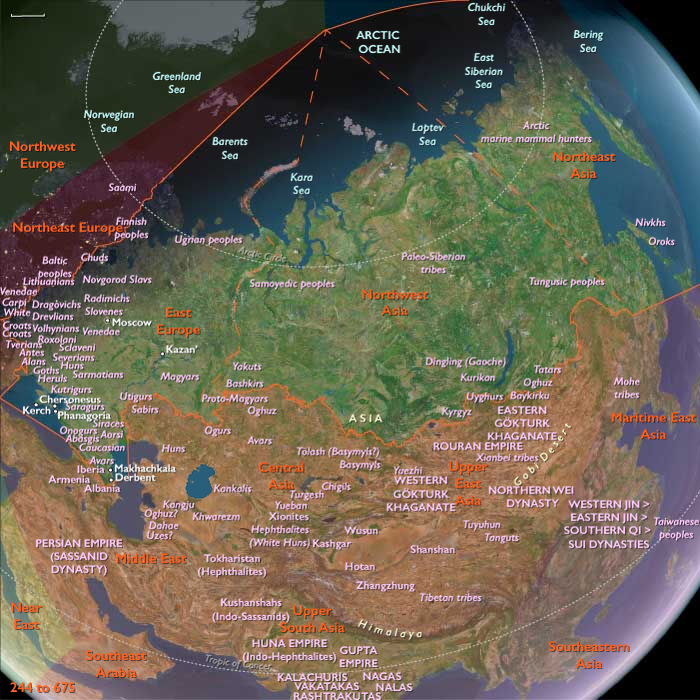
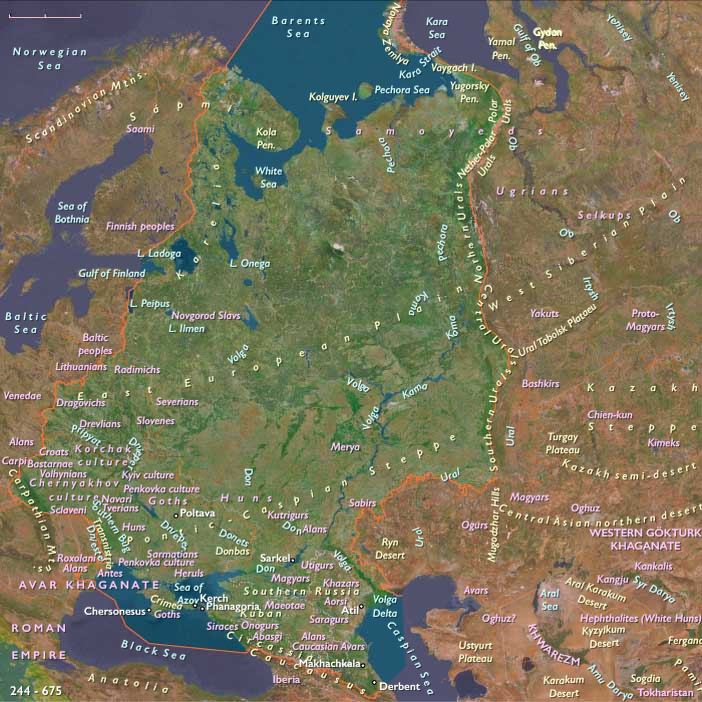
The Huns, victorious in the Battle of the Tanais River, fought on the traditional border between Asia and Europe, destroy the empire of the Alans and cross the Volga and the Don.
The rise of the Huns, which puts pressure on all the Germanic tribes to the immediate west, soon overwhelms the Gothic kingdoms.
Many of the Goths migrate into Roman territory in the Balkans, while others remain north of the Danube under Hunnic rule.
Locations
Groups
- Lugii
- Franks
- Vandals (East Germanic tribe)
- Lombards (West Germanic tribe)
- Goths (East Germanic tribe)
- Germans
- Huns
- Alamanni (Germanic tribal alliance)
- Thervingi (East Germanic tribe)
- Greuthungi (East Germanic tribe)
- Roman Empire: Valentinian dynasty (Rome)
- Hunnic Empire
- Alani, Realms of the
Topics
Subjects
Regions
Subregions
Related Events
Filter results
Showing 10 events out of 59637 total
The Eastern Jìn court has managed to survive the rebellions of Wang Dun and Su Jun.
Another rebellious military leader, Huan Wen, had been perceived as one of the greatest generals since Jin's loss of northern China.
He had led the campaign that destroyed Cheng Han and annexed its lands to Jin, and had had some successes against the northern states Former Qin and Former Yan (although both campaigns ultimately ended in failure, perhaps due to his overcautiousness).
Huan Wen dies in 373 before he can carry out his intention to usurp the throne, but the Huan clan will remain entrenched in the Jin power structure for decades to come.
Athanaric, who has continued to follow the old Germanic pagan religion, initiates a fierce persecution of his Christian subjects in Dacia.
According to Christian tradition, his most notable victim is one Sabbas the Goth, who, when one of Athanaric’s sub-chiefs came to the village where Sabbas lived and asked if there were any Christians about, stepped forward and said, “Let no-one swear an oath on my behalf.
I am a Christian.” The leader dismissed him, saying, “This one can do us neither good nor harm.” The next year, a priest comes to the village and celebrates Easter with Sabbas.
The pagans of the village report this, and the leader returns a second time to arrest Sabbas.
They drag Sabbas naked through thorn bushes, bind him and the priest to trees, and force them to eat food that had been sacrificed to idols.
Both men refuse to touch the meat.
Athanaric passes a death sentence on Sabbas, who goes off with the soldiers praising God all the way, denouncing the pagan and idolatrous ways of his captors, and scorning them.
The commander orders Sabbas to be thrown in a river, tying a rock around his neck and his body to a wooden pole.
Sabbas thus becomes the earliest known native-born martyr on Romanian soil.
Pap has been struggling to rule a kingdom that had been recently dismantled by Shapur; his actions to keep a tight grip on power lead to his downfall.
Pap has begun acting in high-handed fashion, even executing, by poison, the Armenian bishop Nerses, a very close Roman ally, and demanding control of a number of Roman cities, including Edessa.
Theodosius, the future emperor, had been born in 347 in Cauca in the province of Gallaecia in northwestern Spain.
His father was to become the general Flavius Theodosius; his mother's name is unknown.
His grandparents, like his parents, were probably already Christians.
Growing up in Spain, Theodosius had not received an extensive education but is intellectually open-minded and has acquired a special interest in the study of history.
While on his father's staff, he has participated in his campaigns against the Picts and Scots in Britain in 368-369, the Alamanni in Gaul in 370, and the Sarmatians in the Balkans in 372-373.
As a military commander in Moesia, a Roman province on the lower Danube, he defeats the Sarmatians in 374.
Valens, pressed by his generals and fearing that Pap will defect to the Persians, makes an unsuccessful attempt to capture the Armenian boy-king.
He then assigns Traianus to gain Pap's confidence and murder him; Traianus does so in 374 during a banquet which he had organized for the young ruler.
In his stead, Valens imposes another Arsacid, Varazdat, who rules under the regency of the notoriously pro-Roman sparapet Mushegh Mamikonian.
Shapur, who had long been courting Pap, is infuriated by Pap’s murder and the installation of a new Arsacid on the Armenian throne.
The Persians begin agitating again for compliance with the 363 treaty.
Jerome (Eusebius Hieronymus), born at Stridon on the borders of Dalmatia and Pannonia of a well-to-do Christian family, had gone with his friend Bonosus to Rome to further his intellectual interests.
There, Jerome had acquired a knowledge of classical literature and had been baptized in 361 at the age of 19.
After several years in Rome, he had begun to develop theological interests with others similarly inclined to asceticism, and had gone with Bonosus to Trier, "on the semi-barbarous banks of the Rhine," where he seems to have first taken up theological studies, and where he copied, for his friend Rufinus, Hilary's commentary on the Psalms and the treatise De synodis.
Next came a stay of at least several months, or possibly years, with Rufinus at Aquileia where he made many Christian friends.
Some of these accompanied him when he set out at about 373 on a journey through Thrace and Asia Minor into northern Syria.
Finding a warm reception in Antioch, where he makes the longest stay, continuing the pursuit of his humanistic and monastic studies, two of his companions die and he himself is seriously ill more than once.
During one of these illnesses (about the winter of 373-374), he has a vision in which he is accused, in a dream, of being "a Ciceronian, not a Christian."
This makes him determined him to lay aside his secular studies and devote himself to the things of God.
His close friend and translator Rufinus will later suggest, however that this vow was not strictly kept, but in any case, Jerome seems to have abstained for a considerable time from the study of the classics and to have plunged deeply into that of the Bible, under the impulsion of Apollinaris of Laodicea, at this time teaching in Antioch and not yet suspected of heresy.
Apollinaris had collaborated with his father Apollinaris the Elder in reproducing the Old Testament in the form of Homeric and Pindaric poetry, and the New Testament after the fashion of Platonic dialogues, when the emperor Julian had forbidden Christians to teach the classics.
He is best known, however, as a noted opponent of Arianism.
Teaching that human beings are composed of body, soul, and spirit, his eagerness to emphasize the deity of Jesus and the unity of his person has led him so far as to deny the existence of a rational human soul (νους, nous) in Christ's human nature, this being replaced in him by the logos, or the second person of the Trinity, so that his body was a glorified and spiritualized form of humanity.
Over against this the orthodox or Catholic position maintains that Christ assumed human nature in its entirety including the νους, for only so could He be example and redeemer.
It is alleged that the system of Apollinaris is really Docetism, that if the Godhood without constraint swayed the manhood there was no possibility of real human probation or of real advance in Christ's manhood.
Religious peace reigns in the West, where tolerance is proclaimed.
Rome, after some difficulty, has found a great pope in Damasus.
When the Arian bishop of Milan, Auxentius, dies in 374, and the Arians challenge the succession.
Ambrose, the consular prefect or "Governor" of Liguria and Emilia, with headquarters at Milan, goes to the church where the election is to take place, to prevent an uproar, which is probable in this crisis.
His address is interrupted by a call "Ambrose, bishop!", which is taken up by the whole assembly.
A bachelor born into a Roman Christian family between about 337 and 340 and raised in Trier, Ambrose is known to be orthodox in belief, but also acceptable to Arians due to the charity shown in theological matters in this regard.
At first he energetically refuses the office, for which he is in no way prepared: although his strong rule, modesty, and rhetorical skill have made him a tremendously popular governor, Ambrose has neither been baptized nor formally trained in theology.
Upon his appointment, Ambrose flees to a colleague's home to seek hiding.
Upon receiving a letter from the Emperor praising the appropriateness of Rome appointing individuals evidently worthy of holy positions, Ambrose's host surrenders his guest.
Within a week, Ambrose is baptized, ordained and duly installed as bishop of Milan.
As bishop, he immediately adopts an ascetic lifestyle, apportions his money to the poor, donating all of his land, making only provision for his sister Marcellina (who will later become a nun), and commits the care of his family to his brother.
Ambrose also writes a treatise by the name of "The Goodness Of Death".
According to legend, Ambrose immediately and forcefully stops Arianism in Milan.
Valentinian has remained at Trier for seven years, devoting his attention to the construction of an elaborate system of fortifications on the Rhine.
A good administrator, he is noteworthy for having persecuted neither pagans nor Arians.
Basil’s predecessor Eusebius had in 364 persuaded him to accept ordination; he had completed his the third and final installment of Against Encomius in 365.
Having succeeded Eusebius in 370, Basil has flourished in his role as defender of orthodoxy among the churches of Anatolia, which have suffered from rifts caused by the Arian controversy.
He has applied his brilliant organizational gifts to the founding of hospitals, the fostering of monastic communities, and the reformation of the liturgy.
He has formulated a code for monastic life known as the Rule, which becomes the foundation of eastern monasticism.
His introduction of charitable service as a work discipline places monasticism in an urban context.
A prolific writer, he is celebrated for his influential 375 treatise, On the Holy Spirit.
Years: 373 - 373
Locations
Groups
- Lugii
- Franks
- Vandals (East Germanic tribe)
- Lombards (West Germanic tribe)
- Goths (East Germanic tribe)
- Germans
- Huns
- Alamanni (Germanic tribal alliance)
- Thervingi (East Germanic tribe)
- Greuthungi (East Germanic tribe)
- Roman Empire: Valentinian dynasty (Rome)
- Hunnic Empire
- Alani, Realms of the
